Quote Explained: “In the depths of winter, I finally learned that within me there lay an invincible summer.”
By Albert Camus, French philosopher and Nobel Prize-winning novelist
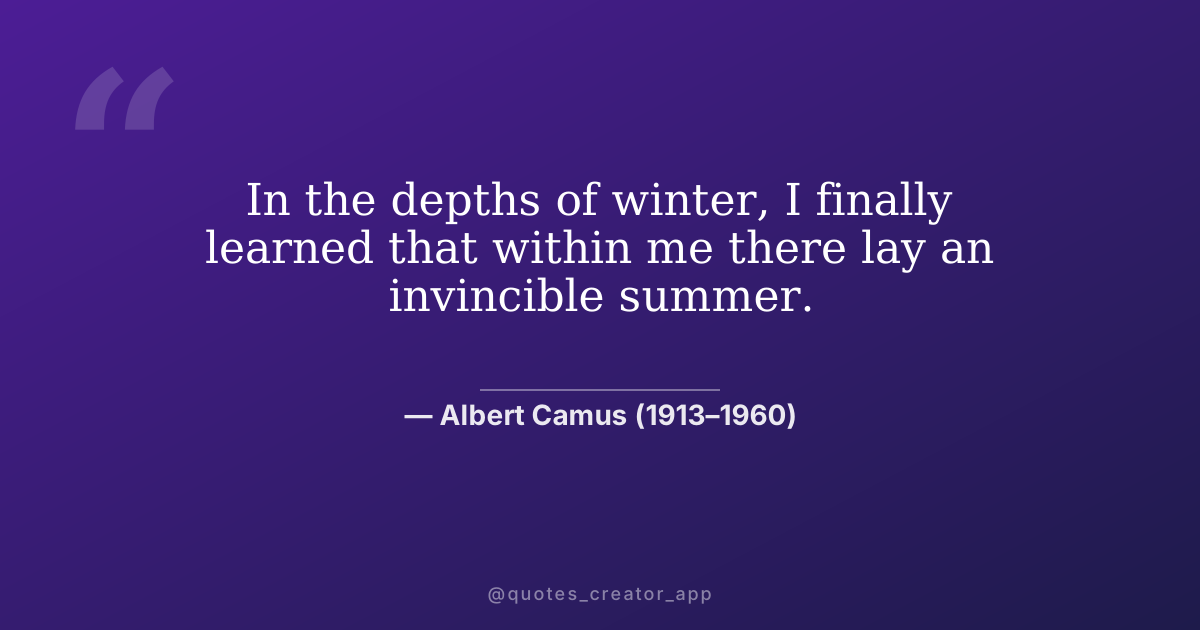
“In the depths of winter, I finally learned that within me there lay an invincible summer.”
The context
Albert Camus wrote “Return to Tipasa” in 1952, during the coldest season of his life — and not just metaphorically. A decade earlier he had been an unknown French Algerian working on a novel about a man who feels nothing at his mother’s funeral. By 1952 he was an international literary celebrity, a Nobel laureate-in-waiting, and one of the most recognizable intellectual voices in postwar Europe. But fame had come at a cost. The publication of The Rebel in 1951 — a philosophical essay that rejected revolutionary violence and Soviet-style communism — alienated Camus from the Parisian left intelligentsia. His once-close friend Jean-Paul Sartre publicly condemned the book in the pages of Les Temps Modernes, and the resulting feud splintered Camus’s social and intellectual world. Overnight, the man who had been the conscience of the French Resistance found himself isolated, attacked from both the communist left and the nationalist right.
On a personal level, Camus was also unmoored. His marriage to Francine Faure was strained by a years-long infidelity with the Spanish actress María Casares — an affair that had become an open secret in literary Paris. Francine suffered a severe depressive episode in the early 1950s, and Camus, wracked with guilt, withdrew into periods of creative paralysis. Meanwhile, his homeland of Algeria was sliding toward a war of independence that would tear him between his pied-noir identity and his anti-colonialist principles. “The troubles in Algeria,” he once wrote, “affect me as others feel pain in their lungs.”
It was in this state of exhaustion and exile that Camus traveled back to Tipasa, a coastal town in Algeria dotted with Roman ruins, where as a young man he had experienced moments of pure, sun-drenched joy. The resulting essay is a pilgrimage: can the warmth of youth be recovered after the cold of middle age, political betrayal, and creative doubt? His answer is captured in the single most quoted sentence of his entire body of work.
The meaning
On its surface, the sentence is a simple seasonal metaphor: after enduring a difficult period, the writer discovered an inner source of warmth and vitality he hadn’t recognized before. The logic is intuitive. Everyone knows what it feels like to be cold and to be warm, so the metaphor bypasses intellectual abstraction and registers in the body. But the word “invincible” elevates the line from comforting to radical. Summer is not sturdy or durable or persistent — it is invincible, a military term normally reserved for armies and fortresses. Camus is not saying that he can endure winter; he is saying that winter cannot defeat what already lives inside him. The power dynamic is inverted. The external darkness is not the protagonist of the story; the internal light is.
Philosophically, the line is a compressed version of Camus’s absurdist worldview. In The Myth of Sisyphus (1942), he had argued that the universe is silent and indifferent to human needs for meaning — this is “the absurd.” But the realization of absurdity, he insisted, is not a reason for despair. It is a reason for revolt: for living fully and passionately in full knowledge that the cosmos will never validate your existence. “Winter” here is not just personal hardship but the absurd condition itself — the cold silence of a universe that offers no answers. “Invincible summer” is the human capacity to create meaning, to find beauty, and to experience joy even in the face of that silence. It is the warmth that Sisyphus feels at the foot of the mountain, choosing his rock again, knowing it will roll back down, and calling the struggle enough. Camus does not say winter will end; he says summer was there all along, waiting to be discovered.
The emotional power of the line comes from its refusal to minimize suffering while simultaneously refusing to grant it the final word. Camus does not pretend winter is not real — the essay dwells at length on his sadness, his creative block, his fear that he has lost the capacity for joy. But by locating the source of warmth inside himself rather than in external conditions, he makes a quietly heroic claim: that the worst the world can do to you cannot extinguish what you carry. It is a line that has survived because it says something people desperately want to believe is true — and Camus, the great chronicler of absurdity, earned the right to say it by never pretending the world was kind.
Why it still matters today
In an era defined by burnout, anxiety disorders, and what the World Health Organization has called a global mental health crisis, this quote has taken on a second life. It is shared across Instagram and Pinterest, tattooed on arms, and cited in therapy offices — a secular mantra for people trying to locate resilience in a world that often feels like one long winter. Its endurance is not accidental. The line performs a specific psychological function that has become urgent in the twenty-first century: it tells people that their capacity for joy and meaning is not dependent on their circumstances improving. In an age of climate anxiety, political polarization, and economic precarity — conditions that individuals cannot fix alone — the idea of an internal summer that external forces cannot reach has become profoundly consoling.
The quote also speaks to a collective experience. Societies, like individuals, endure winters: wars, depressions, pandemics, periods of authoritarian drift. What carries a community through such seasons is not the promise that things will return to normal but the stubborn persistence of human connection, art, mutual aid, and the refusal to surrender to cynicism. Camus, who survived the Nazi occupation of France by running an underground newspaper, understood this at a cellular level. His “invincible summer” is not a denial of suffering but a declaration of what suffering cannot destroy: the impulse to create, to love, to rebel against meaninglessness. When a line from a 1950s philosophical essay feels as urgent as this one does today, it is because the winter it describes has never really ended — and the summer it points to has never stopped being necessary.
How to apply this in your own life
The first and most practical application is an act of self-inquiry: what, exactly, is your invincible summer? What activity, relationship, creative practice, or memory persists as a source of warmth regardless of what is going wrong around you? For Camus, it was the sensory memory of the Algerian coast — the smell of wormwood, the heat of stone, the sound of the sea. For someone else it might be playing an instrument, cooking a meal, walking in a familiar park, reading a particular book, or simply being with a particular person. The exercise is not to manufacture positivity but to identify what has already survived your worst seasons — and to recognize that its persistence is evidence of something durable in you. Naming this summer does not make winter go away, but it gives you something to orient toward when the cold deepens.
The second application is a mindset shift. Camus is advocating for what might be called radical self-sufficiency of spirit — not the toxic individualism that refuses help, but the recognition that your core capacity for meaning does not require the world’s permission. You do not need your career to be going well, your relationships to be untroubled, or your political circumstances to be favorable in order to access what makes life worth living. This is not a call to passivity; Camus was one of the most politically engaged intellectuals of his century. It is a call to distinguish between what you can change and what you can carry — and to stop conflating the two. When you stop waiting for external conditions to improve before allowing yourself to feel alive, you reclaim an agency that winter, by definition, cannot touch.
Create your own quote graphic with this quote
This is the kind of quote that carries weight. When you pair timeless words with thoughtful design, you create something people want to save, share, and return to. Use our free online quote maker to turn this exact quote into a shareable image in seconds — no signup needed. For advanced features like video quotes and 100+ templates, try the Quotes Creator Android app.
Why we chose this quote
There are philosophers who build systems and philosophers who write sentences. Camus did both, but his single sentences tend to outlast his systems. “In the depths of winter, I finally learned that within me there lay an invincible summer” is not just a beautiful string of words — it is an entire philosophy compressed into one image. It offers no false comfort, no promise that suffering will end soon, and no appeal to a higher power. It simply insists that what we carry inside us is stronger than what the world throws at us. That is an unfashionably hopeful thing for an absurdist to say, which is precisely why it has resonated across seven decades. We chose this quote because it rewards every minute spent sitting with it — and because, in a cultural moment that often confuses cynicism with intelligence, Camus offers a reminder that the most radical act may be to refuse to let the cold win.
— ThinkPeak Studio Editorial Team
Create your own quote graphic with this quote
Turn this line into a shareable graphic in seconds — free, no signup needed. For video quotes and 100+ templates, try the Android app.
Advertisement
Enjoyed this article? Get more like it in your inbox.