Quote Explained: “Imagination is more important than knowledge.”
By Albert Einstein, German-born theoretical physicist
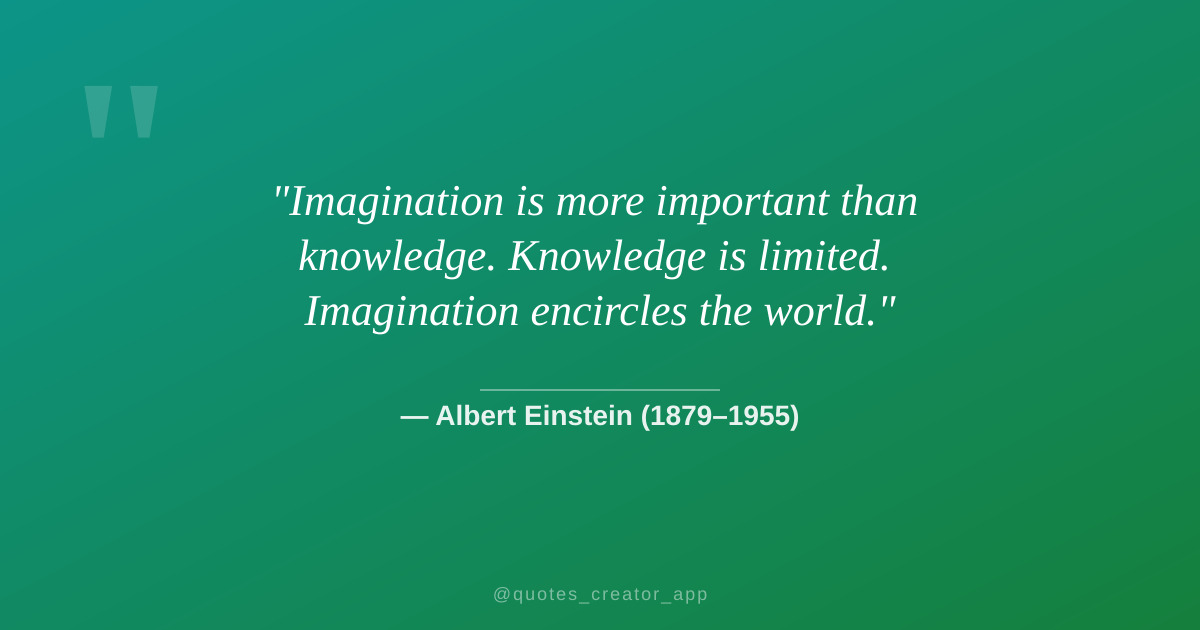
“Imagination is more important than knowledge. Knowledge is limited. Imagination encircles the world.”
The context
In October 1929, Albert Einstein sat down with journalist George Sylvester Viereck for an interview that would be published in The Saturday Evening Post, one of the most widely read magazines in America at the time. Einstein was 50 years old and at the absolute peak of his global fame. A decade had passed since the 1919 solar eclipse expedition confirmed his general theory of relativity, transforming him from an obscure physicist into the first true scientific celebrity of the modern age. His face was already iconic, his name synonymous with genius, and his every public utterance treated as news. The interview ranged across topics from religion to politics to science, but it was a single remark near the end that would outlive everything else he said that day.
The line about imagination was not a prepared statement or a quotation from a paper. It emerged in response to a question about how Einstein made his discoveries. Viereck had asked, “How does it feel to be a great scientist?” and Einstein, characteristically, deflected the question into something more interesting. He began talking about method — about how the theory of relativity had not been deduced from experiments but had come to him as a visual image first, a thought experiment about riding alongside a beam of light. He spoke about the limits of pure logic, about the insufficiency of data alone, and about the role of intuition in scientific breakthrough. The remark about imagination being more important than knowledge was his way of summarising an entire philosophy of discovery in a single sentence.
What is easy to forget is that Einstein was making this argument at a time when science was becoming increasingly specialised and data-driven. The early twentieth century was the age of the laboratory, of systematic experimentation, of the belief that accumulating enough facts would eventually reveal nature’s secrets. Einstein’s own work — especially the general theory of relativity, which had been derived almost entirely from thought experiments — stood as a counterexample to this trend. He was, in a sense, defending his own approach against the professionalising instincts of the scientific establishment. The interview made his case directly to the public, and the response was immediate. The line was quoted in newspapers across the world, reprinted in textbooks, and eventually carved onto plaques and mugs and posters. It became, along with E=mc², the thing Einstein was most famous for saying.
The meaning
The surface meaning of the quote is simple: knowledge is finite, but imagination has no boundaries. But the relationship Einstein draws between the two is more subtle than it first appears. He is not dismissing knowledge. He had spent a lifetime acquiring it, mastering mathematics and physics at a level few humans ever reach. The phrase “knowledge is limited” is not a criticism of knowledge itself but a recognition that knowledge is always knowledge of what already exists. It is a catalogue of the past, a description of the world as it has been observed. Imagination, by contrast, is the faculty that reaches into what does not yet exist. It is the engine of discovery, the thing that proposes a hypothesis before the data arrives to confirm or refute it. Without imagination, knowledge is inert — a library with no one to read the books.
Einstein’s phrase “encircles the world” is doing more work than it first appears. In German, the language in which Einstein thought and often spoke, the word he likely had in mind was umfasst — which means encircles but also encompasses, comprehends, and contains. Imagination does not just travel around the world; it creates the mental framework within which the world becomes intelligible. This is a profoundly philosophical claim. It aligns Einstein with the tradition of Kant, who argued that the human mind actively structures our perception of reality, rather than passively receiving it. When Einstein says imagination encircles the world, he is suggesting that the pictures we form in our minds are not optional extras to the scientific process but the very foundation of it. The equations come later. The experiment comes later. The first step is always an act of imagination.
The emotional power of the quote comes from its unexpected reversal of values. We are taught from childhood that knowledge is the highest good, that facts are the building blocks of understanding, that the wise person is the one who knows the most. Einstein — the man who knew more physics than almost anyone alive — turns this hierarchy on its head. He says, in effect, that what made him great was not the knowledge he accumulated but the imaginative freedom he refused to surrender. This is a deeply humanising message. It means that the quality that drove the most celebrated scientific mind of the century is the same quality that drives an artist, a child at play, or a novelist building a world. Einstein was not a superhuman fact-machine. He was, in his own description, someone who never stopped wondering, who held onto the curiosity most people outgrow. The quote is an invitation to see genius not as a mountain of data but as an unfettered mind.
Why it still matters today
In an age of artificial intelligence, the distinction between imagination and knowledge has become urgent in ways Einstein could not have anticipated. Large language models can memorise and reproduce more knowledge than any human who has ever lived, and they do it in seconds. If knowledge were the measure of intelligence, every human being has already been surpassed. Yet these same systems, for all their staggering capabilities, cannot genuinely imagine. They cannot form a hypothesis that no one has thought before. They cannot look at a problem from a perspective that has never been encoded in their training data. Einstein’s line, written nearly a century ago, now reads as a prophecy. It tells us that the thing that makes us irreplaceable is not how much we know but our ability to see what does not yet exist. The quote has been cited in countless discussions about the future of work, education, and creativity, always making the same point: that a mind trained only to absorb and reproduce knowledge is a mind preparing for obsolescence.
The quote also speaks to the crisis of attention and imagination in modern life. We swim in information. The average person consumes more data in a single day than a nineteenth-century scholar encountered in a year. Social media, news feeds, notifications, and search engines have made knowledge astonishingly accessible and, paradoxically, have made genuine imagination rarer and harder to sustain. Imagination requires stillness, boredom, and the kind of unstructured mental space that modern technology systematically eliminates. Einstein’s line is a reminder that the scarcest resource in the information age is not knowledge but the imaginative capacity to do something meaningful with it. The students, professionals, and leaders who will thrive are not the ones who know the most but the ones who can connect what they know in ways no one has connected it before.
How to apply this in your own life
The first practical application of Einstein’s insight is to deliberately protect time for unstructured thinking. Knowledge acquisition is easy to measure: you read a book, you complete a course, you learn a skill, and you can tick the box. Imagination cannot be ticked off a list. It grows in the gaps between structured activity — during a walk without headphones, a morning spent staring out a window, a conversation that wanders without an agenda. The most productive thing you can do for your imaginative capacity is to stop filling every silent moment with input. If Einstein, who had access to the finest scientific minds and libraries in Europe, believed that imagination mattered more than knowledge, then the modern habit of constant consumption is not just a distraction. It is a direct assault on the very faculty that makes original work possible.
The second application is about how you approach problems. When you face a difficult question, the instinct is to gather more information, to research, to find out what the experts say. Einstein’s hierarchy suggests you should do the opposite: before you look for answers, spend time imagining the shape that an answer might take. Form a hypothesis based on intuition. Visualise the problem from a different angle. Let your mind play with possibilities before you check whether they are true. The scientific method does not begin with data; it begins with a guess, an image, a story about how the world might work. By giving yourself permission to imagine before you verify, you are adopting the same creative discipline that led to the theory of relativity. You do not need to be a physicist to benefit from this. Every act of creation — writing, designing, strategizing, inventing — follows the same arc. Imagination proposes. Knowledge disposes. The order matters.
Create your own quote graphic with this quote
This is the kind of quote that carries weight. When you pair timeless words with thoughtful design, you create something people want to save, share, and return to. Quotes Creator gives you the tools to turn this quote into a beautiful graphic — custom fonts, gradient backgrounds, and export sizes for every platform.
Why we chose this quote
Einstein’s line about imagination is one of the most quoted sentences in the English language, and yet it is almost never quoted with the full weight of its context. People treat it as an inspirational poster — a gentle reminder that creativity matters. But the original interview and the scientific philosophy behind it reveal something far more radical. Einstein was not diminishing knowledge; he was reordering the relationship between discovery and evidence in a way that still challenges how we think about intelligence, education, and human potential. We chose this quote because, in an era of AI, information overload, and the growing pressure to specialise, it has become more relevant than the man who spoke it could ever have imagined. It is a reminder that the mind’s greatest power is not its ability to store facts but its unwillingness to stop asking what lies beyond them.
— ThinkPeak Studio Editorial Team
Create your own quote graphic with this quote
Turn this line into a shareable graphic in seconds — free, no signup needed. For video quotes and 100+ templates, try the Android app.
Advertisement
Enjoyed this article? Get more like it in your inbox.