Quote Explained: “We don’t see things as they are, we see them as we are.”
By Anaïs Nin, French-born diarist and novelist
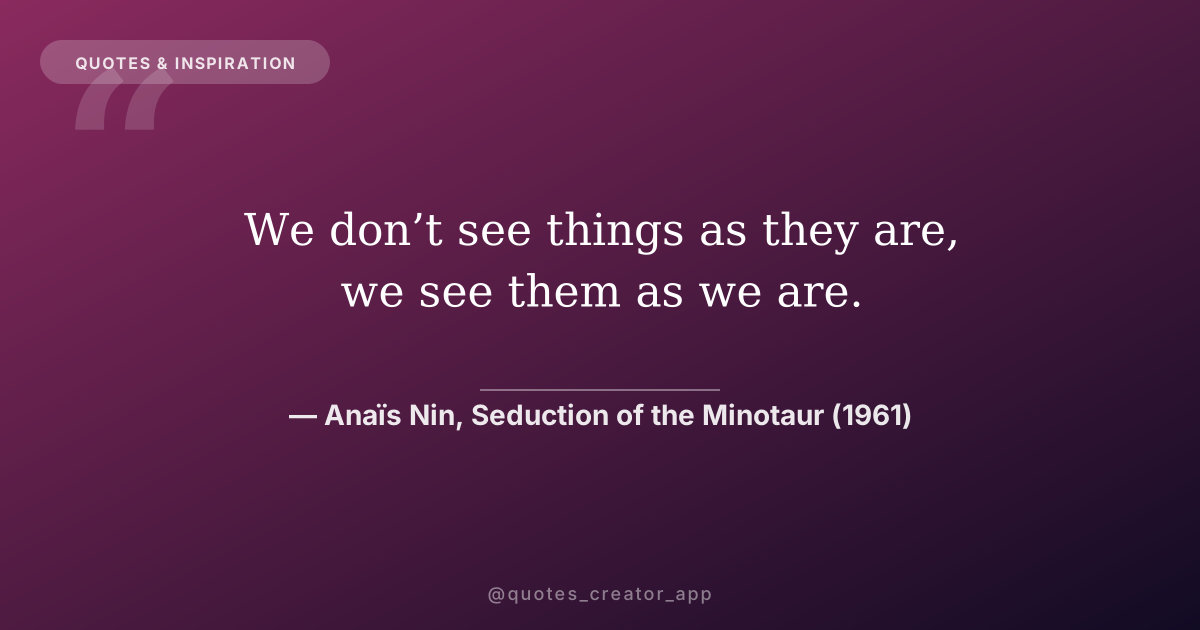
“We don’t see things as they are, we see them as we are.”
The context
The quote has one of the strangest origin stories in modern letters. It is attributed to Anaïs Nin, and it appears in her 1961 novel Seduction of the Minotaur, the final panel of the continuous novel she called Cities of the Interior. But look closely at the sentence in the book and you find something curious. The protagonist, Lillian — a woman fleeing the rigid order of her life in New York for the heat and disorder of Mexico — is described as recalling “the talmudic words: ‘We do not see things as they are, we see them as we are.’” That single phrase, “talmudic words,” set off a century-long game of attribution. Nin herself pointed backward, toward an ancient Jewish source; after her, the line began circulating under the Talmud’s name with no cited passage, then circled back to Nin, until the two became almost interchangeable. The ambiguity is not a flaw in the quote. It is the quote’s subject, enacted in miniature: a sentence reshaped by every mind that carries it.
To understand the line, you have to understand the woman who wrote it down. Anaïs Nin was born in 1903 near Paris, the daughter of a Cuban pianist father and a French-Danish mother, and she spent her life crossing borders — between languages, countries, and selves. When her father abandoned the family, the young Anaïs began keeping a diary, a habit she maintained for more than sixty years, producing thousands of pages that became one of the most extraordinary records of the inner life ever published. She moved between Paris, New York, and Los Angeles, between the literary avant-garde — Henry Miller, Antonin Artaud, Lawrence Durrell — and the psychoanalytic circle of Otto Rank, who treated her and whose ideas about the creative will left a permanent mark on her thinking. Everything in her biography converged on a single conviction: the self is not a fixed object but a moving center of interpretation, and the story we tell about the world is always, at bottom, a story about ourselves.
The quote is also a summary of one of the oldest ideas in philosophy, compressed into a single breath. From Plato’s allegory of the cave — prisoners mistaking shadows cast on a wall for reality itself — to Immanuel Kant’s insistence that we can never know the “thing-in-itself,” only the world as filtered through the structures of our own mind, thinkers have long argued that perception is not a window but a lens. Nin’s version is remarkable because it strips that idea of its technical apparatus and says it in twelve ordinary words. It stands against what philosophers call naive realism: the unexamined assumption, held by most of us most of the time, that we simply see the world as it is. That assumption is deeply comfortable, and it is everywhere. The quote is its quiet, devastating undoing.
The meaning
The sentence is built on a hinge, and the hinge does all the work. “We don’t see things as they are” — the first clause demolishes the common-sense picture of perception as a faithful recording of reality. “We see them as we are” — the second clause supplies the substitute, and the tiny shift from “they” to “we” carries the entire argument. The object of vision does not disappear; what changes is the subject who does the seeing. Every act of looking is an act of projecting. We bring to the world our history, our wounds, our desires, our fears, and these shape not only how we interpret what we see but what we are capable of seeing at all. The eye is not a camera. It is a storyteller, and the story it tells is always, in part, an autobiography.
The deeper implication is that the world functions as a mirror. What irritates us, what attracts us, what we notice and what we overlook — all of it is diagnostic. Two people watch the same conversation, read the same headline, walk down the same street, and report back two different realities, because each carried a different self into the encounter. This is the mechanism behind the projection Nin spent her life documenting: the rival who seems to possess everything we lack, the stranger whose flaw we detect instantly because we know it so intimately in ourselves, the fault we are most eager to condemn in others because we refuse to see it in ourselves. The quote does not merely say we are biased. It says our biases are not noise layered on top of perception. They are perception. There is no clean, untainted image waiting underneath the self for us to finally polish our glasses and behold.
That is what makes the line so unsettling — and so liberating. If we never see things as they are, then the comfort of “I’m just telling you what happened” collapses, and every account of the world becomes a confession about the person giving it. But the quote is not nihilism. It does not claim there is no reality; it claims only that we have no direct access to it. It turns humility into the precondition of truth rather than an obstacle to it. To say “I see things as I am” is not to abandon the pursuit of accuracy; it is to begin that pursuit honestly, by first admitting that the instrument is flawed. The person who believes they see objectively is the most dangerous of all, because they mistake their projection for the world and then demand that everyone else agree with it.
Why it still matters today
The quote has never been more urgent, because technology has industrialized the very process it describes. The internet does not show us the world; it shows us a version of the world assembled from our own clicks, a feed tuned to the self we have already been. Social media sorts us into ever-narrower channels of agreement, search engines return different answers to different people asking the same question, and recommendation engines learn our preferences so precisely that the line between what we choose and what is chosen for us dissolves. The result is not that we see the world “as we are” in any honest sense; it is that we are offered a world that flatters who we already are, and we mistake that reflection for the whole of reality. Nin wrote the sentence decades before the internet existed, and yet it reads like a prophecy of the filter bubble.
The quote also diagnoses the specific sickness of our public life: the impossibility of disagreement. Across politics, culture, and even family dinners, people increasingly speak as though they are all looking at the same facts and the other side is simply lying or insane. Nin offers a humbler and far more accurate explanation: they are not looking at the same facts at all, because each is looking through a different self. The two sides of an election, the parent and the teenager, the two people in a dying marriage — each is convinced they are seeing “things as they are,” and neither can understand how the other fails to see it. The first step out of any deadlock is not more evidence but the recognition that evidence itself is interpreted through the lens of the observer. Until we can say “I see this as I am,” we will keep shouting past one another into the void.
How to apply this in your own life
The practical application begins with a small discipline of curiosity. When you feel certain — especially certain about what someone else meant, or why they acted as they did, or what “really happened” — pause and run the quote through your reaction. Ask: what does my interpretation of this tell me about me? What am I bringing into this room that I have not noticed? The question does not mean your view is wrong. It means your view is partial, and the missing piece is usually hidden inside you rather than out in the world. Practiced over time, this turns self-righteousness into curiosity and defensiveness into inquiry. You stop needing to be right and start wanting to see more clearly — which is a different, and far more difficult, ambition.
The quote is also a manual for relationships and for any group of people trying to work together. In the middle of a conflict, separate your observations from your interpretations. “You raised your voice” is an observation; “you’re trying to intimidate me” is a story you have projected onto it — possibly true, possibly not, but not the same thing as the fact. When you find yourself convinced of another person’s motives, remember that you cannot see their motives; you can only see their behavior through the lens of your own history. The most powerful sentence in any disagreement may be: “Here is how I’m seeing this, and I know I’m seeing it as me.” That admission does not weaken your position; it is the only position from which two people can actually meet. The goal is not to escape your subjectivity — that is impossible. The goal is to become conscious of it, and to let that consciousness make you gentler, clearer, and more honest.
Create your own quote graphic with this quote
Few sentences in any language compress this much wisdom into this few words. Its elegance, its brevity, and its bottomless depth make it perfect for social graphics, posters, journal covers, and conversation starters. Use our free online quote maker to turn this exact quote into a shareable image in seconds — no signup needed. For advanced features like video quotes and 100+ templates, try the Quotes Creator Android app.
Why we chose this quote
Most people encounter this line as a meme, a motivational poster, or a caption under a sunset photo — and they nod and scroll on, never noticing how much it is asking of them. We wanted to restore the sentence to its full weight. It is not a soothing truism about “perspective.” It is a radical claim about the limits of human knowledge, one that reaches back through Nin to the Talmud and forward into the machinery of the modern attention economy. What makes it endure is its refusal to comfort us. It denies us the refuge of “I’m just seeing things as they are,” and in exchange it offers something harder and more honest: the chance to know ourselves through what we see. In an age of echo chambers and certainty, a sentence that teaches humility is not a decoration. It is a survival tool.
— ThinkPeak Studio Editorial Team
Create your own quote graphic with this quote
Turn this line into a shareable graphic in seconds — free, no signup needed. For video quotes and 100+ templates, try the Android app.
Advertisement
Enjoyed this article? Get more like it in your inbox.