Quote Explained: “How wonderful it is that nobody need wait…”
By Anne Frank, German-born Jewish diarist and Holocaust victim
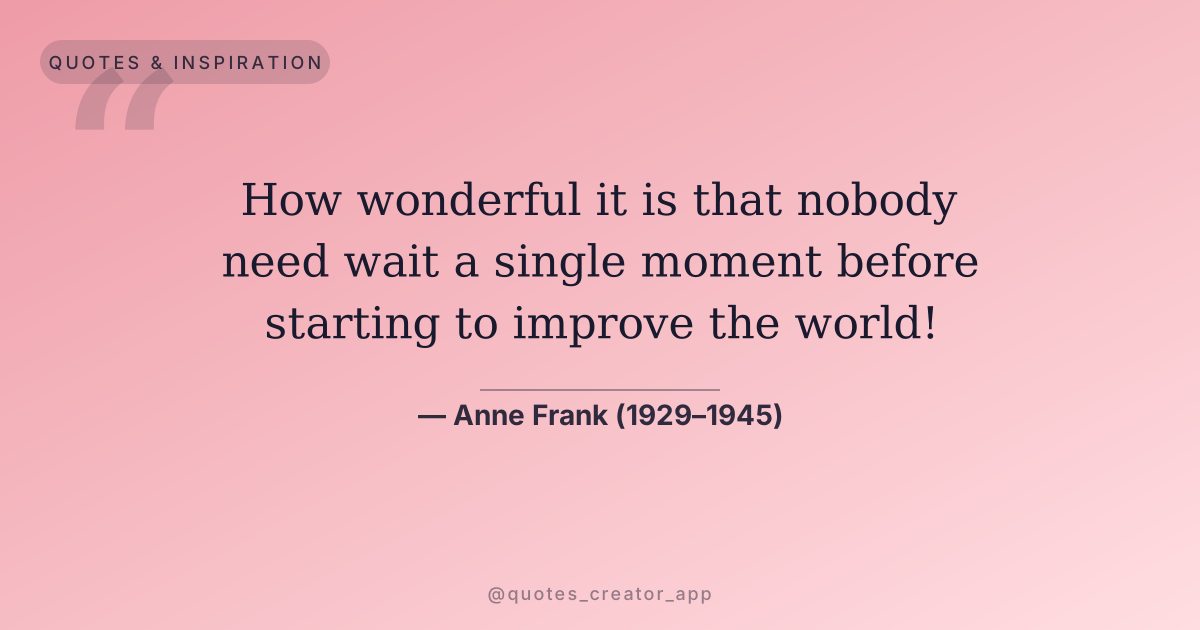
“How wonderful it is that nobody need wait a single moment before starting to improve the world!”
The context
March 1944. It is the third spring since Anne Frank and her family vanished into the Secret Annex above Otto Frank’s business at Prinsengracht 263 in Amsterdam. For nearly two years they have lived in 500 square feet of concealed rooms — 25 months of blacked-out windows, whispered conversations, and the adrenalized terror of footsteps on the stairs at the wrong hour. Outside, Amsterdam groans under Nazi occupation. Jewish families are rounded up daily. The Frank family’s former neighbors, classmates, colleagues — gone, deported east to camps whose names and purposes mark the edge of what the human mind can absorb. Anne writes about these deportations in her diary: columns of people marched through the streets, children clutching toys, old people unable to keep pace.
Anne is 14 years old. She is not a philosopher, a politician, or a seasoned writer. She is a teenage girl who began keeping a diary on her 13th birthday and who has since filled its pages with the full spectrum of adolescent life — bitter fights with her mother, tentative explorations of her own changing body, first stirrings of romantic feeling for Peter van Pels in the room next door, and piercing observations about a world that seems determined to destroy her. By early 1944, she has also begun writing short stories and essays in a separate notebook she titles Tales from the Secret Annex. She listens to Radio Oranje, the Dutch government’s wartime broadcasts from London, and hears the Minister of Education call for ordinary citizens to preserve their diaries and letters as testimony for future generations. Anne takes this seriously. She begins revising her diary entries and composing pieces she dreams of publishing after the war — a war she still believes she will survive.
The essay “Give!” is one of those pieces. Dated March 26, 1944, it is a short, luminous meditation on charity, kindness, and social justice. Anne begins by surveying the world’s inequalities — the beggar children she remembers from pre-war Amsterdam, the immense gulf between those who hoard and those who have nothing. But rather than sink into despair, she pivots into a declaration of radical agency. “How wonderful it is that nobody need wait a single moment before starting to improve the world!” she writes. Pause on that. This is a girl who cannot go outside, who owns almost nothing, who has been legally classified as subhuman by the regime occupying her country. And she is writing about the immediacy of goodness. She follows the famous line with a quieter one: “You can always — always — give something, even if it’s a simple act of kindness.”
The meaning
On its face, Anne is saying something elegantly simple: you do not need permission, credentials, wealth, or perfect conditions to do good in the world. Improving the world is not reserved for presidents or philanthropists or people with millions of followers. It is available to every person, right now, starting from wherever they stand. The word “wonderful” is crucial here. She is not merely stating a fact like a textbook. She is expressing genuine astonishment and delight that moral action is so radically accessible. There is joy in the sentence, a kind of exuberance at the discovery that goodness has no gatekeepers.
But look deeper, and the quote contains a quietly subversive philosophical claim. Anne is rejecting what might be called the “big before” fallacy — the deeply ingrained belief that meaningful change requires big resources, big plans, big moments, big audiences. She is arguing that moral agency lives in the present tense, not in some hypothetical future when the conditions are finally right. This challenges both the procrastination of the comfortable (who say, “I’ll give more when I earn more”) and the despair of the overwhelmed (who say, “nothing I do could possibly matter”). By rooting moral action in the immediate — “nobody need wait a single moment” — Anne takes away every excuse without diminishing the weight of the responsibility. She is telling us that our impact is not deferred. It is now.
And then there is the almost unbearable emotional power generated by the gap between the author and the words. Anne Frank — imprisoned in a sealed attic, stripped of every freedom a human being can lose short of life itself, writing under a shadow that will consume her within the year — looks at her circumstances and does not find reasons for bitterness but opportunities for action. This is not the facile, untested optimism of someone who has never suffered. Anne’s diary is full of rage, full of sadness, full of sharp and unsparing critiques of the adults around her. Her hope was hard-won, a deliberate posture adopted against the full gravitational pull of despair. That is what gives the quote its peculiar force: it is not a bromide from a comfortable pulpit, but a battle cry shouted from a battlefield.
Why it still matters today
In an era defined by algorithmic outrage, doomscrolling, and a pervasive ambient anxiety about everything from climate collapse to democratic decay, Anne Frank’s words land with uncomfortable precision. We live in a time when the scale of our collective problems produces a distinctive kind of paralysis. The dominant emotional register of online public life is a frantic, performative dread — people post, share, argue, declare that something must be done, feel terrible about the state of things, and then return to scrolling. Anne’s quote is a direct challenge to this learned helplessness. She does not pretend the problems are smaller than they are. She had witnessed, by the age of 14, more human evil than most of us will encounter in a lifetime. But she insists, with startling clarity, that the size of a problem does not justify inaction. The relationship between the scale of a crisis and your obligation to respond is simply not linear. You start anyway.
The quote has been cited in contexts Anne could never have imagined: by climate activists resisting the narrative that individual action is meaningless, by educators teaching students that moral courage begins with small choices, by mental health advocates arguing that recovery starts with a single step. It appears in commencement addresses and therapy worksheets. It lives in the Instagram bios of people who have decided to stop waiting for permission to care publicly. Why does it endure across eight decades and such wildly different domains? Because it dissolves the artificial barrier between “caring about something” and “doing something about it.” Anne Frank collapsed the distance between spectator and participant, and we have been trying to live up to that collapse ever since.
How to apply this in your own life
The most direct application is to identify one specific area where you have been “waiting” and simply stop. Not in a grand, life-reorganizing sense, but in a concrete, today-sized sense. Perhaps you have been meaning to volunteer but the commitment feels too large — give one hour, not one week. Perhaps you have been thinking about reconnecting with a lonely relative but cannot find the perfect words — send the imperfect words today. Perhaps you have been reading about a cause for months without taking any tangible step — find one local organization and donate ten dollars or sign up for their newsletter before you close this browser tab. The quote does not demand heroism or self-sacrifice. It demands motion. Movement. The breaking of inertia. Anne Frank, from a room she could not leave, believed that inertia was the only real enemy and that the moment you decide to act is the moment you have already improved the world.
The deeper shift, though, is one of identity. Most of us think of ourselves as people who care about the world — a passive, internal orientation. Anne invites us to think of ourselves as people who improve the world through small, daily, almost invisible actions. That reframing changes what you notice. A kind word to a cashier becomes an act of world-improvement. Picking up a piece of litter on your street becomes an act of world-improvement. Showing up for a friend in crisis, without anyone watching, becomes an act of world-improvement. When you stop waiting for the grand gesture or the perfect moment, you start seeing opportunities everywhere. This was Anne’s insight: the world is not improved primarily by people who are powerful, but by people who are available. And availability is a decision, not a circumstance. From a sealed attic in occupied Amsterdam, a 14-year-old girl found more ways to improve the world than most of us find from wide-open doors. That perspective — not her circumstances, not her suffering — is the gift she left us.
Create your own quote graphic with this quote
This is the kind of quote that carries weight. When you pair timeless words with thoughtful design, you create something people want to save, share, and return to. Use our free online quote maker to turn this exact quote into a shareable image in seconds — no signup needed. For advanced features like video quotes and 100+ templates, try the Quotes Creator Android app.
Why we chose this quote
Anne Frank’s most famous quote — “in spite of everything, I still believe that people are really good at heart” — is justly celebrated. But this line, from an essay tucked inside her lesser-known collection Tales from the Secret Annex, deserves equal stature. Where the famous quote expresses a belief about human nature, this one issues a call to human action. It is more urgent, more practical, and in some ways more challenging. Anne was not just an optimist; she was a strategist of moral engagement. This quote reminds us that goodness is not something we wait to receive. It is something we begin.
— ThinkPeak Studio Editorial Team
Create your own quote graphic with this quote
Turn this line into a shareable graphic in seconds — free, no signup needed. For video quotes and 100+ templates, try the Android app.
Advertisement
Enjoyed this article? Get more like it in your inbox.