Quote Explained: “The arc of the moral universe is long, but it bends toward justice.”
By Martin Luther King Jr., paraphrasing the 19th-century abolitionist Theodore Parker
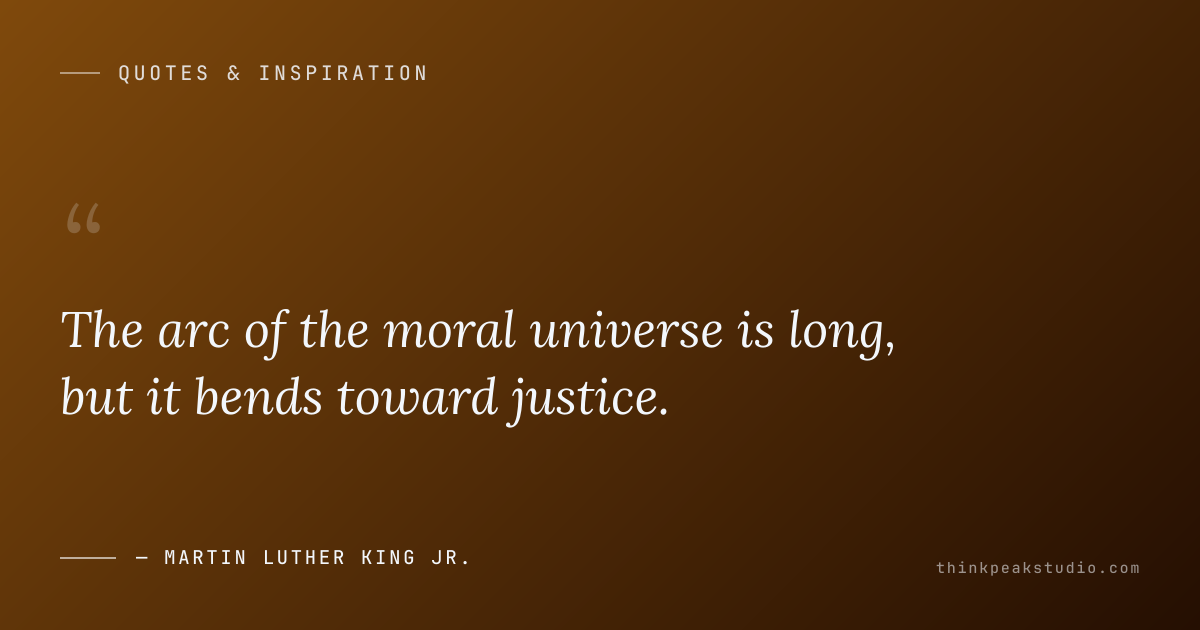
“The arc of the moral universe is long, but it bends toward justice.”
The context
Few sentences in American public life are quoted more often, or with less sense of where they came from, than this one. It is the line people reach for when they want to say that history is on the side of the patient; it is what a cause tells itself after it loses a battle. Martin Luther King Jr. gave it its most famous form at the National Cathedral in Washington on March 31, 1968 — four days before he was assassinated in Memphis — as the closing promise of a sermon titled “Remaining Awake Through a Great Revolution”: “We shall overcome because the arc of the moral universe is long, but it bends toward justice.” The words are inscribed on his memorial on the National Mall. They have been repeated so often, and with such assurance, that the sentence can sound less like one man’s conviction than a law of nature.
But the sentence is not King’s, and that is more than a footnote. Its earliest known form belongs to Theodore Parker, a Unitarian minister, Transcendentalist, and abolitionist born in Lexington, Massachusetts, in 1810 and dead by 1860, on the eve of the Civil War. In a sermon called “Of Justice and the Conscience,” published in his 1853 collection Ten Sermons of Religion, Parker wrote: “I do not pretend to understand the moral universe; the arc is a long one, my eye reaches but little ways; I cannot calculate the curve and complete the figure by the experience of sight; I can divine it by conscience. And from what I see I am sure it bends towards justice.” The polished version we know is a much later condensation. The quotation researcher known as Quote Investigator, who traces the provenance of famous sayings, found the short phrasing already credited to Parker by 1918, decades before King ever used it. What Parker wrote and what King said are not the same sentence, and the distance between them is the most interesting thing about the quote.
King first put the sentence into print in February 1958, in an article called “Out of the Long Night” published in The Gospel Messenger, the weekly magazine of the Church of the Brethren. He set it in quotation marks — the signal of a borrowed adage — and he kept borrowing it for the rest of his life. At the close of the Selma-to-Montgomery march in March 1965 he answered the question “How long?” with “Not long, because the arc of the moral universe is long, but it bends toward justice.” He used it again in his 1967 address to the Southern Christian Leadership Conference, “Where Do We Go From Here?” and again at the National Cathedral in 1968. Sometimes he credited Parker by name; often he simply absorbed the line into his own voice. It traveled so completely into his authorship that President Obama had it woven into the Oval Office rug in 2010 — and even then, listeners had to write in to correct the attribution. That is how a quotation becomes a proverb: the original author dissolves, and the sentence starts to feel like common property.
The meaning
The metaphor is doing precise work, and it rewards being taken apart word by word. An arc is not a line and not a circle; it is a curve with a direction, the shape of a trajectory rather than a destination. To say the arc is “long” is to make a claim about time — that the span in which justice plays out is longer than a single life, longer than a movement, longer than the patience of anyone who wants to see the ending. To say it “bends” is to make a claim about geometry and about fate: a curve can be traced, extrapolated, and predicted even when most of it lies beyond sight. And “toward justice” supplies the terminus, the point the curve is aimed at. The whole sentence is an act of extrapolation. We cannot see the end of the arc, both men insist, but we can reason about its shape — and the shape is moral.
The crucial difference between the two versions is what each is willing to admit it does not know. Parker’s original is a confession of ignorance before it is an assertion of faith. He “does not pretend to understand” the moral universe; his eye “reaches but little ways”; he cannot calculate the curve by sight and must “divine it by conscience.” Only then does he arrive at the confident clause. King’s compression deletes the hesitation. His sentence is declarative, public, and certain — a promise rather than a wager — and its rhetorical force comes precisely from that certainty. This is the trade every memorable paraphrase makes: it buys power by spending nuance. Parker gives you a man peering into the dark and choosing to trust what his conscience tells him. King gives you an oracle. The shorter version is more useful in a speech and less honest about how little anyone actually knows, which is why it is both the one we remember and the one most easily misused.
That misuse has a specific shape: read flatly, “it bends toward justice” can sound like a guarantee that justice arrives no matter what we do. If the arc bends on its own, then waiting becomes a strategy and struggle becomes optional. Neither man meant that, and the surrounding record forbids it. Parker was an abolitionist who aided people escaping slavery and who was one of the “Secret Six” who funded John Brown’s raid on Harpers Ferry; his faith in the direction of the arc was the premise of his action, not a replacement for it. King spent the years from the Montgomery bus boycott in 1955 to his death in 1968 inside a movement that cost him everything, and he was killed in the middle of the work, not at the end of it. The honest reading is that the arc describes where history tends when people push, and that the pushing is part of the physics. The line is not a promise that the future will be just. It is a claim that hope is rational — that the effort to bend the world is not futile — and that claim only holds if someone is doing the bending. The sentence is quoted at memorials; it was spoken by a man who expected to keep working.
Why it still matters today
The quote matters now because we live in an age that has made patience nearly impossible to practice and despair nearly impossible to avoid. The news cycle delivers a fresh outrage every hour, and social platforms are tuned to the feeling that everything is happening at once and that everything is going wrong. In that environment the arc is a corrective, but a strange one: it does not say things are fine, and it does not promise they will improve on any schedule you will live to see. It says the timescale of justice is longer than the timescale of your fear. That is a hard message to sell to an audience trained to expect resolution before the hour ends, which is exactly why it is still worth saying. It converts the question “is it working?” — a question the present almost always answers with a no — into “is it bending?”, a question you can only answer across years.
There is a second reason the line is still argued over and still necessary: it names the central tension of any long struggle, the conflict between urgency and endurance. Movements need the anger that refuses to wait and the patience that survives defeat, and the arc is the bridge between them. Its well-documented danger is that it can be quoted to soothe rather than to summon — deployed by the comfortable to tell the aggrieved that time will take care of things. Its value is that it offers something better than either cynicism or denial: a wager that the direction of history is not fixed and can therefore be influenced. In a period when people on every side describe the present as a moral emergency, a sentence that insists on the long view while demanding action is not a platitude. It is a discipline.
How to apply this in your own life
To apply this line is to change the timescale on which you judge your own life. Most of us keep score in weeks and quarters, and by that measure almost everything worthwhile looks like failure: the work is unfinished, the cause is losing, the change has not arrived. The arc asks you to measure in decades, and then to do the one thing a long timescale permits — keep going. Practically, that means separating optimism from hope. Optimism is a prediction that things will turn out well; hope is a commitment to act as though they might, whether or not the prediction holds. Parker could not calculate the curve; he chose to trust it. You can do the same without pretending to certainty: pick the direction you believe in, name the bend you are trying to contribute, and then judge yourself not by whether justice has arrived but by whether you moved it a single degree. Keep a record. Direction is invisible day to day and obvious year to year, and the record is how you see it.
The second application is collective, because the arc is never bent by one person. The metaphor’s quiet lesson is that no individual lives long enough to see the curve complete — Parker died before emancipation, King before the full flowering of the movement he led — and that is not a reason to withdraw but a reason to think in terms of chains of effort. The abolitionists, the marchers, the legislators, the ordinary people who kept showing up: the arc is the sum of what they did, most of it unglamorous and most of it unrecorded. So the practical question is not “how do I fix this?” but “what is my link in the chain?” That might be a vote, a donation, a letter, a habit of honesty in a small room, a conversation with someone who disagrees. None of it will bend the whole arc. All of it is the arc. The line endures because it tells the truth about scale — that the moral universe is larger than any of our lifetimes — and then hands the work back to us anyway.
Create your own quote graphic with this quote
This is a line made for the long haul — the kind you pin above a desk when the results are slow and the point is easy to lose. When you pair an idea this steadying with thoughtful design, you create something worth returning to. Use our free online quote maker to turn this exact quote into a shareable image in seconds — no signup needed. For advanced features like video quotes and 100+ templates, try the Quotes Creator Android app.
Why we chose this quote
We chose this quote because it is one of the rare lines that has been made more famous by its second author than by its first, and because the story of that handoff says something important about how hope actually works. The sentence people attribute to Martin Luther King Jr. is a compression of a far more hesitant passage written by the abolitionist Theodore Parker in 1853 — and the difference between the two is the difference between certainty and faith. King’s version is the one we need in a speech; Parker’s is the one we need in private, on the days when we cannot see the curve at all and have to trust it anyway. In an era that runs on outrage and instant judgment, a quote that insists on the long view while still demanding that we do the bending has never been more useful. That is why we wanted to give it the full treatment: not as a slogan, but as an instruction.
— ThinkPeak Studio Editorial Team
Create your own quote graphic with this quote
Turn this line into a shareable graphic in seconds — free, no signup needed. For video quotes and 100+ templates, try the Android app.
Advertisement
Enjoyed this article? Get more like it in your inbox.


