Quote Explained: “We are what we repeatedly do…”
By Aristotle, ancient Greek philosopher
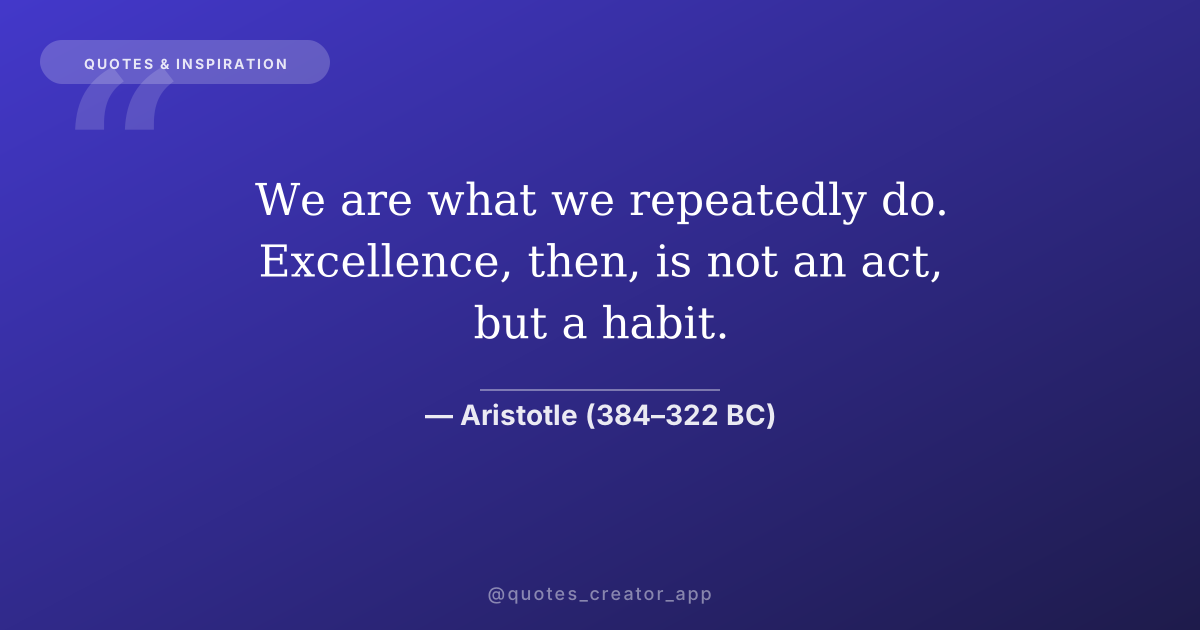
“We are what we repeatedly do. Excellence, then, is not an act, but a habit.”
The context
The sentence that has traveled two and a half thousand years into graduation speeches and Instagram posts was originally buried in a dense philosophical treatise no one was ever supposed to find inspirational. Aristotle’s Nicomachean Ethics was compiled from lecture notes, probably by his son Nichomachus, and its intended audience was not a general readership but a small circle of aristocratic Athenian men already steeped in philosophical training. Aristotle was not trying to motivate anyone. He was answering a technical question he considered the most important in all of ethics: how does a person become good? His teacher Plato had argued that virtue was a form of knowledge — that if you truly understood what was right, you would inevitably do it. Aristotle thought this was naive, and the Ethics is his sustained argument that knowing the good and being good are radically different things.
The quote appears in Book II, in a section where Aristotle is laboring over a definition of moral virtue. He had already established that virtues are neither innate nor merely intellectual; they are acquired, like skills, through practice. To illustrate this, he draws the architectural analogy: “men become builders by building, and lyre-players by playing the lyre.” The same principle, he insists, governs character. A person becomes just by doing just acts, courageous by doing courageous acts, temperate by doing temperate acts. This is where the statement arrives — almost as an aside, a summary of everything that came before — but it landed with the force of a thunderclap precisely because Aristotle extended the logic to its limit. He was saying that your identity, the very substance of who you are, is not something you discover but something you construct, one repeated act at a time. The implications of this were staggering, because it meant that moral failure was not a destiny or a flaw of insight; it was a deficit of practice. And if it was a deficit of practice, it was reversible.
There has been generous paraphrase in the English versions we quote today. The Greek is more austere. A literal rendering would be closer to “states of character arise out of like activities,” which has none of the rhetorical momentum of the popular translation. That memorable phrasing — “We are what we repeatedly do. Excellence, then, is not an act, but a habit” — is a distillation, likely shaped by generations of translators and anthologists who recognized that Aristotle’s idea was too important to be left in academic Greek. The sentiment is absolutely faithful to Aristotle’s argument, even if the exact English words belong to the tradition of interpreting him. What matters is the argument itself, which remains one of the most revolutionary claims ever made about human agency: character is not a gift. It is a craft.
The meaning
The first half of the quote arrests you because it is not reasonable advice; it is an ontological claim. “We are what we repeatedly do.” Not “we eventually become,” but “we are.” Right now, in the present tense, the sum total of our daily repetitions is our character. There is no hidden self waiting to be excavated beneath layers of bad behavior. If you fail to exercise courage each day, you are not a courageous person in waiting; you are a coward who would like not to be one. If you habitually procrastinate at work, the identity “hard worker” belongs to someone else. Aristotle collapses the distance between identity and action entirely. There is no “deep down” person. There is only what you do again and again. This is both a brutal judgment and a profound liberation, because it means that when you change what you repeatedly do, you are not just changing your behavior; you are changing who you are at the foundations.
The second half turns the whole idea into a principle of achievement. “Excellence, then, is not an act, but a habit.” The Greek word here is aretē, which is broader than our word “excellence.” It means human flourishing, the condition of living well, the realization of your highest potential as a rational being. Aristotle is not talking about winning a trophy. He is claiming that living a genuinely good life — the kind of life you would not regret on your final day — is not the product of isolated heroic moments. It is the product of ordinary repetitions directed toward virtue. The single courageous act, however dramatic, cannot make you a courageous person any more than a single hour at the piano can make you a pianist. What makes you a pianist is the thousand hours of practice that nobody sees, the scales repeated when you are tired, the sore fingers you push through on a Tuesday morning with no audience. The glory is just the visible tip of a much larger, largely invisible, structure of repetition. And Aristotle’s point is that exactly the same structure underlies moral life.
Beneath both halves lies an even deeper claim about human nature, which separates Aristotle from much of the self-help tradition that later borrowed his language. He did not believe in empty willpower. He believed that desire follows action, not the other way around. You cannot wait to feel brave before you act bravely. You act bravely, awkwardly and trembling, and the feeling of bravery eventually arrives as a consequence. This is the exact opposite of how most people approach self-improvement. They wait for motivation, inspiration, clarity — and then they act. Aristotle says the sequence runs the other way. Act first, repeatedly, and the inner disposition will be reshaped by the outer deed. This is the ethical equivalent of the physical principle that form follows function. The hand that has spent a thousand hours gripping a tool is a different hand. The soul that has spent a thousand hours choosing patience over impulse is a different soul. The act shapes the actor, and after enough repetitions, the act becomes the actor. That is the full meaning of the quote, and it is far more demanding than it sounds.
Why it still matters today
In a culture that worships breakthroughs, viral moments, and overnight success, Aristotle’s claim functions as a necessary deflation. Nearly every modern mythology — the start-up that exploded, the artist discovered by accident, the transformation story that fits neatly into a three-minute video — teaches the opposite lesson: that the decisive act is everything. But the research on expertise, from Anders Ericsson’s work on deliberate practice to Angela Duckworth’s work on grit, has repeatedly confirmed Aristotle’s thesis. Grandmasters are not born in tournaments; they are built across decades of positions analyzed alone at a board. The difference between the person who publishes a book and the person who merely talks about wanting to write one is not a lightning strike of inspiration; it is the accumulation of mornings spent at the desk when no one was watching, no one was encouraging, and the quality of the output was embarrassing. Aristotle understood this twenty-three centuries before any psychologist measured it. Durable excellence belongs to the domain of the habitual precisely because the habitual is what persists when motivation fails. And motivation always fails.
Equally urgent is the moral dimension of his claim. In an age of carefully curated online identities, the temptation to believe that what you project is what you are has never been stronger. Aristotle’s sentence functions as a necessary corrective: whatever you say you value is irrelevant. Look at your calendar. Look at your screen time report. Look at the first thing you reach for in the morning and the last thing you do before sleep. That is who you are. Not the person described in a bio. Not the principles you admire in others and vaguely claim to share. The person constituted by your daily repetitions. This is discomfiting, but it is also the only solid ground on which to build genuine change. As long as you locate your identity in some theoretical future self — the person you will be once the kids are older, once the promotion comes, once you feel ready — you have given yourself permission to remain as you are. Aristotle closes that escape hatch permanently. There is only the practice. There is no other path to the person you want to be.
How to apply this in your own life
Begin with an honest audit of your current repetitions, because they are already shaping you whether you acknowledge it or not. For a single week, write down everything you do on autopilot: what you consume first when you wake up, how you speak to your partner under stress, what you default to when you are bored, what physical movement you do each day. Do not judge it yet. Just observe it. At the end of the week, ask Aristotle’s question coldly: if this is what I repeatedly do, who am I? The gap between your answer and the person you believe yourself to be is the exact measure of the work ahead of you. Most people discover that their actual identity, as revealed by their routines, bears almost no resemblance to the one they carry in their head. This is not cause for shame. It is cause for clarity. Shame freezes you; clarity focuses you. And Aristotle’s insight is that you do not need to solve the whole problem at once. You need to change one repetition and trust that the subsequent repetitions will change you in turn.
The second application is to identify the smallest unit of practice you can commit to daily, and then protect it from your own inner negotiator. If you want to become a writer, the habit is not “write a novel.” It is “write two hundred words every morning before touching anything else.” If you want to become patient, the habit is not “become a Zen master.” It is “pause for three full seconds before responding, every single time.” The scale of the action does not have to be heroic; in fact, it should not be. What matters is the relentless repetition, because that is the mechanism by which identity is constructed. For the first eighty days, the behavior will feel mechanical and foreign. Somewhere around day ninety, it will feel slightly less foreign. Around day three hundred, you will begin to forget you were ever any other way. And that is the moment Aristotle predicted: the act has finally shaped the actor. You did not will yourself into excellence. You practiced your way into it, one unremarkable day at a time, and by the time anyone else noticed, it was already too late for it to be undone.
Create your own quote graphic with this quote
This is the kind of quote that carries weight. When you pair timeless words with thoughtful design, you create something people want to save, share, and return to. Use our free online quote maker to turn this exact quote into a shareable image in seconds — no signup needed. For advanced features like video quotes and 100+ templates, try the Quotes Creator Android app.
Why we chose this quote
This sentence is quoted so often that it has become a cliché, which is tragic because the argument behind it is genuinely life-changing. Most people treat it as a gentle nudge about “good habits,” missing Aristotle’s radical central claim: that your identity and your repetitions are the same thing, and that discipline must precede motivation, not follow it. We chose it because it is the rare piece of ancient philosophy that makes a falsifiable promise — try it, and see — and because the modern world, with its relentless toolkit of frictionless distraction, makes the builder’s craft of character harder and more necessary than ever. Aristotle spent his career arguing that the good life was within reach, not reserved for the lucky or the gifted. The only entry fee, he said, is what you do again and again when no one is watching.
— ThinkPeak Studio Editorial Team
Create your own quote graphic with this quote
Turn this line into a shareable graphic in seconds — free, no signup needed. For video quotes and 100+ templates, try the Android app.
Advertisement
Enjoyed this article? Get more like it in your inbox.