On this page
Quote Explained: “Be curious, not judgmental…”
The most-quoted line ever credited to Walt Whitman — written instead by an advice column, and made famous by a fictional football coach
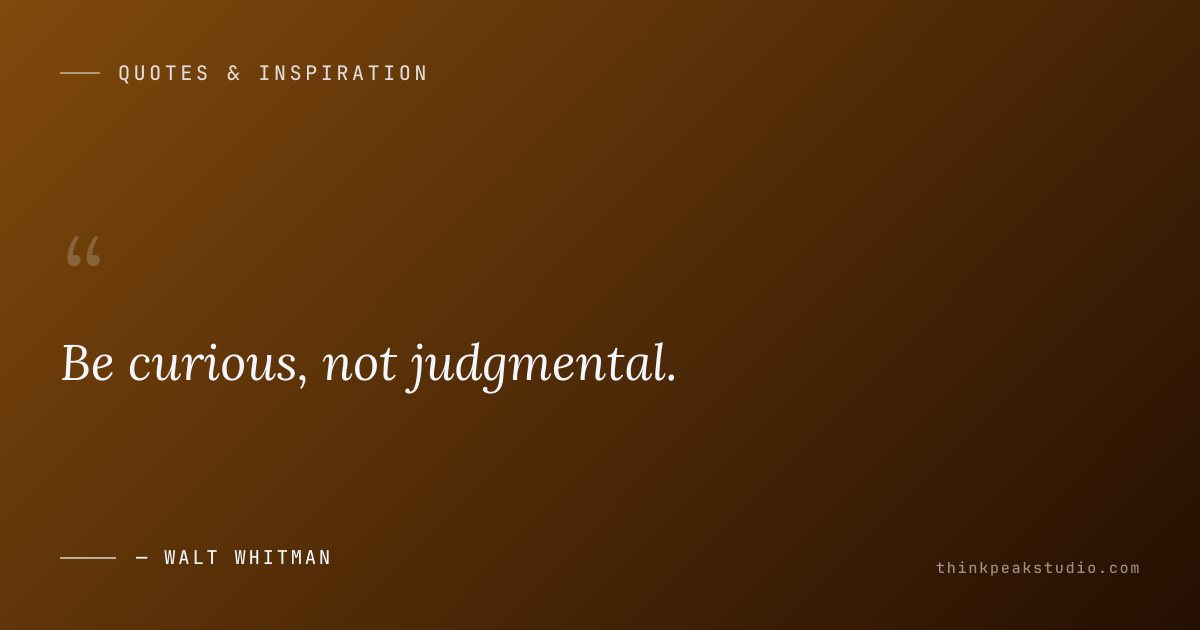
“Be curious, not judgmental.”
Context
Since the autumn of 2020 this sentence has been printed on mugs, posters, tote bags and office walls, usually with a name underneath it: Walt Whitman. It is a good line and a false attribution. Whitman — born in West Hills, Long Island, on May 31, 1819, and dead in Camden, New Jersey, on March 26, 1892 — never wrote it. Ed Folsom, a professor of English at the University of Iowa and co-director of the Walt Whitman Archive, told Snopes in August 2021: “Whitman never said or wrote ‘Be curious, not judgmental.’ It is one of ten or fifteen ‘quotes’ often falsely attributed to Whitman.” It appears nowhere in Leaves of Grass, and a search of the archive turns up no trace. The line has authority because of a name that does not belong to it.
Where it actually comes from is more ordinary and more interesting. The earliest use of this exact phrasing that researchers have found is an advice column by Marguerite and Marshall Shearer, published in the January 1986 edition of The Charlotte Observer. The columnists were answering a parent who had found oral contraceptives in a seventeen-year-old daughter’s bedroom. Their counsel: “Try to find out her concerns. Be curious, not judgmental.” The sentiment is older still — Snopes found expressions of the general idea reaching back to at least the 1970s — but the wording that traveled is a syndicated columnist’s, spoken to one parent about one teenager. Nothing about it is Whitmanesque except how nicely it sounds.
The line became a Whitman quote through fiction. Ted Lasso, developed by Jason Sudeikis, Bill Lawrence, Brendan Hunt and Joe Kelly for Apple TV+ and based on a character Sudeikis had played in NBC Sports promotions, premiered on August 14, 2020. In the first season’s eighth episode, “The Diamond Dogs,” which aired September 18, 2020, the title character plays darts against Rupert Mannion in the Crown and Anchor pub. Losing badly, Ted tells a story about driving his son to school and seeing “this quote by Walt Whitman” painted on a wall: “Be curious, not judgmental.” He then hits two triple twenties and a bullseye and wins. The scene is one of the show’s best known, and it did what the 1986 advice column never could: it fixed an orphan sentence to a famous author’s name. No one vetted the credit, because within the story it was never a citation at all. It was dialogue.
Meaning
The sentence sets two postures against each other. Curiosity begins from the premise that the other person is not yet known; judgment begins from the premise that they already are. One asks; the other declares. Ted’s monologue spells out the mechanism he thinks he has discovered: the people who underestimated him “weren’t curious… they thought they had everything all figured out. So they judged everything, and they judged everyone.” The claim is causal, not decorative. Judgment rushes in precisely where curiosity is absent, because a verdict is cheap and a question costs something.
“Not judgmental” is easy to misread as “never judge.” The line is not asking you to abandon discernment; it is asking you to change the order in which it happens. Judgment that arrives after inquiry is a considered opinion. Judgment that arrives instead of inquiry is a prejudice — literally a pre-judging, a decision made before the evidence exists. The instruction is epistemic before it is moral: gather before you grade. That is why the phrasing is “be curious” first. Curiosity is not the opposite of standards. It is the only honest route to earning them.
The strangest thing about the line is what its own history proves. A sentence that commands curiosity has spent decades being repeated by people who never got curious enough to check the name attached to it. The quote is a demonstration of its own thesis. Had anyone applied the line to the line — asked who actually said this, before chiseling it into a wall — the false attribution would not have survived a week. And there is a genuine Whitman to turn to instead. In “Song of Myself,” section 51 of Leaves of Grass, he writes: “Do I contradict myself? / Very well then I contradict myself, / (I am large, I contain multitudes.)” That is the same refusal to reduce a person to a single verdict, written by the man the internet invented a much blander version of.
Relevance
The line is relevant in 2026 precisely because the environment it lives in is built against it. Feeds, replies and short-form video reward the fast verdict and penalise the slow question; a confident judgment travels further in an hour than a careful inquiry travels in a week. The economics of attention are judgment’s economics. This is also why the quote’s misattribution is not a trivial footnote. A line attached to a celebrated name spreads much further than the same line unattributed, which is the same dynamic that moves misinformation everywhere else: provenance is the first casualty of sharing. The most famous advice about curiosity is, by its own history, a case study in how little of it we actually practise.
The line also matters because it is aimed at almost every part of life at once. In leadership it is the difference between a manager who has already decided what an employee is capable of and one who asks; in families it is the difference between a verdict on a teenager and a conversation with one; in public argument it is the difference between a caricature of an opponent and an attempt to understand why they think what they think. And it applies inward as well as outward. The same reflex that judges other people usually judges the self first, which is why the instruction is so often quoted by people who are harder on themselves than on anyone else.
Application
Make the sentence operational by attaching it to a missing question. The reason Ted’s story lands is not the motto but the follow-up: “if they were curious, they would have asked questions. Questions like, ‘Have you played a lot of darts, Ted?’” That is the whole method compressed into one line — replace the story you have already written about a person with a question only that person can answer. Start with someone you have quietly written off, and notice the moment you feel certain you know them. That certainty is the signal. Ask the question you would ask if you did not already know the answer, and listen to the answer as though it might change you.
Then turn the same curiosity on what you repeat, including this quote. The line that launched a thousand mugs is not Walt Whitman’s; when you share it, say so, and you can even tell the truer story — a newspaper advice column from 1986, on a hard night for one family. Checking a source before crediting it is a small, concrete act of the very curiosity the sentence demands, and it costs you nothing but a minute. Finally, point the practice at yourself. When you catch yourself delivering an internal verdict — about your work, your body, your worth — get curious about the person on trial instead of sentencing them. The instruction was never only about other people. Judgment is a habit, and so is curiosity; only one of them can be built in the moment you notice you are about to decide.
Create your own quote graphic with this quote
This is a line made for a wall — short, warm, and easy to read at a glance, which is exactly why it has travelled so far. Set it plainly and it does the work on its own. Use our free online quote maker to turn this quote into a shareable image in seconds — no signup needed. For advanced features like video quotes and 100+ templates, try the Quotes Creator Android app.
Why we chose this quote
We chose this quote because it is a rare thing: a genuinely useful piece of advice that is also a perfect example of the failure it warns against. Almost everyone who shares “Be curious, not judgmental” credits Walt Whitman, and Whitman never wrote it — the Walt Whitman Archive’s co-director has said so plainly, and the line appears in none of his work. The earliest exact wording researchers have located is an advice column by Marguerite and Marshall Shearer in the January 1986 Charlotte Observer. The line entered the culture through fiction: Ted Lasso’s dart scene in “The Diamond Dogs,” which aired on September 18, 2020. That history makes the quote sharper, not weaker. It shows how a confident attribution outruns an accurate one, and it turns the sentence into a test. If we can be curious about a sentence we have repeated a hundred times — who actually said it, and why — we can be curious about the people we have already decided we understand.
— ThinkPeak Studio Editorial Team
Create your own quote graphic with this quote
Turn this line into a shareable graphic in seconds — free, no signup needed. For video quotes and 100+ templates, try the Android app.
Advertisement
Enjoyed this article? Get more like it in your inbox.


