On this page
Quote Explained: “The best way to predict the future is to invent it.”
The computer scientist’s creed — and the paper trail that shows the words were not his alone
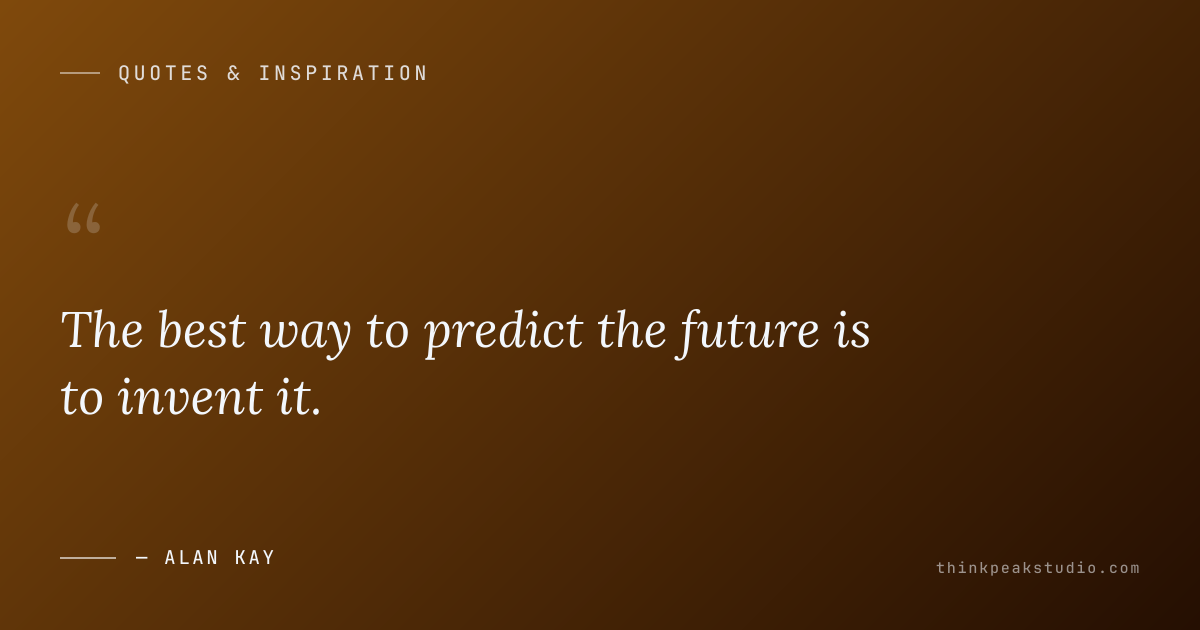
“The best way to predict the future is to invent it.”
Context
Alan Curtis Kay was born on May 17, 1940, in Springfield, Massachusetts. He studied mathematics and molecular biology at the University of Colorado and took a master’s degree in 1968 and a doctorate in computer science in 1969 at the University of Utah, where he worked with the pioneers of computer graphics. In 1970 he joined Xerox’s Palo Alto Research Center, and over the next decade he led the development of Smalltalk, the influential object-oriented programming language in which he designed most of the early versions; conceived the Dynabook, a notebook-sized personal computer for children that was never built but that prefigured the laptop and the tablet; and helped shape the Alto, the machine whose windowed interface influenced the computers that followed. He received the ACM A. M. Turing Award in 2003, and the Charles Stark Draper Prize and the Kyoto Prize in 2004. That is the essential context for the sentence: the man who says the best way to predict the future is to invent it spent his career doing precisely that, describing machines years before they could be built.
Kay’s own account of the quote is unusually specific. In an email on September 17, 1998, to Peter W. Lount, whose smalltalk.org site collected the attribution, he wrote: “The origin of the quote came from an early meeting in 1971 of PARC, Palo Alto Research Center, folks and the Xerox planners. In a fit of passion I uttered the quote!” The version he gave Lount was fuller than the one in circulation: “Don’t worry about what anybody else is going to do… The best way to predict the future is to invent it. Really smart people with reasonable funding can do just about anything that doesn’t violate too many of Newton’s Laws!” The corollary about funding and physics matters, because it turns a motivational slogan back into a statement about capability. But the memory is the memory: Kay dated the remark to 1971, while the earliest print sighting that the quotation-tracing site Quote Investigator has located is a decade later, in InfoWorld on April 26, 1982, where a report on a computing-in-education conference noted that “at Xerox PARC the researchers’ maxim was ‘The best way to predict the future is to invent it,’” and that Kay, then chief scientist at Atari, had spoken of the effort to design a truly personal computer. The gap between the utterance and the record is itself a lesson in how quotes travel.
The line also did not begin with Kay. Its earliest documented form comes from Inventing the Future (1963), by the Hungarian-born British physicist Dennis Gabor, who invented holography in 1949 and would win the Nobel Prize in Physics in 1971: “The future cannot be predicted, but futures can be invented.” Gabor’s idea was noticed and rephrased almost immediately — in his review of the book in New Scientist on March 28, 1963, Nigel Calder wrote that Gabor’s approach was that “we cannot predict the future, but we can invent it” — and in 1968 the U.S. Secretary of Agriculture Orville Freeman used that concise version while crediting Gabor by name. From there the phrase multiplied into variants and misattributions. By 1986 the “create” form, “The best way to predict the future is to create it,” was being ascribed to the management writer Peter Drucker, and a September 1982 Atari advertisement carried the same wording. A later attribution to Abraham Lincoln is not supported by any evidence; Quote Investigator and other researchers have found none. Kay’s version is best understood not as a duplicate of Gabor but as a redesign of it, in which the point is sharpened by inverting the grammar.
Meaning
The sentence is a claim about the relationship between forecasting and agency, and its force comes from reversing the order we usually assume. The normal sequence runs: predict the future, then prepare for it. Kay puts invention first and treats prediction as a lesser technique for reaching a future you want. The word “best” is careful — it does not say prediction is impossible or useless, only that it is inferior to building. And the claim is not merely strategic. It rests on a view of the future as underdetermined: not a fixed target waiting to be sighted, but a space of possibilities that choices collapse into one history. If that view is right, then forecasting is inherently second-rate, because the thing being forecast is partly produced by the people acting on the forecast.
The two verbs carry two theories of the person. To predict is to receive a future that is already settled; the predictor stands outside it as a spectator. To invent is to author one; the inventor is a participant with a hand on the outcome. Gabor’s sentence states the failure of the first activity — the future cannot be predicted. Kay’s sentence supplies the replacement technique, and in doing so shifts the emphasis from knowing to making. This is why the quote has always appealed more to builders than to analysts: it does not promise to tell you what will happen, it tells you what to do when nobody can. It also quietly demotes the expertise of the forecaster and promotes the willingness of the maker, which is precisely the trade the technology industry wants to believe in.
The danger is that a slogan so clean can be used to skip the hard part. Read carelessly, “invent the future” licenses techno-solutionism — the assumption that any problem will yield if you build something. Kay’s own corollary resists that reading: invention, he said, takes really smart people and reasonable funding, and it must respect constraints or it simply fails. The line is also not as anti-prediction as it sounds. Without a forecast you cannot tell whether what you built answers a need, and Gabor’s own book was full of projections. Prediction and invention are a loop, not a contest: you build, the world responds, and the response is the only prediction that ever arrives already tested. The sentence is best read as an instruction about where to spend your effort, not a denial that the future has constraints.
Relevance
The quote has become the operating assumption of the artificial-intelligence era, which is why it is worth knowing exactly what it does and does not claim. When models can draft, code, draw and design on demand, invention has never been cheaper, and the temptation is to treat the future as something to generate. But there is a sharp irony in the technology that made the quote current. Large language models are trained on the past; they are superb at prediction and pattern continuation, which is exactly the faculty Kay’s sentence subordinates. The useful division of labour is the one the quote implies: let the machine predict, and let the human decide what is worth inventing. A model that predicts fluently can still be aimed at a future nobody wants. Aiming is the part that is not automated.
The starker relevance is about power. If the best way to predict the future is to invent it, then the future belongs to whoever can build, and the sentence that sounds like optimism is also a statement about who holds the pen. That is empowering for one person with a laptop, and concerning if the means of invention concentrate into a few firms and platforms. The quote also contains a quiet value judgment that is easy to miss. Kay’s defining project, the Dynabook, was not merely a forecast that computing would become personal and portable; it was an argument that these machines should belong to children and to learning. The prediction was right, but the value behind it — who the future is for — is what made it matter. Prediction describes what will happen; invention decides whom it happens for.
Application
The practical use of the sentence is to convert it from a poster into a weekly question: what is the smallest thing I can build now that makes the future I want more likely? The quote systematically favours building over forecasting, prototypes over plans, and shipping over speculation. But applied without a check it becomes a licence to make things nobody needs, so pair it with the discipline Kay’s own wording implies. Before you build, write down what the thing must do and how you will know it failed — that is the prediction you are allowed, and it is the one that pays. Then respect the constraints, physical and financial, that Kay gestured at with his line about Newton’s laws; the inventors who ignore them do not invent the future, they merely demo it.
The quote’s own history teaches a second, less comfortable lesson about provenance. Kay’s words drifted to Peter Drucker, to a corporate founder, and finally to Abraham Lincoln, and what keeps the attribution honest is not the fame of the line but the paper trail — a dated email, a 1982 magazine, a 1963 book. If you invent something of consequence, date it, source it, and write down what it actually does; the record is what protects your contribution from the story people prefer to tell about it. And note how the future Kay actually helped invent arrived: the Dynabook was never built, yet its description shaped the laptops and tablets that came decades later. The most influential inventions are often not products but proposals — clear enough that other people can build them. That may be the deepest reading of the sentence. The best way to predict the future is not to build the machine. It is to describe it so precisely that the future builds itself.
Create your own quote graphic with this quote
This is a line built for a clean, confident setting — short enough to read in a glance, dense enough to keep working on you. Set it in a strong display face against a dark field, give the words room, and let the argument carry the design. Use our free online quote maker to turn this quote into a shareable image in seconds — no signup needed. For advanced features like video quotes and 100+ templates, try the Quotes Creator Android app.
Why we chose this quote
We chose this quote because it is the rare tech-world maxim with a real paper trail, and because the trail is more interesting than the slogan. Alan Kay, born May 17, 1940, and a 2003 Turing Award winner, said he uttered it “in a fit of passion” at an early 1971 Xerox PARC meeting; the earliest print sighting researchers have found is a 1982 InfoWorld article reporting the PARC researchers’ maxim. The idea did not start with him. Dennis Gabor wrote in Inventing the Future in 1963 that “the future cannot be predicted, but futures can be invented,” and the variants migrated through Nigel Calder’s review, Orville Freeman, Peter Drucker, an Atari advertisement, and eventually an unsupported attribution to Abraham Lincoln. Kay’s achievement was rhetorical: he kept Gabor’s insight and inverted its grammar so that invention became the technique and prediction the lesser one. We chose it because that inversion is a working instruction — build rather than merely forecast — and because Kay’s own life, and the never-built Dynabook that shaped the laptop, proves the line better than the line proves itself. A sentence whose sourcing is a lesson in sourcing has earned a close read.
— ThinkPeak Studio Editorial Team
Create your own quote graphic with this quote
Turn this line into a shareable graphic in seconds — free, no signup needed. For video quotes and 100+ templates, try the Android app.
Advertisement
Enjoyed this article? Get more like it in your inbox.


