Quote Explained: “I have learned that success is to be measured not so much by…”
By Booker T. Washington, American educator, author, and founder of Tuskegee Institute
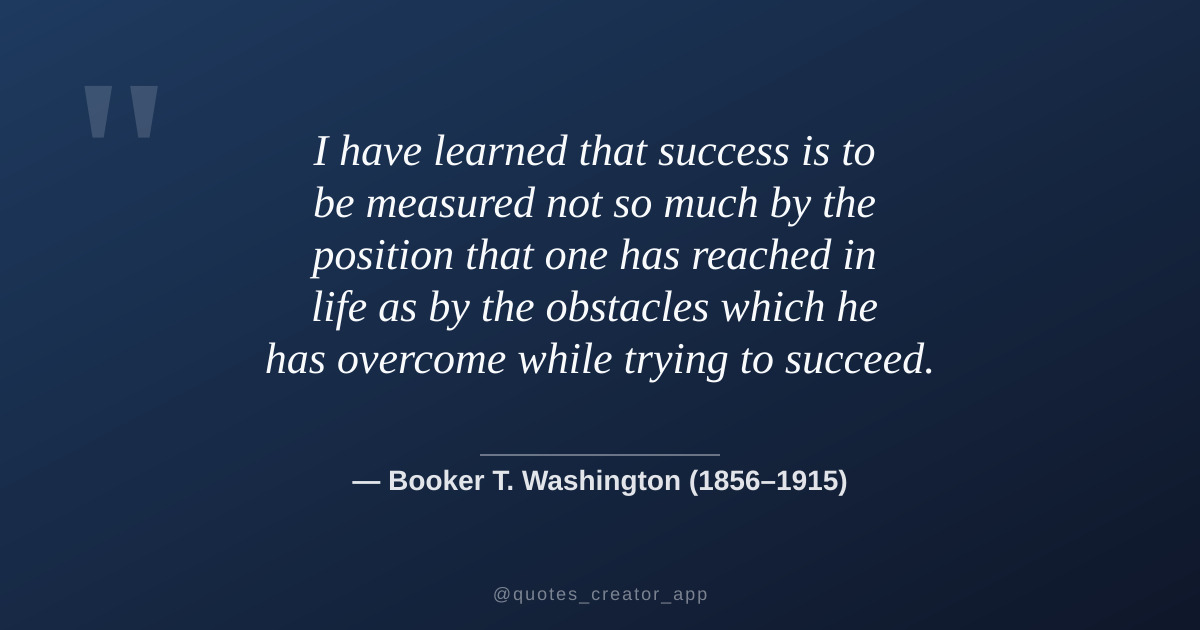
“I have learned that success is to be measured not so much by the position that one has reached in life as by the obstacles which he has overcome while trying to succeed.”
The context
Booker T. Washington was born into slavery in 1856 on a plantation in Franklin County, Virginia. He never knew his father — a white man whose identity remains uncertain — and his mother was a cook for the plantation. Emancipated at age nine when the Civil War ended in 1865, Washington’s early life was defined by grinding poverty and relentless labor. As a boy, he worked in salt furnaces and coal mines in West Virginia, always hungry for the education he had been systematically denied. At sixteen, having heard of a school where Black students could learn a trade, he walked five hundred miles to enroll at Hampton Normal and Agricultural Institute in Virginia, where he worked as a janitor to pay his way. That journey — literal and metaphorical — shaped everything he would later become.
The quote comes from Chapter II, “Boyhood Days,” of Washington’s 1901 autobiography Up From Slavery. The book appeared at a pivotal moment in American history. Reconstruction had ended, Jim Crow segregation was tightening its grip across the South, and the Supreme Court had sanctioned “separate but equal” in Plessy v. Ferguson just five years earlier. Washington had already delivered his controversial Atlanta Compromise speech in 1895, advocating for Black economic progress through vocational education and patient self-improvement rather than immediate political agitation. Up From Slavery was both memoir and manifesto — a document designed to persuade white America of Black Americans’ capacity for citizenship while modeling a philosophy of dignified self-help for his own people.
The audience for Up From Slavery was primarily white readers and northern philanthropists whose financial support Washington needed to sustain Tuskegee Institute, the Alabama school he had founded in 1881. But the book was also consumed voraciously by Black Americans searching for a viable path forward in an era of disenfranchisement and lynching. When Washington wrote that success is measured by obstacles overcome, he was not offering empty platitudes. He was drawing from a life in which every achievement was won against structural barriers specifically designed to prevent it. The autobiography became an international bestseller, translated into multiple languages, and made Washington one of the most famous Americans of his era — the first Black person invited to dine at the White House, an advisor to presidents Theodore Roosevelt and William Howard Taft.
The meaning
At its most literal level, Washington is inverting the conventional metric of success. In a world that judges people by their titles, bank accounts, and social station, he argues that these end-point indicators miss the point entirely. Success, properly understood, is not a snapshot but a trajectory. What matters is the distance traveled — the gap between where someone started and where they ended up. A person born into wealth who maintains it has, by this measure, accomplished less than someone born into poverty who reaches a stable middle-class life. The obstacles become the denominator that gives success its true weight. Washington understood this viscerally: the same achievement — literacy, employment, property ownership — means something radically different when it was won by someone who began life as chattel.
There is a deeper, more radical layer to this insight. Washington is not merely arguing that “obstacles make success sweeter” — a sentimental trope. He is suggesting that obstacles are constitutive of success itself. Without resistance, there is nothing to measure. A life free of difficulty produces outcomes, but those outcomes carry no moral or existential weight. The person who inherited a thriving business and maintained it has demonstrated competence. The person who built one from nothing with no capital, no connections, and systemic prejudice actively working against them has demonstrated something far greater — not merely skill, but a kind of soul-level resilience that cannot be acquired any other way. Washington taught his students at Tuskegee that their struggles were not burdens to merely endure but the raw material from which character, dignity, and true achievement would be forged.
Philosophically, Washington’s framing aligns with a tradition stretching from the Stoics through existentialism. It echoes Epictetus, who taught that external circumstances are morally indifferent — it is our judgment and response that matter. It anticipates Viktor Frankl’s later insight, forged in the concentration camps, that meaning is found not in avoiding suffering but in how we meet it. What makes Washington’s version uniquely powerful is its provenance. This is not abstract philosophy composed in comfort. It is hard-won wisdom spoken by a man born a slave, to a people systematically brutalized, offering a radical reframe: the very thing that was supposed to destroy you is what makes your forward motion remarkable. The quote transforms victimhood into agency without denying the reality of the victimization. It says: your obstacles are real, they are unjust, and they are also the measure of your triumph.
Why it still matters today
In the age of social media, Washington’s metric of success is more countercultural than ever. Platforms like Instagram and LinkedIn train us to measure life by visible positions — follower counts, job titles, filtered vacation photos, curated lifestyles. We see everyone’s polished destination but almost never their starting line. This fuels a toxic cycle of comparison and inadequacy, where a person who clawed their way to stability feels like a failure because they see someone else’s yacht. Washington’s quote offers a liberating alternative: stop comparing your Chapter 1 to someone else’s Chapter 20. The single mother earning $40,000 a year after growing up hungry and unsupported may have traveled further than the executive earning $400,000 after a private-school-to-Ivy-League-to-family-connections pipeline. The quote gives us permission to measure ourselves by our own journey rather than someone else’s scoreboard.
The quote also speaks powerfully to contemporary debates about privilege, resilience, and equity. In a society increasingly aware of structural inequality, Washington’s framing refuses to let disadvantage be the final word on anyone’s life. It acknowledges that obstacles are real, systemic, and unjust — he lived them, he never minimized them — but it insists that overcoming them is both possible and meaningful. This is a nuanced position that resists the poles of our current discourse. It neither dismisses structural barriers with naïve bootstrapping rhetoric, nor surrenders to them with a fatalism that strips people of agency. Washington’s insight offers a version of hope that is honest about difficulty while fiercely committed to the possibility of transcendence. It is a perspective our polarized era desperately needs.
How to apply this in your own life
The most immediate application is a mental reframe. When you feel behind in life — when you scroll past peers with more money, better titles, or faster progress — pause and ask yourself: what have I overcome that they haven’t? Take honest inventory of your obstacles. Perhaps you are the first person in your family to graduate from college. Perhaps you built a career while caring for aging parents or raising children alone. Perhaps you are navigating a chronic illness, recovering from a financial collapse, or rebuilding after a relationship ended. Whatever your list contains, these are not detours from your success story. They are the very things that give your achievements their weight and worth. Write them down. Own them as evidence of your capability rather than marks against you. This simple shift from position-based to obstacle-based self-assessment can transform self-doubt into genuine self-respect.
On a practical level, adopt Washington’s lens when facing new challenges. The next time you encounter a daunting obstacle — a career setback, a health crisis, a creative block, a difficult relationship — resist the impulse to ask “why is this happening to me?” Instead, ask “what will I have proved to myself when I get past this?” The obstacle is not an interruption of your path. It is the path. This is not toxic positivity or denial of difficulty. Washington, who spent his entire life navigating crushing systemic racism while building an institution, never pretended obstacles were not real or did not hurt. He simply refused to let them define the meaning of his life. You can do the same: treat every struggle as future evidence of your resilience, and you will discover reserves of strength you did not know you possessed.
Create your own quote graphic with this quote
This is the kind of quote that carries weight. When you pair timeless words with thoughtful design, you create something people want to save, share, and return to. Use our free online quote maker to turn this exact quote into a shareable image in seconds — no signup needed. For advanced features like video quotes and 100+ templates, try the Quotes Creator Android app.
Why we chose this quote
Booker T. Washington remains one of the most complex and debated figures in American history — celebrated by some as a pragmatic genius, criticized by others as too accommodating of segregation. But on this one point, there is near-universal agreement: his reframing of success as a measure of obstacles overcome rather than status achieved is an insight of enduring power. In an era of constant social comparison, algorithmic envy, and rising anxiety about achievement, it is a perspective we need now more than ever. Washington’s words remind us that every struggle is a credential, every hardship a measure of how far we have truly come.
— ThinkPeak Studio Editorial Team
Create your own quote graphic with this quote
Turn this line into a shareable graphic in seconds — free, no signup needed. For video quotes and 100+ templates, try the Android app.
Advertisement
Enjoyed this article? Get more like it in your inbox.