Quote Explained: “Vulnerability sounds like truth and feels like courage…”
By Brené Brown, research professor and bestselling author
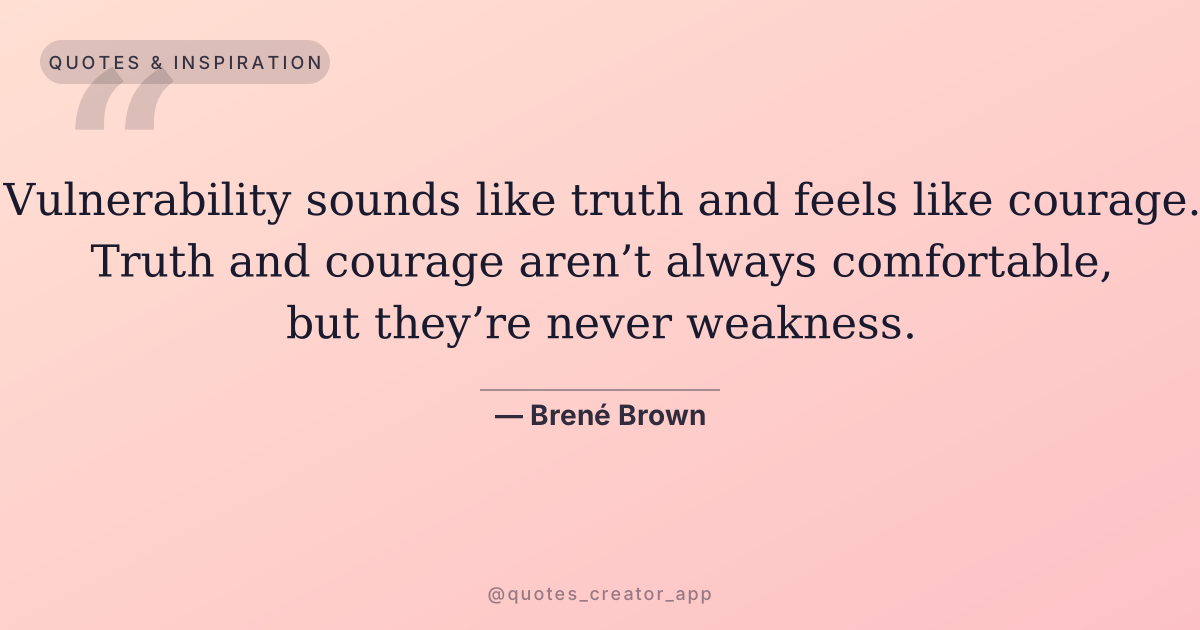
“Vulnerability sounds like truth and feels like courage. Truth and courage aren’t always comfortable, but they’re never weakness.”
The context
In 2010, a research professor from the University of Houston Graduate College of Social Work stepped onto a TEDx stage in Houston and delivered an 18-minute talk that would become one of the most-watched TED talks in history. Brené Brown had spent the previous decade studying connection — what gives it life, what destroys it, and why some people seem to have it while others struggle. Her research methodology was grounded in grounded theory, a rigorous qualitative approach that required her to collect thousands of stories through interviews and then systematically code them for patterns. She had set out to study the anatomy of human connection. What she found instead was a universal experience that terrified her so much she went into what she later called a “year-long shame storm” and saw a therapist: the single greatest barrier to connection was the fear of being seen as not enough.
That fear, Brown discovered, has a name: vulnerability. But her data revealed something radically counterintuitive. The people who reported the deepest sense of love, belonging, and worthiness were not the ones who had armored themselves against vulnerability. They were the ones who had fully embraced it. They believed, at a fundamental level, that what made them vulnerable also made them beautiful. They were willing to say “I love you” first. They were willing to invest in a relationship that might not work out. They were willing to do something where there were no guarantees. And this willingness was not a sign of fragility — it was, Brown concluded, the birthplace of courage itself. In 2012, she published Daring Greatly, the book that took two years of additional research and synthesized it into a cultural manifesto. The quote emerges from the heart of that work.
The line — “Vulnerability sounds like truth and feels like courage” — appears not as a standalone aphorism but as a distillation of hundreds of interviews. Brown had noticed a recurring pattern in how people described moments of emotional exposure. When someone admitted a fear, confessed a mistake, or shared a dream they felt unqualified to pursue, their voice changed. The tone shifted from performative to authentic. The language simplified. Listeners leaned in. Brown realized that vulnerability has a sound — it sounds like someone telling the truth for the first time. And it has a bodily feeling — it feels like stepping off a cliff and trusting something to catch you. That combination of honesty and risk is the exact definition of courage. And the second sentence completes the thought: just because something is uncomfortable doesn’t mean it’s weak. In fact, discomfort is often the price of strength.
The meaning
The first sentence operates on two sensory dimensions — hearing and feeling — to make an abstract concept visceral. “Vulnerability sounds like truth” is a claim about authenticity. When someone is being truly vulnerable, their words carry a specific quality. There is no posturing, no performance, no trying to manage the impression they are making. The mask drops, and what remains is raw and unvarnished. We recognize this sound instantly. It’s the difference between a friend saying “I’m doing great, everything’s amazing” in a flat, rehearsed tone, and that same friend pausing, lowering their voice, and saying “Actually, I’ve been struggling.” The second sentence cuts deeper. The shift from polished to honest is audible. Brown is identifying vulnerability as the primary carrier frequency of truth-telling — not the sanitized, strategic truth we deploy to look good, but the truth that costs something to speak.
“Feels like courage” is the companion insight that flips our cultural script. For most people, the felt experience of vulnerability is indistinguishable from fear. The racing heart, the sweaty palms, the urgent desire to retreat — these are the same physiological signals the body produces in the presence of physical danger. The difference, Brown argues, is that vulnerability is fear plus an intention to stay present anyway. Courage is not the absence of fear; it is fear walking. When you speak an uncomfortable truth, when you ask for help, when you admit you don’t know the answer, the physical sensation you are experiencing is courage. The pounding in your chest is not evidence that you should stop. It is evidence that you have already begun. This reframe is enormously practical: if vulnerability feels terrifying, you are not doing it wrong — you are doing it exactly right.
The second sentence — “Truth and courage aren’t always comfortable, but they’re never weakness” — closes the loop with a quiet moral declaration. The modern world has a comfort obsession. We curate our online selves, avoid difficult conversations, and retreat from emotional risk because it feels better to stay in the shallow end. Brown is calling out the logical error underneath that retreat: we have confused comfort with strength. Armor is comfortable; it also weighs you down and restricts your movement. Vulnerability is uncomfortable; it also makes authentic connection possible. Weakness is collapsing under pressure. Vulnerability is standing in the storm without pretending it isn’t raining. The sentence forces a re-examination of what strength actually looks like — not the stoic facade that never cracks, but the honest presence that shows up and says this is hard, and I’m still here.
Why it still matters today
In 2026, this quote has grown more urgent because the dominant cultural forces are actively hostile to vulnerability. Social media rewards polished performance, curated highlight reels, and hot takes delivered with unearned confidence. Artificial intelligence tools can generate flawless text and images, raising the baseline for what looks “good enough to share” while saying nothing about what is true. The pressure to present an invulnerable self has never been higher, and yet loneliness, anxiety, and burnout have reached epidemic levels — especially among younger generations who have never known a world without Instagram. Brown’s insight diagnoses this crisis with precision: we are surrounded by communication, but starved of the sound of truth. The very thing that could connect us — honest, unpolished, vulnerable expression — is the thing we have been trained to suppress.
The quote also speaks directly to the transformation happening in leadership and organizational culture. The old model of leadership was command-and-control: the leader projects certainty, hides weakness, and maintains a strategic distance from the team. The new model, driven by research like Brown’s and validated by real-world results at companies that have embraced psychological safety, is radically different. Leaders who admit uncertainty, ask for feedback, acknowledge mistakes, and share what they are personally wrestling with don’t lose authority — they earn trust. Google’s Project Aristotle, a multi-year study of what makes teams effective, found that the single most important factor was psychological safety: “a shared belief held by members of a team that the team is safe for interpersonal risk-taking.” That is a clinical way of saying vulnerability is allowed here. Brown’s quote captures the why behind the data. When a leader speaks the uncomfortable truth, they model that courage is valued over posturing. The sound of truth cascades. The feeling of courage becomes shared.
How to apply this in your own life
The most immediate way to apply this quote is to start listening for the gap between what you say and what is true. Pick one relationship — a partner, a close friend, a trusted colleague — and one conversation you have been avoiding. Ask yourself: what am I afraid would happen if I said the real thing out loud? Then, when the moment comes, speak the truth without the protective packaging. Don’t cushion it with jokes, don’t hedge it with disclaimers, don’t deliver it over text because face-to-face feels too scary. Say it plainly and let it land. Notice the physical sensation when you do — the tightness in your chest, the tremble in your voice — and label it correctly. Not as weakness, but as courage. Not as a signal to retreat, but as confirmation you are exactly where you need to be. The first time will be the hardest. The hundredth time will feel like freedom.
The deeper application is to examine the stories you tell yourself about vulnerability. Many people carry a script that goes something like: If I show weakness, I will be rejected. If I admit I don’t know, people will lose respect for me. If I say what I really feel, I will be alone. These scripts are not truths; they are protective mechanisms that made sense in some earlier environment but no longer serve you. Brown calls this “the story I’m making up” — a phrase you can deploy in real-time when insecurity flares. Instead of slamming the armor shut, say out loud: “The story I’m making up right now is that you’re angry with me. Is that true?” You have replaced assumption with inquiry, defense with openness. The other person almost always responds with relief, because you have just given them permission to be honest too. This is how vulnerability becomes contagious. One person says the uncomfortable true thing, and suddenly everyone else relaxes into their own humanity. The armor was always heavier than the truth it was protecting.
Create your own quote graphic with this quote
Some quotes live on the wall of your mind. This one deserves to live on the wall of your studio, your office, or your phone screen. When you pair timeless words with thoughtful design, you create something that invites others into the conversation. Use our free online quote maker to turn this exact quote into a shareable image in seconds — no signup needed. For advanced features like video quotes and 100+ templates, try the Quotes Creator Android app.
Why we chose this quote
Brené Brown has written many memorable lines across her body of work, but this one distills her entire research program into two sentences that don’t just explain vulnerability — they let you hear it and feel it. The quote does something rare: it gives you an embodied definition of courage that bypasses the intellect and lands in the gut. When we read it, we don’t just understand a concept. We remember a moment when we spoke a hard truth and felt that exact combination of terror and strange exhilaration. And the second sentence is the one we all need to tape to our mirrors: discomfort is not the same as weakness. The fact that something is hard does not mean you are failing at it. That single reframe can change how someone shows up in every important area of their life.
— ThinkPeak Studio Editorial Team
Create your own quote graphic with this quote
Turn this line into a shareable graphic in seconds — free, no signup needed. For video quotes and 100+ templates, try the Android app.
Advertisement
Enjoyed this article? Get more like it in your inbox.