Quote Explained: “Until you make the unconscious conscious, it will direct your life and you will call it fate.”
By Carl Jung, Swiss psychiatrist and founder of analytical psychology
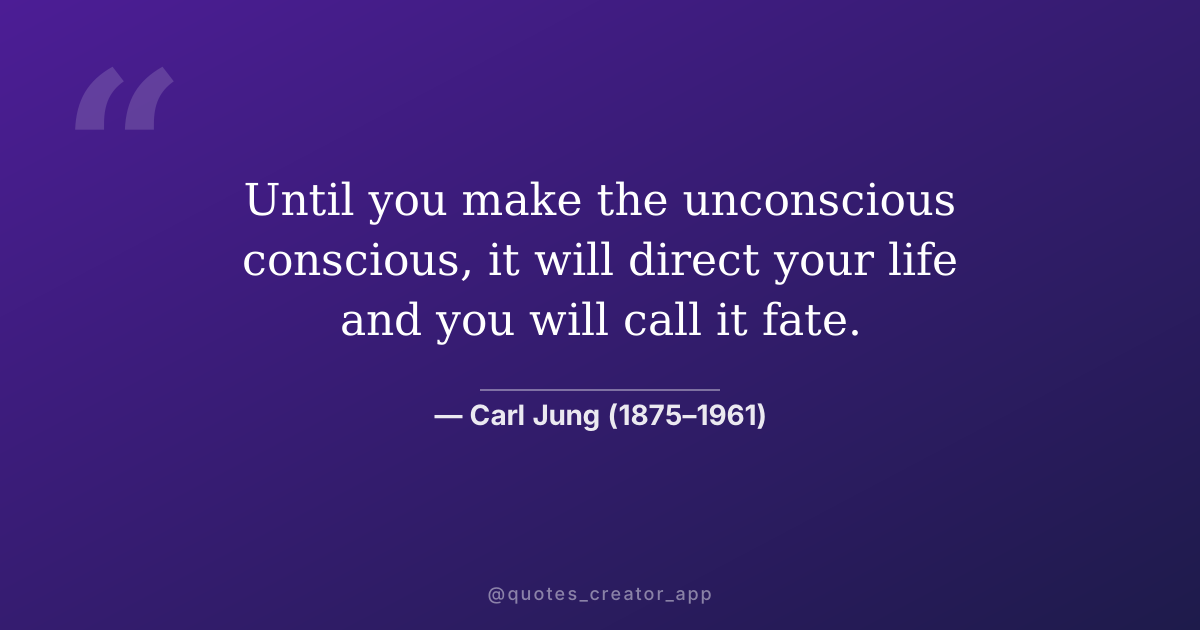
“Until you make the unconscious conscious, it will direct your life and you will call it fate.”
The context
In 1951, Carl Gustav Jung was 75 years old and the undisputed elder statesman of depth psychology. Sigmund Freud, his former mentor and later intellectual adversary, had been dead for over a decade. The horrors of the Second World War had reshaped the intellectual landscape of Europe, and Jung — a Swiss citizen who had watched the continent descend into mass psychosis — was increasingly occupied with a single question: why do collectives, like individuals, get possessed by forces they do not understand? His answer, developed across decades of clinical work and self-examination, was that what remains unconscious does not disappear. It accumulates. It festers. It projects itself onto the world as ideology, as enemy, as fate. Aion, published as Volume 9, Part II of his Collected Works, was the culmination of this line of inquiry. Subtitled Researches into the Phenomenology of the Self, it explored the archetype of wholeness and the process by which consciousness and the unconscious must integrate if the individual — and by extension, civilization — is to avoid being devoured by its own shadow.
The specific line that would become one of Jung’s most quoted insights appears in a passage discussing the tension between ego-consciousness and the vast, largely unknown inner world. The exact wording in the Collected Works is: “When an inner situation is not made conscious, it happens outside as fate.” The more familiar version — “Until you make the unconscious conscious, it will direct your life and you will call it fate” — is a distillation that has circulated for decades, capturing the essence of the original with a sharper rhetorical edge. Jung wrote this not as a philosophical abstraction but as the clinical conclusion drawn from thousands of hours sitting with patients who were, without exception, living out patterns they could not see. The woman who kept marrying men who treated her like her father did. The man whose fear of failure caused him to sabotage every project before it could succeed, then blame external circumstances. The patient who insisted life was conspiring against them while never examining the ways their own choices produced their predicament. Jung’s claim was that “fate” — that immovable, external-seeming force — was often the unconscious directing the show from behind a curtain the ego refused to pull back.
It is impossible to understand this quote without understanding what Jung meant by “the unconscious.” For Freud, the unconscious was largely a basement of repressed sexual and aggressive impulses — personal, biographical, and pathological. For Jung, it was far larger. Below the personal unconscious — the forgotten memories, the suppressed desires, the disowned aspects of the self that constitute what he called the shadow — lay the collective unconscious: a layer of the psyche shared by all humanity, populated by archetypes — primordial images and patterns that shape human experience across cultures and millennia. The Mother, the Father, the Hero, the Trickster, the Wise Old Man, the Self. These archetypes, Jung argued, were not ideas we learned but structures we were born with, like the instinct to build nests or migrate south. And they exert their influence whether we acknowledge them or not. To make the unconscious conscious was therefore not merely to remember childhood traumas. It was to enter into a lifelong dialogue with the deepest and oldest parts of what it means to be human.
The meaning
At the literal level, the quote describes a psychological mechanism that is almost embarrassingly simple once you see it operating in your own life. Every person carries a set of unconscious beliefs, fears, desires, and defense mechanisms that were formed before they had the language to articulate them. These inner structures act as filters, shaping what we notice, what we pursue, what we avoid, and what we interpret events to mean. When you consistently fail to recognize that a pattern originates inside you, the pattern appears to originate outside you. You call it “just my luck,” or “the way the world works,” or “my destiny.” But Jung is arguing that what you call fate is often the footprint of something you have not yet looked at. The alcoholic who keeps losing jobs and insists the world is unfair. The person who falls in love with unavailable partners and concludes that true love is a myth. The entrepreneur whose ventures keep collapsing at the same stage, each collapse blamed on a different external villain. The common thread is the refusal — not willful but unconscious — to ask: what am I doing, over and over, that creates the conditions for this outcome?
The deeper layer is what this insight implies about agency and freedom. Jung was not saying that everything that happens to you is your fault. Trauma, accidents, historical injustice, economic forces — these are real and can shape a life in ways no amount of introspection can erase. His point was narrower and more precise: the portion of your suffering that arises from unconscious patterns is suffering you have the power to reduce, but only by making those patterns conscious. This is the core of what Jung called individuation — the lifelong process of integrating the conscious and unconscious parts of the psyche into a more complete, more authentic whole. Individuation is not about becoming perfect or resolving all inner conflict. It is about knowing what you contain, so that what you contain no longer sneaks up on you disguised as the world. The person who knows they have a tendency to trust too quickly can learn to pause before committing. The person who knows they deflect criticism with anger can learn to sit with discomfort before lashing out. Consciousness does not eliminate the pattern. It gives you a relationship with the pattern, and that relationship is the foundation of freedom.
The philosophical ground this quote stands on is a radical revision of the ancient question of free will. If the unconscious is directing your life, are you free? Jung’s answer is nuanced: you are not free in the sense of being an uncaused cause, a sovereign self that chooses from nowhere. But you can become more free — not by escaping causation but by becoming conscious of the causes that shape you, and in doing so, gaining the capacity to respond to them rather than simply be moved by them. The difference between a person who has never examined their jealousy and a person who knows they are jealous and can feel the impulse rise without acting on it is the difference between being possessed and being in dialogue. The unconscious made conscious does not disappear. It becomes a partner rather than a puppeteer. And the word for that shift, Jung would argue, is not “fate” but “growth.”
Why it still matters today
Jung’s insight has, if anything, grown more relevant in a culture saturated with the language of self-awareness but still largely unfamiliar with its actual practice. The twenty-first century has produced an explosion of interest in mental health, therapy, and personal growth. Terms like “shadow work,” “attachment style,” “inner child,” and “triggered” have migrated from clinical literature into everyday conversation. This is progress in one sense: people are more willing than any previous generation to acknowledge that inner dynamics shape outer outcomes. But it has also produced a kind of performative self-awareness — the ability to name one’s patterns without doing the slow, uncomfortable work of changing them. Jung’s quote is a corrective to this. It does not ask you to label your unconscious patterns and stop there. It demands that you bring them fully into the light of consciousness, which means feeling the feelings you have been avoiding, accepting the parts of yourself you find shameful, and taking responsibility for choices you would prefer to attribute to circumstance. The quote’s staying power comes from the fact that it cannot be domesticated into a social media platitude. It remains stubbornly, usefully uncomfortable.
The quote also speaks with unexpected force to the collective dimension of our current moment. In a world of algorithmic polarization, political tribalism, and what historian Daniel Boorstin called “pseudo-events,” Jung’s framework offers an explanation for why groups behave the way they do. A nation that has not made its history conscious — that has not reckoned with the shadow of colonialism, slavery, or imperialism — will find that history returning as “fate” in the form of social unrest, political instability, or intergenerational trauma. A social movement that has not examined its own shadow — its unacknowledged hunger for power, its projection of evil onto opponents — will eventually replicate the dynamics it claims to oppose. Jung believed that the unconscious operates at every scale, from the individual psyche to the body politic. The mechanism is the same. What is not faced within projects itself outward, and the outward projection is experienced as an alien force — fate, conspiracy, the malice of others. The only way out, for a person or a people, is the long, unglamorous labor of consciousness.
How to apply this in your own life
The first and most immediate application is to examine the narratives you use to explain the recurring difficulties in your life. Take a specific pattern — a type of conflict that follows you from job to job, a dynamic that repeats across relationships, a frustration that seems to arise wherever you go — and ask a different question than the one you are used to asking. Instead of “Why does this keep happening to me?” ask “What am I contributing to this pattern that I cannot yet see?” This is not an invitation to self-blame but to self-investigation. Journal about the pattern. Notice what you feel before it emerges. Identify the moment when you could have made a different choice but did not. Ask a trusted friend or therapist to reflect back what they observe. The goal is not to solve the pattern immediately but to bring it into the field of awareness, because awareness itself changes the calculus. A pattern you can see is a pattern you can begin to negotiate with. A pattern you cannot see is one you will continue to call fate.
The deeper application is to commit to the ongoing practice of making the unconscious conscious, not as an emergency measure applied to crises but as a way of living. This means paying serious attention to your dreams — Jung called them “the small hidden door in the deepest and most intimate sanctum of the soul” — and recording them before they evaporate. It means noticing what triggers you and asking, before you blame the trigger, what it reveals about you. It means developing the discipline of sitting with discomfort rather than immediately numbing, distracting, or projecting. It means being curious about the parts of yourself you dislike and asking what they want, what they fear, and what they might be protecting. None of this is easy. Jung was transparent about the cost: “There is no coming to consciousness without pain.” But the alternative, he insisted, is worse — a life lived on autopilot, directed by forces you do not understand, whose outcomes you will call fate because you never learned to call them anything else. The promise embedded in the quote is not that consciousness solves everything. It is that consciousness is the only thing that gives you a say in what your life becomes.
Create your own quote graphic with this quote
This is the kind of quote that carries weight. When you pair timeless words with thoughtful design, you create something people want to save, share, and return to. Use our free online quote maker to turn this exact quote into a shareable image in seconds — no signup needed. For advanced features like video quotes and 100+ templates, try the Quotes Creator Android app.
Why we chose this quote
Jung’s line has a rare quality: it is both an accusation and a liberation. It tells you that the circumstances you call fate are, to some meaningful degree, the unexamined contents of your own psyche — which is uncomfortable. But it also tells you that the power to change those circumstances lies within you — which is the most hopeful thing anyone can hear. We chose it because it refuses to let the reader off the hook without also handing them the key. In an era that oscillates between fatalism (“the system is rigged, nothing I do matters”) and magical thinking (“manifest your destiny”), Jung’s actual psychological insight cuts through both. It says: look within. Not to find a comforting story, but to find the truth of what is actually driving your life. And then, once you see it, choose differently.
— ThinkPeak Studio Editorial Team
Create your own quote graphic with this quote
Turn this line into a shareable graphic in seconds — free, no signup needed. For video quotes and 100+ templates, try the Android app.
Advertisement
Enjoyed this article? Get more like it in your inbox.