Quote Explained: “Who looks outside, dreams; who looks inside, awakes.”
By Carl Jung, founder of analytical psychology
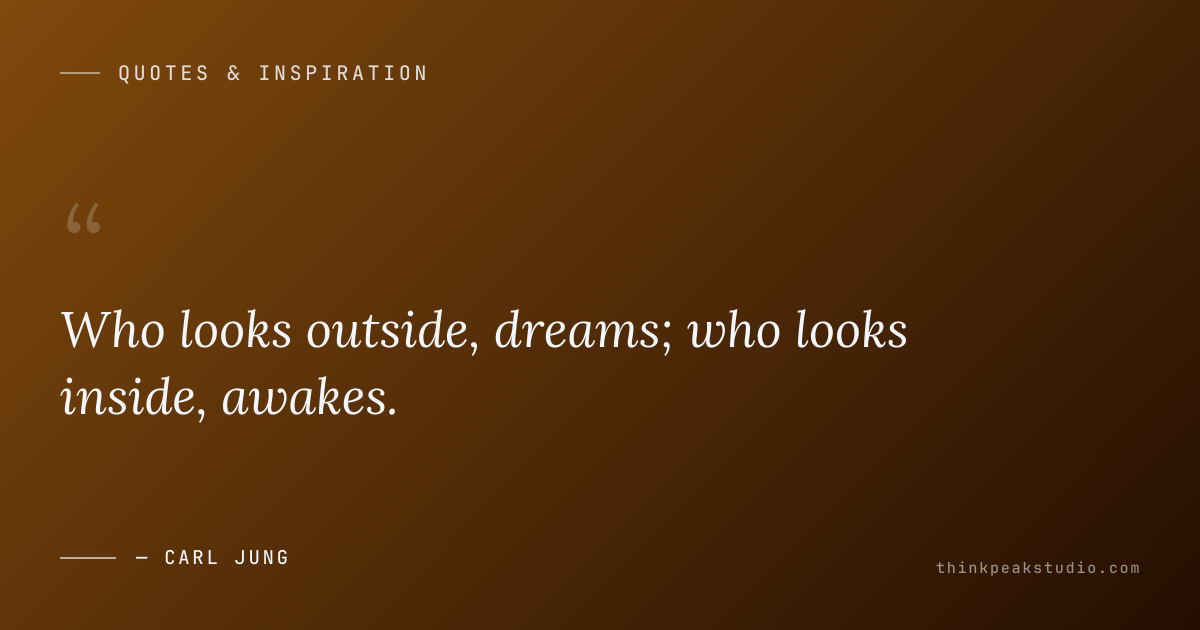
“Who looks outside, dreams; who looks inside, awakes.”
The context
Carl Gustav Jung was born in 1875 in a small Swiss village, the son of a pastor, and grew up to become one of the most consequential thinkers of the twentieth century. Trained as a psychiatrist, he was Sigmund Freud’s handpicked heir — the “crown prince” of psychoanalysis, Freud called him — until a disagreement over the nature of the unconscious split them apart for good in 1913. Jung could not accept Freud’s insistence that the deepest layer of the mind was essentially a basement full of repressed desire, a place of instinct and pathology to be managed. He believed the unconscious was far more than that: a vast reservoir holding not only our wounds but our unlived potential, our inherited patterns of feeling, our soul. Out of that rupture he built analytical psychology — a name for a different way of understanding the mind, one that treated the inner world not as a symptom to be cured but as a territory to be explored.
The line “who looks outside, dreams; who looks inside, awakes” belongs to this vision. Its exact source is often given as Jung’s Collected Letters, and it circulates in slightly different translations; but its meaning is unmistakably his, because it compresses the single idea his entire career turned around — that the truth of a human life is found not in what the world reflects back but in what a person is willing to face within. The years after his break with Freud were, for Jung, a kind of personal descent, what he later called his “confrontation with the unconscious.” Between 1913 and 1917 he withdrew from public life and kept a private record of his own inner experience, filling the leather-bound notebooks that became the Red Book, a work he refused to publish in his lifetime and that was finally released to the world only in 2009. He drew mandalas, recorded his dreams, and met the figures of his own psyche as if they were real people. He did all of it, he said, because he had realized he could not help others with their inner lives until he had descended into his own.
What he found there became the foundation of the ideas for which he is remembered — the collective unconscious, the archetypes, the shadow, and the process he called individuation, the lifelong work of becoming the person you are meant to be. The quote is a compressed statement of that entire architecture. To “look outside” is to live through the eyes of others — chasing recognition, comparison, and the endless reflection of oneself in the world; to “look inside” is to turn the same searching attention back toward one’s own depths. One state Jung called dreaming, and the other, waking. The dream, in his vocabulary, is not a condemnation — it is simply the name for a life lived unconsciously, and his whole career was an argument that we are all capable of waking from it.
The meaning
The quote’s first move is to redefine what counts as a dream. In ordinary language, dreaming is something that happens at night while the body sleeps, and waking is what happens in the morning when the eyes open. Jung borrows these words and reassigns them to the whole of a life. A person can be wide awake in the physiological sense — working, talking, achieving, accumulating — and still be dreaming in the deeper sense, because their attention is pointed entirely outward. They are looking at what others have, what others think, what the world demands, and in that outward gaze they are, in effect, asleep to themselves. The dreamer in Jung’s sentence is not the person who imagines; it is the person who has never turned the imagination inward. The sentence is startling because it flips a cultural assumption on its head. We tend to think that looking outward — at reality, at the facts, at other people — is the wakeful, hard-headed thing to do, and that turning inward is a soft, dreamy retreat. Jung says the opposite is closer to the truth.
The second clause explains what awakening costs and promises. “Who looks inside, awakes.” The inward turn is not a gentle act of self-indulgence; it is, in Jung’s account, the most demanding and disorienting thing a person can do, because what you meet inside is not always pleasant. There is the shadow — the parts of yourself you have denied, disowned, or never dared to look at — and there are the archetypal forces, the inherited patterns of feeling and meaning that shape you without your consent. To look inside is to meet all of it, and to stop running from it. That confrontation is precisely what Jung meant by awakening. The person who looks inside does not become happier in the shallow sense; they become conscious, which is a deeper and more durable thing. They trade the comfort of not knowing themselves for the clarity of knowing, and that clarity — not pleasure, not success — is what Jung understood by a life actually lived.
Beneath both clauses is a claim about where meaning comes from. The outer world can give a person status, pleasure, comfort, and applause, but it cannot give them a self, because the self is not something that can be received from outside; it is something that must be discovered from within. This is why the outward gaze leaves a person dreaming: they are waiting for the world to tell them who they are, and the world never quite finishes the sentence. The inward gaze, by contrast, makes a person the source of their own meaning. Jung did not mean that we should abandon the outer world — he was a physician and a scholar deeply engaged with it — but he insisted that a life built only on the outer world is a life lived in a dream from which the dreamer never wakes. The quote is not a dismissal of ambition or relationship or work; it is a diagnosis of their limits. They can fill a life, but only the inward turn can wake it.
Why it still matters today
The line has never been more needed than in the present, because we have built an entire civilization designed to keep the gaze pointed outward. Smartphones, social feeds, and the attention economy all operate on the same premise: that there is always something outside you more interesting than what is inside you, and that your worth is something to be measured in followers, metrics, and the approval of strangers. We are, by any historical measure, the most outwardly-directed people who have ever lived — endlessly comparing, curating, and performing for an audience that never sleeps. And yet the result of all this outward attention has not been greater wakefulness but the opposite: a widely reported epidemic of anxiety, burnout, and a strange sense of emptiness at the center of otherwise full lives. Jung’s diagnosis, made a century ago, reads like a prophecy of the present. We look outside, and so we dream.
At the same time, the culture has begun, fitfully, to turn inward — and Jung is a large part of why. The modern revival of therapy, the language of “shadow work” and “healing,” the explosion of interest in meditation and self-understanding, all descend in part from the vocabulary Jung created. His words — introvert, archetype, the shadow, individuation — are now everyday terms. But the quote carries a caution the wellness industry tends to omit. Looking inside is not the same as feeling better, and awakening is not the same as comfort. The inward turn Jung prescribed is rigorous and often painful, and the modern commodified version of it — the promise that a few minutes of self-care will wake you up — is itself a kind of dreaming. The quote’s true relevance is that it refuses to let the inward turn be cheapened. It demands a real descent, because only a real descent produces a real waking.
How to apply this in your own life
The most direct way to apply the quote is to examine, honestly, where your attention actually goes — because attention is the direction of the gaze, and the direction of the gaze is the whole argument of the sentence. For a week, notice how many hours you spend looking outward — at other people’s lives, at metrics, at comparison, at the news — versus how many minutes you spend looking inward, in silence, without a screen, asking what you actually feel, want, and believe. Most people who run this audit are startled by the ratio. The practice of redressing it need not be dramatic. It can be a daily journal, kept by hand, in which you answer not “what happened today?” but “what did I actually feel today, and what did I avoid feeling?” It can be therapy, which is, at its core, a structured arrangement for looking inside in the presence of a witness. It can be solitude, taken deliberately, the way Jung took his. The point is not to withdraw from the world but to make the inward gaze as intentional as the outward one, until the two are in balance.
The deeper application concerns the long arc of a life. Jung called the work of becoming oneself individuation, and he insisted it is not an event but a process that lasts as long as a person lives. The quote is a compass for that process: whenever you find yourself lost in the dream of other people’s expectations — the career chosen to please a parent, the life shaped to impress an audience, the self edited to fit a group — the sentence is there to wake you. It asks you to stop looking for yourself in the reflection and to start looking for yourself in the source. This is slow, unglamorous work, and it produces nothing the world can photograph. But it is the only work that turns a dreamed life into a lived one — and Jung, who descended into his own depths and came back with a new psychology for the world to inherit, is proof of what the inward gaze can find. Who looks outside, dreams. Who looks inside, awakes.
Create your own quote graphic with this quote
This is the kind of quote that quietly rearranges how you see yourself. When you pair an idea this clarifying with thoughtful design, you create something worth saving and returning to. Use our free online quote maker to turn this exact quote into a shareable image in seconds — no signup needed. For advanced features like video quotes and 100+ templates, try the Quotes Creator Android app.
Why we chose this quote
We chose this quote because it is the rare sentence that works as a diagnosis, a warning, and a promise all at once. It names the exact condition of modern life — a civilization that has mastered the outward gaze while starving the inward one — and it offers no easy cure, only the honest instruction to turn around. Carl Jung spent his whole life mapping the territory most people spend their whole lives avoiding, and this line is the map condensed to eleven words. It does not flatter us with the promise of comfort; it wakes us with the reminder that the person we have been looking for everywhere else has been waiting, all along, in the one place we were afraid to look. That is why it endures — not because it is soothing, but because it is true.
— ThinkPeak Studio Editorial Team
Create your own quote graphic with this quote
Turn this line into a shareable graphic in seconds — free, no signup needed. For video quotes and 100+ templates, try the Android app.
Advertisement
Enjoyed this article? Get more like it in your inbox.


