Quote Explained: “The cosmos is within us. We are made of star-stuff. We are a way for the universe to know itself.”
By Carl Sagan, Astronomer and Science Communicator
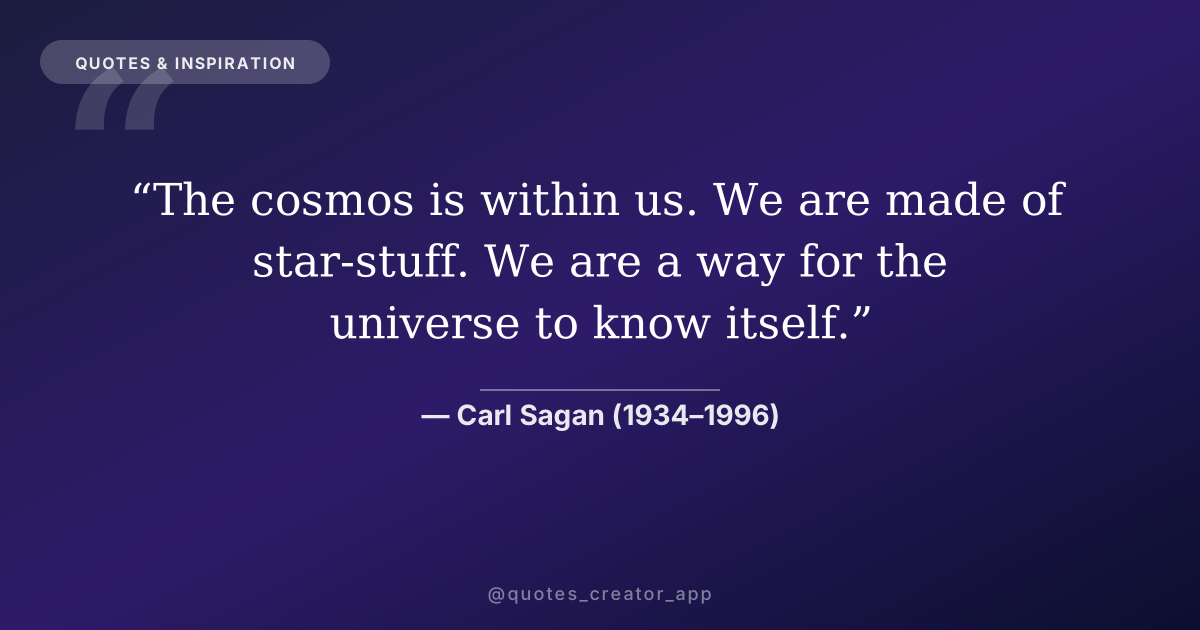
“The cosmos is within us. We are made of star-stuff. We are a way for the universe to know itself.”
The context
Carl Sagan delivered these words during his landmark 1980 television series Cosmos: A Personal Voyage, which reached over 500 million people across 60 countries and became the most widely watched series in the history of American public television. The show was an audacious undertaking: thirteen hour-long episodes that attempted, in Sagan’s words, to tell the story of “how the cosmos came to be,” from the Big Bang to the emergence of human consciousness. Sagan, a Cornell astronomy professor who had already played key roles in NASA’s Mariner, Viking, and Voyager missions, was not merely popularizing science. He was attempting something far more ambitious: to give a secular, scientifically grounded answer to questions that had historically belonged to religion and philosophy. Why are we here? What is our place in the universe? What should awe look like after Darwin and Hubble?
The context that produced this specific line matters because it reflects a genuine scientific discovery that many of Sagan’s viewers were hearing for the first time. The insight that living things are literally made of elements forged in the cores of stars had been established only a few decades earlier, in a landmark 1957 paper by Fred Hoyle, Margaret Burbidge, Geoffrey Burbidge, and Willy Fowler. They demonstrated that nearly all elements heavier than hydrogen and helium — the carbon in our cells, the nitrogen in our DNA, the calcium in our bones, the iron in our blood — were manufactured through nuclear fusion in the interiors of massive stars and then scattered across the galaxy when those stars exploded as supernovae. Sagan was telling his audience, in language that could reach a non-specialist, that the boundary between “us” and “the universe” was an illusion. The iron in your blood was once inside a star that detonated billions of years ago. That was not metaphor; it was meticulously measured fact.
Sagan’s genius as a communicator lay in his refusal to separate the scientific fact from its emotional and existential implications. Most science writers of his generation felt the need to keep the poetry at arm’s length, as if admitting that the stars make you feel something would undermine your credibility as a rigorous thinker. Sagan did the opposite. He recognized that the facts themselves, stated plainly, were the most powerful source of wonder available. When he told his viewers that they were literally made of star-stuff, he was not embellishing a dry textbook claim. He was giving them what he believed to be the most majestic and humbling truth science had ever uncovered, and he was delivering it in a tone of quiet, almost reverent, certainty that made you stop and feel the weight of what he had just said.
The meaning
Sagan’s sentence unfolds in three movements, each building on the one before it. The first — “The cosmos is within us” — is the most counterintuitive and therefore the most important. It inverts the ordinary human experience of looking outward at the night sky as something distant, separate, and indifferent. Sagan insists that the cosmos is not “out there” while we are “in here.” The atoms that compose your body came from the same reservoir of matter that produced every planet, star, and galaxy. The same physical laws that govern the orbit of a comet govern the firing of a neuron. The separation between self and universe is a convenient perceptual shortcut, not a description of reality. When you look at the stars, you are not an observer standing apart from the show. You are a piece of the show looking at itself.
The second movement — “We are made of star-stuff” — is the scientific core that grounds the philosophical claim. Before the first generation of stars formed, the universe contained essentially nothing but hydrogen, helium, and a trace of lithium. Every atom of carbon, oxygen, nitrogen, phosphorus, and iron that makes biology possible was forged by the pressure and heat inside a star that later exploded. The calcium in your teeth, the oxygen you are breathing right now, and the carbon that forms the backbone of every protein in your body were all synthesized billions of years ago in stellar furnaces and scattered across space by supernova shockwaves. Sagan’s phrase “star-stuff” is so elegant precisely because it sounds like poetry, but it is journalism. It reports a literal, physical fact about the provenance of the matter inside you. The poetry is built into the physics.
The third movement — “We are a way for the universe to know itself” — is where Sagan makes his boldest leap, and it is the part of the line that most people remember. After establishing that we are continuous with the cosmos rather than separate from it, he asks what it means that a piece of the universe has become conscious. Human beings, and possibly other forms of life elsewhere, represent a moment at which the universe stops merely being and starts noticing that it is. Through our eyes, the cosmos can observe its own spiral galaxies. Through our instruments, it can measure its own microwave background radiation. Through our equations, it can model its own origins. Consciousness is not a supernatural intrusion into a mindless material universe. It is what the universe does when it reaches a certain level of complexity. Sagan is not saying something vague about “oneness.” He is saying something concrete: that the emergence of life and mind is the mechanism by which a physical universe becomes self-aware.
Why it still matters today
In an age of climate crisis, ecological collapse, and a widening chasm between scientific knowledge and public policy, Sagan’s line has only grown more urgent. The dominant narrative of modern industrial civilization treats nature as a resource to be extracted and the planet as a temporary platform for human ambition. Sagan’s perspective dismantles this narrative at its root. If you are literally made of the same material as every mountain, ocean, and ecosystem, then the destruction of the natural world is not an economic externality. It is a form of self-annihilation, conducted in slow motion by a species that has forgotten what it is made of. The environmental movement has often struggled to bridge the gap between data and motivation — to make people care about rising CO² levels not just as a policy problem but as a violation of something sacred. Sagan’s framing offers a way through that impasse. It gives you a reason to protect the planet that is not based on fear or utility but on identity. You are the planet, temporarily arranged into a person.
The line also speaks powerfully to a crisis of meaning that has become pervasive in secular societies. As traditional religious frameworks have receded in much of the developed world, many people have found themselves without a compelling story about what human life is for, and the available alternatives — consumerism, careerism, nationalism — have proven emotionally and spiritually thin. Sagan offers a different foundation for awe, one built entirely on publicly verifiable facts. You do not need a scripture to feel that your existence is miraculous. You only need to understand, in your bones, that the iron in your hemoglobin was forged in a supernova, that the water in your cells once drifted through interstellar clouds, and that the fact you can read these words at all means you are a piece of the universe that woke up. Sagan’s vision does not compete with religion, but it does provide an alternative architecture for the experience of reverence, one that requires no leap of faith beyond the evidence already available to anyone who looks through a telescope or a microscope.
How to apply this in your own life
The first practical lesson of Sagan’s quote is the discipline of re-embedding yourself in the physical world. It is remarkably easy, especially in a digital age, to live as though the body and the planet are abstractions. You can go weeks without touching soil, without looking at the night sky, without remembering that the air in your lungs was exhaled by trees. Sagan’s line is an invitation to reverse that drift. You can choose, today, to do something that reminds you of your material connection to the cosmos. Step outside and look at the stars for five minutes without a phone. Put your hand on a tree and think about the fact that you and the tree are built from atoms that came from the same exploding star. Read one article about a recent discovery in astronomy or evolutionary biology. The point is not to become a scientist. The point is to stay awake to a fact that is easy to forget: that you are not a spectator of the universe but a temporary expression of it.
The second lesson is about perspective. Most of what we spend our days worrying about — status, reputation, the accumulation of things, the thousand small dramas of social life — shrinks to near-invisibility when held up against the scale of cosmic time and the improbability of our existence. Sagan was not asking his audience to abandon their daily concerns. He was asking them to hold those concerns at the right distance, to remember that a human life is both infinitely precious and cosmically brief, and to let that dual awareness guide how they spent their attention. If you are, in fact, a piece of the universe that has temporarily become conscious, the question of what to do with your consciousness is not trivial. It is the only question that matters. Sagan’s line does not answer it for you, but it gives you the right scale on which to ask, and it reminds you that whatever answer you arrive at, you are answering on behalf of a universe that took thirteen billion years to produce you.
Create your own quote graphic with this quote
Some quotes are worth more than words. When you pair Sagan’s cosmic perspective with thoughtful design, you create something people want to save, share, and return to. Quotes Creator gives you the tools to turn this quote into a beautiful graphic — custom fonts, gradient backgrounds, and export sizes for every platform.
Why we chose this quote
Carl Sagan’s three-sentence declaration from Cosmos is arguably the most elegant fusion of scientific fact and existential meaning in the English language. Most quotes that try to do what Sagan does here collapse into one of two failures: they either state a scientific truth without connecting it to human experience, or they say something emotionally stirring that has no factual anchor. Sagan manages, in forty-four words, to give you the evidence and the awe at the same time. The line has been quoted by astronomers, poets, theologians, and astronauts. It appears on posters in high school science classrooms and on tattoos. It endures because it tells a true story about who we are and where we come from, and because it is one of the rare pieces of writing that makes you feel, viscerally, that the true story is more astonishing than any fiction. We chose this quote because understanding it fully — the physics behind it, the philosophy inside it, and the emotional response it reliably provokes — is its own kind of education in how to think about your place in the universe.
— ThinkPeak Studio Editorial Team
Create your own quote graphic with this quote
Turn this line into a shareable graphic in seconds — free, no signup needed. For video quotes and 100+ templates, try the Android app.
Advertisement
Enjoyed this article? Get more like it in your inbox.