Quote Explained: “Everything has beauty…”
By Confucius, ancient Chinese philosopher
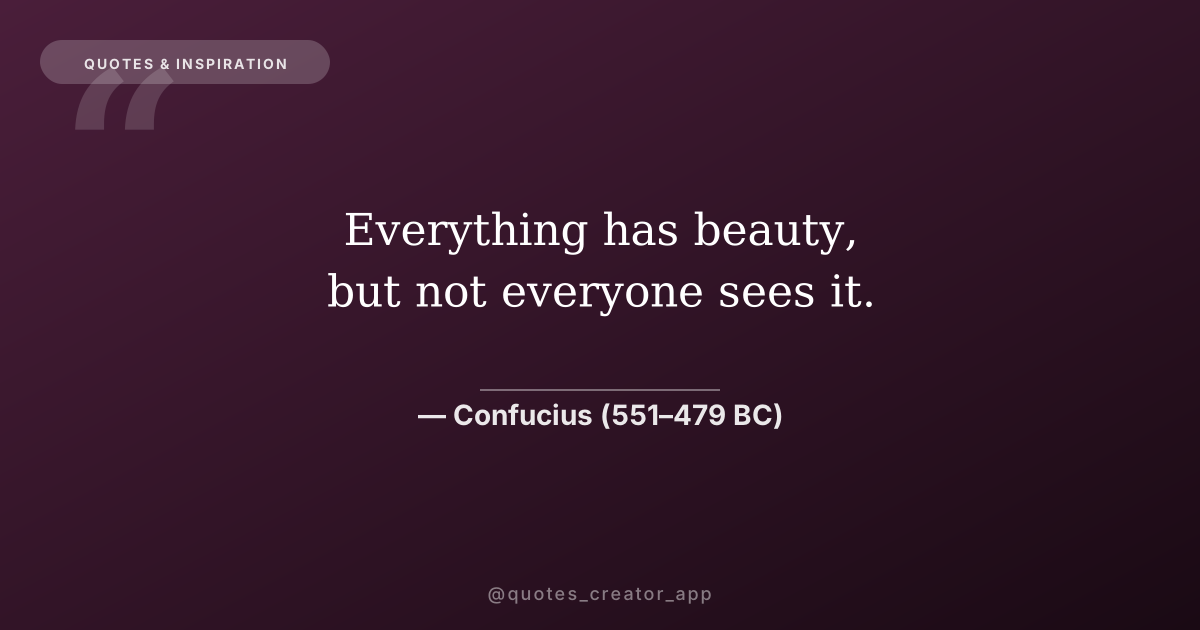
“Everything has beauty, but not everyone sees it.”
The context
Confucius lived in a time of chaos. Born in 551 BC in the state of Lu, in what is now Shandong province, he came of age during the Spring and Autumn period of Chinese history — an era defined by political disintegration, constant warfare between rival states, and the slow collapse of the Zhou dynasty’s moral authority. The social order that had governed Chinese life for centuries was crumbling, and the question that consumed Confucius was not abstract philosophy but an urgent practical one: how do you rebuild a society when its foundations have eroded? His answer, developed over decades of teaching and eventually compiled by his disciples as the Analects, was radical in its simplicity. You do not begin by reforming institutions. You begin by reforming the individual — by cultivating the capacity to see and respond to the world with wisdom, compassion, and attention.
It is within this framework of personal cultivation that the quote finds its deepest resonance. Confucius was not speaking as an art critic or an aesthete, concerned with galleries and masterpieces. He was speaking as a moral philosopher who believed that the quality of a person’s life is inseparable from the quality of their perception. To him, beauty — a term the Chinese language captures with the character 美 (měi), which connotes not just aesthetic appeal but moral goodness and harmonious proportion — was not a luxury reserved for poets and painters. It was a fundamental feature of reality, woven into the fabric of existence, available to anyone who had cultivated the eyes to see it. The tragedy, as he diagnosed it, was not that the world was ugly or mundane. It was that people moved through it without ever learning how to look.
The context of the Analects itself is important for understanding the quote’s weight. The text is not a systematic treatise but a collection of fragmentary dialogues, observations, and aphorisms, recorded by disciples who had spent years sitting at the master’s feet. The elliptical, sometimes cryptic quality of many passages is not a defect of transmission but a deliberate pedagogical strategy. Confucius rarely told his students what to think. He showed them how to think, how to observe, how to draw connections between what they saw and how they lived. When he said that everything has beauty but not everyone sees it, he was not dispensing a comforting platitude. He was issuing a challenge. The burden, he insisted, falls on the observer, not on the observed. If you cannot find beauty in the world around you, the deficit is yours, not the world’s.
The meaning
At its most literal level, the quote is a statement about the unequal distribution of the capacity for aesthetic perception. Some people can stand before a sunset or a painting or a piece of music and be moved to the core; others will pass by, barely registering what is before them, their attention consumed elsewhere. But Confucius is not interested in grading people on their sensitivity like an art school admissions committee. He is making a far more consequential claim about the relationship between perception and the good life. To be capable of seeing beauty is not a genetically determined trait or a matter of luck. It is a skill, something that can be developed through practice and discipline, and the person who has not developed it is not merely missing out on pleasant experiences. They are, in Confucian terms, living an impoverished life — morally impoverished, not just aesthetically so — because they are disconnected from one of the primary ways that reality communicates its value to human beings.
The word “everything” in the quote carries an enormous philosophical weight that casual readers often overlook. Confucius is not saying that some special category of objects — paintings, landscapes, symphonies — possesses beauty. He is saying that beauty is a property of everything, of the ordinary and the overlooked, the humble and the plain, the daily routines and the mundane objects that constitute most of a human life. This is a radically democratic vision of beauty, one that refuses to restrict it to the extraordinary and the elite. The implication is profound: if beauty is present in everything but only perceived by some, then the difference between a life that feels rich and meaningful and a life that feels empty and gray is not a function of circumstance. It is a function of attention. Two people can inhabit identical external conditions, and one can experience life as a landscape of constant small marvels while the other experiences it as a dull corridor of obligations. The external world is the same. The internal capacity to perceive its beauty is what differs.
There is also a quiet subversion in the quote that becomes visible when you place it alongside the dominant values of Confucius’s own society — and, for that matter, ours. The aristocracy of ancient China, like elites in every era, spent enormous energy on the conspicuous display of expensive and rare objects: jade ornaments, bronze vessels, silk robes. The implication was that beauty was something you bought, something scarce, something reserved for those with rank and resources. Confucius, who was born into a family of declining fortunes and spent much of his life as a wandering teacher of modest means, effectively tells his students that this entire framework is wrong. Beauty is not rare; it is everywhere, impossibly abundant. What is rare is the trained capacity to perceive it. That training does not require money or status. It requires the deliberate cultivation of attention, which anyone can undertake. In a single sentence, Confucius democratizes access to one of the deepest sources of human fulfillment and quietly indicts the wealthy for mistaking their collections for actual perception. You can own a gallery of masterpieces and still, in the only sense that matters, be blind.
Why it still matters today
The modern world has engineered an environment that is, in many ways, precisely calibrated to prevent the kind of perception Confucius described. The average person now consumes more visual stimuli in a single day than a medieval peasant encountered in a lifetime. Social media feeds, streaming platforms, digital advertisements, and the general churn of the attention economy have created a condition of permanent visual saturation. And yet, paradoxically, people report feeling less moved by beauty, less awed by the world, than at almost any point in recorded history. The reason is not complicated. Beauty requires a certain quality of attention to register — a stillness, a receptivity, a willingness to let something make an impression on you before you swipe past it to the next thing. The digital environment trains precisely the opposite habit. It trains rapid scanning, shallow processing, and instantaneous judgment, all of which are antithetical to the kind of looking that Confucius had in mind. The result is a generation that has access to more images of beautiful things than any in history, and yet struggles to actually feel beauty.
The relevance of Confucius’s insight also extends into the growing mental health crisis that characterizes the twenty-first century, particularly among young people. Researchers studying the psychology of well-being have identified a construct they call “the capacity to savor” — the ability to notice, appreciate, and prolong positive experiences. People who score high on measures of savoring consistently report higher life satisfaction, lower depression, and greater resilience in the face of adversity. The connection to Confucius’s maxim could hardly be more direct. Savoring is, at root, the trained perceptual habit of locating and dwelling on what is good, what is beautiful, what is worthy of appreciation in the stream of ordinary experience. It is exactly what Confucius was urging his students to cultivate two and a half thousand years ago. The modern person who cannot put down their phone long enough to notice the quality of light through a window, or the sound of rain, or the expression on a friend’s face, is not suffering from a lack of beauty in their environment. They are suffering from an atrophied capacity to see it, which Confucius would have diagnosed as a moral and spiritual problem, not just a psychological one.
How to apply this in your own life
The practical application of this quote begins with a single countercultural commitment: to slow down enough to actually look. This sounds almost embarrassingly simple, but simplicity is not the same as ease, and in an environment engineered for constant acceleration, choosing slowness is genuinely difficult. The exercise is straightforward. Pick one ordinary object or scene each day — a cup of tea, a tree outside a window, the grain of wood on a desk, a piece of music, a face in a crowd — and give it five minutes of uninterrupted attention. Do not analyze it. Do not try to produce anything from the experience. Do not photograph it for social media. Simply look, listen, or attend, with the kind of receptive openness that allows the object to make its full impression. At first, this will feel uncomfortable, even boring. The mind will protest and reach for distraction. That protest is itself the evidence of how deeply the habit of inattention has been trained. Over weeks and months, the capacity expands. The world begins to offer itself differently, to reveal textures and relationships and harmonies that were always there but were drowned out by the noise of perpetual mental commentary.
The second, more demanding application involves translating this perceptual discipline into the moral sphere, which is where Confucius ultimately intended it to land. The same principle that applies to aesthetic beauty applies to the beauty of other people — not in a physical sense, but in the sense of seeing their humanity clearly, their struggles, their quiet virtues, their hidden dignity. Most interpersonal friction, most resentment, most of the casual cruelty that marks daily life, arises from the failure to truly perceive the person in front of you. You see a rude cashier rather than an exhausted human being at the end of a double shift. You see an annoying colleague rather than someone fighting a private battle you know nothing about. You see an obstacle rather than a person. Confucius’s claim that beauty is present in everything but not everyone sees it applies here with full force. The person who has trained their perceptual capacity does not merely enjoy more sunsets and symphonies. They find themselves increasingly incapable of dismissing anyone as irredeemably ugly, because they have learned to look past the surface into the deeper structures of need, effort, and vulnerability that constitute a human life. That, in the end, was the whole point. The cultivation of perception was never just about art. It was about learning to see the world, and the people in it, in a way that makes love possible.
Create your own quote graphic with this quote
This is the kind of quote that rewards slowing down and sitting with it. When you pair timeless words with thoughtful design, you create something people want to save, share, and return to. Use our free online quote maker to turn this exact quote into a shareable image in seconds — no signup needed. For advanced features like video quotes and 100+ templates, try the Quotes Creator Android app.
Why we chose this quote
Confucius occupies a strange place in modern culture. His name is universally recognized, but the substance of his thought is rarely engaged beyond fortune-cookie clichés. This particular quote has circulated widely on social media and in self-help literature, often reduced to a vague encouragement to “stay positive.” We wanted to recover the original philosophical force of the sentence — to show that it is not about looking on the bright side but about fundamentally reorienting the way a person relates to the act of perception itself. In an age of attention scarcity, where the ability to genuinely perceive the world has become a contested resource, Confucius’s insistence that beauty is a function of trained attention rather than external circumstance feels less like ancient wisdom and more like a survival strategy for people who want to remain fully human in a machine-optimized environment.
— ThinkPeak Studio Editorial Team
Create your own quote graphic with this quote
Turn this line into a shareable graphic in seconds — free, no signup needed. For video quotes and 100+ templates, try the Android app.
Advertisement
Enjoyed this article? Get more like it in your inbox.