Quote Explained: “Realize deeply that the present moment is all you ever have.”
By Eckhart Tolle, author of The Power of Now
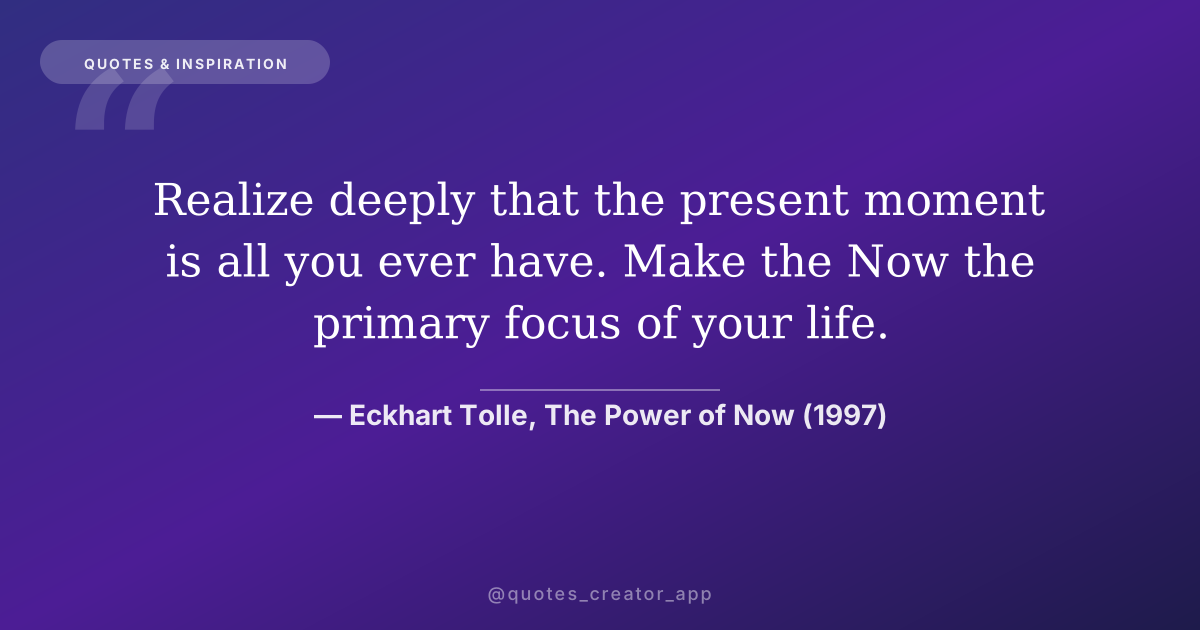
“Realize deeply that the present moment is all you ever have. Make the Now the primary focus of your life.”
The context
The origin of this quote is not a philosophy seminar but a breakdown. Eckhart Tolle was born Ulrich Leonard Tölle in Lünen, Germany, in 1948, and spent his early adulthood in a fog of anxiety and depression. By his own account, he was so consumed by dread and self-loathing that, at the age of twenty-nine, he reached a tipping point. Lying awake one night, he thought a sentence that would change everything: “I cannot live with myself.” And then, in a flash of clarity, a second thought followed it — who is the “I” that cannot live with “myself”? If there is an “I” and a “myself,” he realized, there must be two of him: the thinker and the voice the thinker observes. That single question collapsed the identity he had been carrying. In the silence that followed, what remained was not a depressed man but a vast, quiet awareness, and the years of suffering simply dissolved.
The insight he stumbled into that night became the foundation of a book that was initially all but impossible to publish. For years, Tolle lived quietly in England, carrying a teaching that had no obvious market — until he wrote The Power of Now, which was published in Canada in 1997 and released by New World Library in the United States in 1999. It sold modestly at first, then took off by word of mouth with a velocity no publisher predicted. When Oprah Winfrey championed the book — and later his 2005 follow-up, A New Earth, as the subject of a global online book club that drew millions of participants — Tolle became one of the most influential spiritual voices of the twenty-first century, translated into dozens of languages and read by people far beyond any traditional religious audience. The quote at its heart is the book’s thesis in a single breath: an instruction to stop postponing life for a future that never arrives.
To understand why the line landed, you have to see what it was up against. The culture Tolle was writing into had spent centuries organizing itself around the future — progress, achievement, the next goal, the next acquisition, the better version of yourself that lives somewhere just ahead. Even spirituality had become a future project: something to attain, a state to reach someday. Tolle arrived at a moment when that bargain was showing its cracks. Rates of anxiety, burnout, and a diffuse, unnameable dissatisfaction were climbing in the most prosperous societies on earth. People had more of everything and less peace. Tolle’s insight was that the problem was not what they lacked but where they lived — almost entirely in memory and anticipation, almost never in the only moment that actually exists. The quote became a corrective to an entire civilization that had forgotten how to be where it is.
The meaning
The sentence does its work through a single, quietly radical verb: realize. Tolle is not asking you to believe anything, adopt a doctrine, or force yourself to feel grateful for the present. He is asking you to see something — to notice a fact about existence that has been true the entire time. The past is a collection of thoughts; the future is a projection of thoughts. Neither can be touched, and neither has ever been anything but a mental event occurring in the here and now. When you actually look for a time other than now, you cannot find one. The present moment is not a sliver between past and future; it is the whole of experience. Past and future, Tolle insists, have no reality of their own. They are the mind borrowing the present to replay what is gone and rehearse what may never come.
What the quote really dismantles is the assumption that we are our thinking minds. The mind, Tolle argues, is a magnificent tool but a terrible master — and left unchecked, it runs a nearly continuous commentary of worry, comparison, regret, and craving that keeps us perpetually absent from our own lives. This is the deeper meaning of “all you ever have.” It is not a phrase of scarcity but of radical sufficiency. Everything that has ever happened to you — every joy, every connection, every moment of beauty — happened now, when you were present enough to receive it. The tragedy is that we are so busy thinking about life that we miss living it. To “make the Now the primary focus” is therefore not a technique of relaxation; it is a reordering of consciousness itself, a shift from being lost in thought to being the awareness in which thoughts arise and pass.
Beneath this lies a subtle point most casual readers miss: the quote is not anti-thinking and not anti-planning. Tolle distinguishes between clock time — the practical use of past and future to navigate life, keep appointments, learn from mistakes, and pursue goals — and psychological time, the compulsive habit of mentally living in memory and expectation, where most human suffering is manufactured. You can plan a trip in clock time and be entirely present; you can sit in silence and be tortured by psychological time. The quote is a diagnosis of where suffering actually lives. It tells us that anxiety is almost always a story about a future that is not here, and regret a story about a past that is already gone — and that both dissolve the instant you return your attention to what is, here, in front of you. Realizing this is not escapism. It is the most practical thing a person can do.
Why it still matters today
In 2026, the quote has never been more urgent, because the environment has been engineered to extract our attention from the present moment and never return it. The attention economy is, in Tolle’s terms, a psychological-time machine: every notification, feed, and autoplay is designed to pull awareness out of the now and into a loop of anticipation, comparison, and craving. We check our phones not because the moment contains something we want but because it does not — and the device offers a reliable escape from the very presence Tolle says is our only home. The result is a population that is physically present and mentally absent, scrolling through other people’s curated futures while missing the only life it actually has. Tolle’s instruction to make the Now the primary focus reads less like spiritual advice and more like a survival strategy for a distracted age.
The quote also speaks directly to a cultural crisis of meaning that no amount of achievement has resolved. We live in the most comfortable, connected, and productive era in human history, and yet reported rates of anxiety, depression, and loneliness keep rising. Tolle’s diagnosis explains why: meaning is not found in the future, so pursuing more future — more goals, more milestones, more progress — cannot produce it. It is found only in presence, in the quality of attention you bring to what is already here. A sunset, a conversation, a breath — each is infinitely meaningful when fully inhabited and entirely meaningless when missed. In an era that treats busyness as virtue and distraction as default, the sentence is a bracing reminder that the life you are always preparing to live is the one you are, right now, failing to live.
How to apply this in your own life
The practical application begins with the smallest possible unit of attention: the breath. When you notice the mind pulling you into worry about tomorrow or rumination over yesterday, use the body as an anchor back to the now — feel your hands, your feet on the floor, the air moving in and out of your lungs. The body, Tolle observes, cannot be in the future or the past; it is always here. This is why so many of his exercises begin with sensing the inner energy field of the body, which he calls the inner body. The discipline is not to silence thought — which is impossible — but to become the witness of thought, to watch it arise without being swept away by it. Each time you do this, even for a few seconds, you are practicing the sentence itself: you are realizing, again, that the present moment is all you ever have.
The deeper application is a reordering of how you pursue everything else in your life. Goals remain useful — Tolle does not ask you to abandon ambition — but they must stop being the place you live. The common pattern is to treat the present as a mere stepping stone to a future that will finally be good enough, which guarantees that it never is, because the moment of arrival instantly becomes another now to be escaped. The invitation of the quote is to invert this entirely: make the quality of your attention, right now, the measure of your life, and let your goals become directions rather than destinations. You may or may not reach them, but you will no longer have missed your life on the way. That is why the sentence endures — it is not a trick for managing anxiety, but a way of understanding, with unsparing clarity, that the only moment you ever have is this one, and that living anywhere else is living nowhere at all.
Create your own quote graphic with this quote
Few ideas reorder the way you experience time and attention the way this one does. When you pair a realization this clarifying with thoughtful design, you create something worth saving and returning to. Use our free online quote maker to turn this exact quote into a shareable image in seconds — no signup needed. For advanced features like video quotes and 100+ templates, try the Quotes Creator Android app.
Why we chose this quote
Eckhart Tolle is often dismissed as a wellness brand — a calming voice on meditation apps and airport bookshelves — which is exactly why his central idea deserves a closer look. We wanted to treat the quote as what it actually is: not a slogan about relaxing, but a complete account of where suffering lives and how it dissolves. The sentence is rare in that it is both a metaphysical claim and a practical one — it explains why anxiety and regret are manufactured by the thinking mind, and it hands you the one tool that actually works against them, which is attention, returned to the only place it can ever live. In a culture that is drowning in distraction and starving for presence, it is a reminder that the life you keep postponing is the one unfolding, unmissed or unnoticed, in this very moment. That is why it stays with people long after the page is turned.
— ThinkPeak Studio Editorial Team
Create your own quote graphic with this quote
Turn this line into a shareable graphic in seconds — free, no signup needed. For video quotes and 100+ templates, try the Android app.
Advertisement
Enjoyed this article? Get more like it in your inbox.