Quote Explained: “No one can make you feel inferior without your consent.”
By Eleanor Roosevelt, American diplomat, activist, and longest-serving First Lady
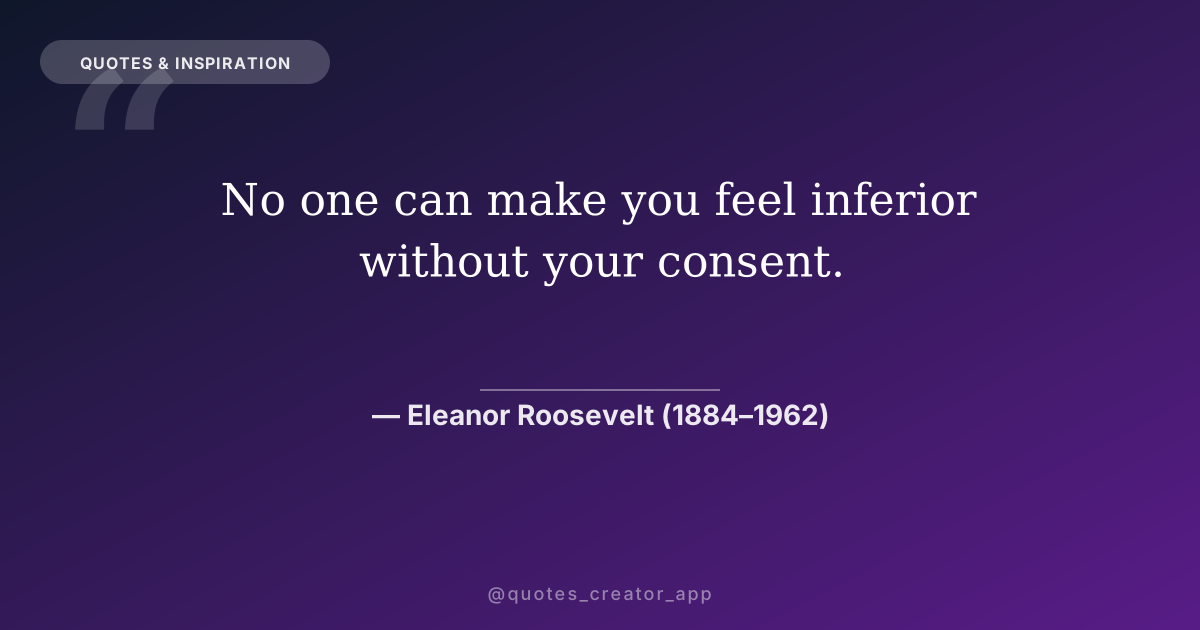
“No one can make you feel inferior without your consent.”
The context
Anna Eleanor Roosevelt was born in 1884 into one of the most prominent families in American life. Her uncle was Theodore Roosevelt, the twenty-sixth president of the United States. But her childhood, for all its aristocratic trappings, was marked by profound emotional hardship. Her mother, Anna Hall Roosevelt, was a celebrated beauty who openly mocked young Eleanor for her plainness, calling her “Granny” in front of guests. “She always made me feel so conscious of my own shortcomings,” Roosevelt would later write. Her father, Elliott Roosevelt, was an alcoholic whose warmth and charm alternated unpredictably with neglect and absence. By the age of ten, Eleanor had lost both parents — her mother to diphtheria, her father to the long consequences of addiction — and had been sent to live with a grandmother who offered stability but little affection. She entered adolescence already acquainted with the feeling the quote would one day name: the crushing sense that others had the power to define her worth.
The arc of her adult life reads as a sustained, deliberate refutation of that early verdict. She married her fifth cousin, Franklin Delano Roosevelt, in 1905, and within a decade found herself navigating not only the demands of political life but also a profound personal betrayal: her husband’s affair with her own social secretary, Lucy Mercer, discovered in 1918. The marriage survived, but it was transformed. From that point forward, Eleanor increasingly built a life and a career independent of Franklin’s, becoming an activist, a journalist, and — from the moment she became First Lady in 1933 — the most publicly visible woman in the United States. She held 348 press conferences during her White House tenure, all of them restricted to female reporters, forcing newspapers to hire women. She toured the country during the Great Depression as Franklin’s eyes and ears, visiting coal mines, slums, and migrant labor camps, and reporting back. She was attacked relentlessly — by the press, by political opponents, by segregationists threatened by her open advocacy for civil rights — and she absorbed it all while continuing to speak, to write, and to act.
After Franklin’s death in 1945, Eleanor Roosevelt did not retreat into private life. She was appointed a delegate to the newly formed United Nations by President Harry Truman and was elected chair of the UN Commission on Human Rights. It was in that role that she oversaw the drafting of the Universal Declaration of Human Rights — arguably the single most important document in the history of international human rights law. The woman who had been told as a child that she was ugly and unworthy became the architect of the world’s foundational statement on the dignity of every human being. The quote “No one can make you feel inferior without your consent” comes from this woman — not from someone who had never been belittled, but from someone who had been belittled her entire life and had learned, through decades of disciplined self-construction, that inferiority is a feeling others can only impose if you agree to carry it.
The meaning
At first reading, the sentence is a piece of practical psychological advice: do not let other people’s opinions dictate how you feel about yourself. Ninety-nine percent of people who clip and share this quote understand it exactly that way, and that reading is valid. But closer analysis reveals a far more radical claim. Roosevelt is not merely asserting that you shouldn’t feel inferior when someone insults or dismisses you. She is asserting that another person literally cannot generate the feeling of inferiority inside you without your participation. The word “consent” is doing the heavy lifting here. Consent is a legal and moral concept with far greater weight than simple permission. It implies agency, awareness, and the presence of a real choice. By framing inferiority as something that requires your consent, Roosevelt is saying that your self-worth is not a thing that can be taken from you; it can only be surrendered by you. This is a radical relocation of power from the external world to the internal self.
The second layer is philosophical and, like much of Roosevelt’s thinking, deeply influenced by the democratic and human-rights frameworks she spent her later life institutionalizing. The quote implicitly draws a distinction between what happens to you — other people’s words, actions, and judgments — and what happens within you in response. That gap is the space of human agency. In the Universal Declaration of Human Rights, Roosevelt inscribed the principle that “recognition of the inherent dignity and of the equal and inalienable rights of all members of the human family is the foundation of freedom, justice and peace in the world.” Her quote extends that same principle inward. Dignity is not something conferred by the world. It is something inherent, something already present. When someone tries to make you feel inferior, what they are actually trying to do is make you forget that your dignity exists independently of their opinion. To refuse consent is to remember. It is to say: you do not have the power to define me.
There is a third, subtler layer that is often missed, and it concerns the difference between feelings and facts. Roosevelt does not say “no one can make you inferior.” She says “no one can make you feel inferior.” The distinction matters. She is not denying that other people can treat you as inferior — ignore you, devalue you, exclude you, attack you. She experienced all of that and more. What she is denying is that their treatment of you has the inherent power to determine your internal experience of yourself. The feeling of inferiority is a subjective state, not an objective condition. It arises from a judgment you pass on yourself, not from a fact about the world. And that is why consent matters: because the only person who can authorize that judgment is you. This is an extraordinarily empowering claim. It says that even in situations where you are objectively powerless — where someone has authority over you, where you are being publicly shamed, where the whole world seems aligned against you — the one domain that remains yours is the interior domain of self-evaluation. You can be silenced and still know your worth. You can be excluded and still belong to yourself.
Why it still matters today
The quote has taken on a particular urgency in the age of social media, where the machinery of public judgment operates at an unprecedented scale and speed. Every day, billions of people are subject to unsolicited evaluation — likes, comments, follower counts, comparison metrics that code directly into our psychology the idea that our worth is a number determined by strangers. The architecture of social media platforms is, in effect, an industrial-grade consent-manufacturing machine. It trains you to feel inferior unless you perform well by metrics you did not choose and cannot fully control. Roosevelt’s quote, read in this context, is a kind of counter-algorithm. It refuses the premise that your value is up for external determination at all. It says the metric does not own you. The comment does not define you. The feeling of inferiority that follows from a post that flopped or a comparison that stung is not inevitable — it requires your consent, and you can learn, with practice, to withhold it.
Beyond the digital realm, the quote speaks directly to the systemic inequalities that Roosevelt spent her public life fighting. When a society treats someone as inferior on the basis of race, gender, class, or any other marker, it is not enough to say “just don’t consent to feeling that way.” Roosevelt would be the first to acknowledge that structural oppression is real and that political action is necessary to dismantle it. But there is a profound difference between acknowledging the reality of external oppression and internalizing its logic. The quote offers a strategy for survival within systems that will not change overnight: refuse to absorb the contempt the system directs at you. Do not volunteer your spirit to a world that undervalues it. This is the difference between being victimized and seeing yourself as a victim. You can be harmed by unjust structures without ceding your core belief that you are a human being of full and equal worth. Roosevelt lived that truth, and the institutions she built — from the United Nations to the Democratic Party’s women’s division — were designed to give others the conditions in which that truth could be lived at scale.
How to apply this in your own life
The first and most immediate application is a practice of strategic refusal. The next time someone says something that triggers a spike of shame, defensiveness, or self-doubt, pause before you react. Notice the feeling without judgment, then ask a simple question: who is in charge of this feeling right now? If the answer is the person who insulted you, you have given your consent. If the answer is you — because you are choosing how to respond, because you are separating their words from your worth, because you are deciding what this moment means — then you have withheld it. This pause is not about suppressing the emotion. Suppression is a form of denial, and denial is just another way of granting power. The practice is about interception: catching the automatic link between external stimulus and internal verdict before it fires, and inserting a moment of choice. In that moment, you can ask: does this person’s opinion of me, right now, determine anything true about who I am? If the answer is no, you have already begun to reclaim your consent.
The deeper application is the cultivation of what might be called a consent-aware identity. Over time, the practice of intercepting individual slights builds a kind of psychological immune system. You become less porous to random judgment. You start to notice how much of your emotional energy is spent seeking validation from people who do not actually have the power to validate anything real about you — bosses, strangers online, the imagined audience that lives in your head. Once you see that pattern clearly, you can begin to withdraw consent from the whole apparatus. You can decide that your sense of worth is not up for a vote, not dependent on quarterly performance reviews, not contingent on being liked. This is not arrogance. Arrogance is itself a form of dependence on external judgment: it needs comparison to feel good. What Roosevelt is describing is a quieter, sturdier thing: the simple, unshakeable knowledge that you are a person of inherent worth, and that no force outside your own mind can revoke that status unless you hand it the keys.
Create your own quote graphic with this quote
This is the kind of quote that carries weight. When you pair timeless words with thoughtful design, you create something people want to save, share, and return to. Use our free online quote maker to turn this exact quote into a shareable image in seconds — no signup needed. For advanced features like video quotes and 100+ templates, try the Quotes Creator Android app.
Why we chose this quote
Eleanor Roosevelt’s line about consent and inferiority is one of the most frequently quoted sentences of the twentieth century, but it is rarely examined beyond its surface. We wanted to sit with this quote long enough to let its full architecture become visible — the precision of the legal language, the radical relocation of power from the outside world to the interior self, and the way the entire weight of Roosevelt’s remarkable life stands behind every word. When your own mother calls you ugly and you grow up to chair the commission that writes the Universal Declaration of Human Rights, your assertion that dignity cannot be taken without consent is not an aphorism. It is an autobiography compressed into a sentence. We chose this quote because the world has never been louder, the mechanisms of judgment have never been more pervasive, and the quiet act of withholding consent — of deciding, in the privacy of your own mind, that you are not for sale — has never been more urgent.
— ThinkPeak Studio Editorial Team
Create your own quote graphic with this quote
Turn this line into a shareable graphic in seconds — free, no signup needed. For video quotes and 100+ templates, try the Android app.
Advertisement
Enjoyed this article? Get more like it in your inbox.