Quote Explained: “The only thing we have to fear is fear itself.”
By Franklin D. Roosevelt, 32nd President of the United States
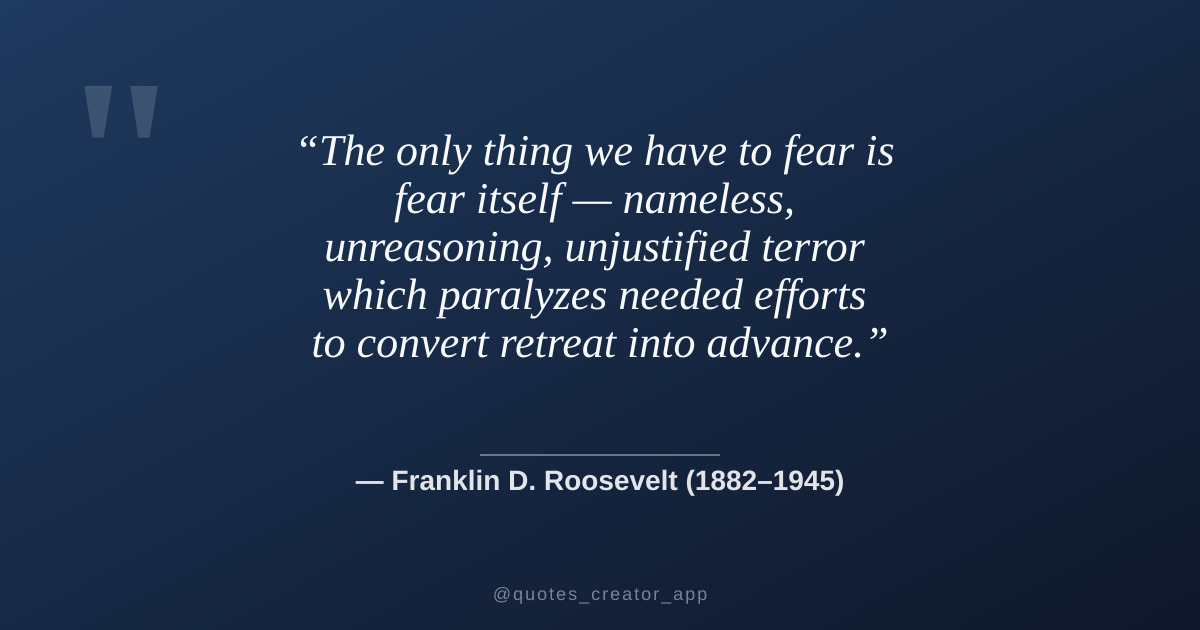
“The only thing we have to fear is fear itself — nameless, unreasoning, unjustified terror which paralyzes needed efforts to convert retreat into advance.”
The context
On March 4, 1933, Franklin Delano Roosevelt stood at the East Portico of the U.S. Capitol to deliver his first inaugural address. It was, by almost every measure, the worst moment for an incoming president in American history since the Civil War. The Great Depression had reached its absolute nadir. Unemployment stood at roughly 25 percent. The banking system had entirely collapsed: over the preceding weeks, panic-stricken depositors had withdrawn their savings in what became known as a “bank run,” and by Inauguration Day, governors in 38 states had declared bank holidays to prevent further collapse. Farmers were losing their land by the thousands. Industrial production had fallen by nearly half. People were starving, and the federal government had no modern safety net to catch them.
Roosevelt brought a particular kind of authority to that podium. A dozen years earlier, at the age of 39, he had been struck by polio, leaving him permanently paralyzed from the waist down. He had spent years relearning how to walk with heavy iron braces and a cane, and he trained his upper body to project the appearance of strength from a wheelchair that the press was careful never to photograph. He understood, in a way few presidents could, what it meant to confront a force that seemed to have total power over your life. The phrase “the only thing we have to fear is fear itself” was not a platitude from a man who had never been tested. It was a declaration from someone who had already beaten a private version of the same enemy.
The address was the first presidential inauguration to be broadcast widely on radio, reaching tens of millions of Americans in their living rooms and kitchens. Roosevelt’s voice — patrician, confident, unhurried — carried an authority that Hoover’s defeated tone had lacked. The reaction was immediate and electric. In the following days, letters poured into the White House. People reported weeping, falling to their knees, and for the first time in years, believing that someone in charge understood what they were feeling. The line about fear became the speech’s enduring centerpiece, not because it was the most concrete proposal — it wasn’t — but because it named, with surgical precision, the emotion that had become the real engine of the crisis.
The meaning
Roosevelt’s sentence appears simple, but its structure is doing three things at once. The first clause — “the only thing we have to fear is fear itself” — is a paradox designed to reorient the listener. It says, in effect, that the primary threat is not the external catastrophe but the internal reaction to it. This was not a denial of the Depression’s reality. Roosevelt opened the speech with “the only thing we have to fear is fear itself” immediately after declaring “this is preeminently the time to speak the truth, the whole truth, frankly and boldly,” and then cataloging the Depression’s toll in unsparing language. The fear he was dismissing was not the fear of hunger or homelessness; it was the secondary, self-amplifying terror that makes things worse by preventing action. He was drawing a line between legitimate fear (a signal) and the runaway version of it (a paralyzing noise).
The second half of the sentence expands and specifies: “nameless, unreasoning, unjustified terror which paralyzes needed efforts to convert retreat into advance.” Each word is chosen with care. “Nameless” suggests a fear that cannot be pinned to a concrete threat — a diffuse anxiety that floats free of any actual danger and attaches itself to everything. “Unreasoning” means it does not respond to evidence; you cannot talk yourself out of it because it does not operate on the same logic as the rest of your mind. “Unjustified” is the most important word: it asserts that the fear, however real it feels, does not correspond to the actual level of threat. And “paralyzes” is the punch — the real crime of this kind of fear is not that it feels bad but that it stops you from doing the things that would actually solve the problem.
There is also a historical irony embedded in the line that Roosevelt almost certainly intended. The Great Depression had been deepened and lengthened by fear itself. Bank runs happened because people were afraid the bank would fail, which caused banks to fail, which justified the initial fear. This is a classic self-fulfilling prophecy, and Roosevelt understood that breaking the cycle required someone in authority to name it, publicly and unmistakably. The line was not just a comfort; it was an intervention. He was asking the American people to see their own fear as a cause of their suffering, not just a reaction to it, and to therefore recognize that they had more power than they thought. If fear was the real problem, then courage was the real solution, and courage was something they could choose.
Why it still matters today
Roosevelt’s formulation has been quoted by nearly every American president since him, and it has become a staple of leadership literature, therapy, and crisis communication. It reappears in predictable cycles — during the 2008 financial crisis, during the COVID-19 pandemic, in the aftermath of terrorist attacks — always in the same role: a reminder that the psychological dimension of a crisis is not secondary to the material one but often determines it. The 2008 crisis was in many respects a replay of the 1930s dynamic: the financial system seized up not because all the assets had suddenly vanished but because fear made everyone stop lending at once, and the stopping of lending caused the losses that the fear had only imagined. Roosevelt’s line still works because the mechanism it describes — fear feeding on itself until it becomes the thing it fears — is wired into human psychology and into the financial and political systems humans build.
In the present moment, the line speaks to a new set of challenges. Climate anxiety, political polarization, algorithmic doom-scrolling, and the pervasive sense of decline that characterizes much of modern discourse are all, in Roosevelt’s terms, varieties of “nameless, unreasoning, unjustified terror.” The specific threats are real, but the diffuse, catastrophic register in which they are often experienced is a product of fear’s tendency to generalize. The line remains relevant because the pattern it identifies is not specific to the 1930s: it is a permanent feature of the human mind, and every generation must learn, again, to distinguish between the signal and the noise, between the legitimate danger and the self-amplifying panic that makes the danger harder to address.
How to apply this in your own life
The first practical lesson of Roosevelt’s line is the discipline of naming your fear. “Nameless” fear is the most dangerous kind because it cannot be examined or answered. When you feel a wave of anxiety about the future, the single most effective move is to articulate the specific thing you are afraid of, in one sentence, on paper. If you cannot name it, it is likely nameless terror rather than legitimate fear, and Roosevelt’s diagnosis says that nameless terror is precisely the kind that does not correspond to reality. Once you have named it, you can ask: is this fear justified by the evidence? Is it helping me act or stopping me from acting? If the answer to the second question is “stopping,” then the fear itself has become the problem, and the most productive thing you can do is act anyway, even imperfectly, to break the paralysis.
The second lesson is about social courage. Fear is contagious, and so is its antidote. Roosevelt understood that a leader’s calm could function as a public good, damping the feedback loop that turns worry into panic. In your own circles — at work, in your family, among your friends — you have the same power. When everyone around you is spiraling into catastrophic scenarios, you can be the person who says, “Let’s name what we are actually afraid of, and let’s see if fear itself is making this worse than it needs to be.” You do not need to be president to break the cycle of self-amplifying terror. You only need to recognize, as Roosevelt did, that the thing we most fear is often the fear itself, and that the first step forward is simply to stop letting it decide what happens next.
Create your own quote graphic with this quote
This is the kind of quote that carries weight. When you pair timeless words with thoughtful design, you create something people want to save, share, and return to. Quotes Creator gives you the tools to turn this quote into a beautiful graphic — custom fonts, gradient backgrounds, and export sizes for every platform.
Why we chose this quote
Roosevelt’s inaugural line is among the most quoted in American history, but it is also among the most misunderstood. Many people remember only the first half — “the only thing we have to fear is fear itself” — and mistake it for a simple declaration that courage is all you need. The full sentence, with its devastating three-adjective description of what fear actually is, reveals a far more sophisticated argument: that the real enemy is a specific kind of runaway fear that has lost touch with reality and is actively preventing the action that would resolve the crisis. We chose this quote because understanding it fully, in its historical and psychological depth, is itself an act of the discipline it recommends. The quote does not just tell you not to be afraid. It teaches you how to recognize the difference between the fear that protects you and the fear that destroys you, which is a skill every generation has to learn for itself.
— ThinkPeak Studio Editorial Team
Create your own quote graphic with this quote
Turn this line into a shareable graphic in seconds — free, no signup needed. For video quotes and 100+ templates, try the Android app.
Advertisement
Enjoyed this article? Get more like it in your inbox.