Quote Explained: “He who has a why to live for can bear almost any how…”
By Friedrich Nietzsche, German philosopher, philologist, and writer
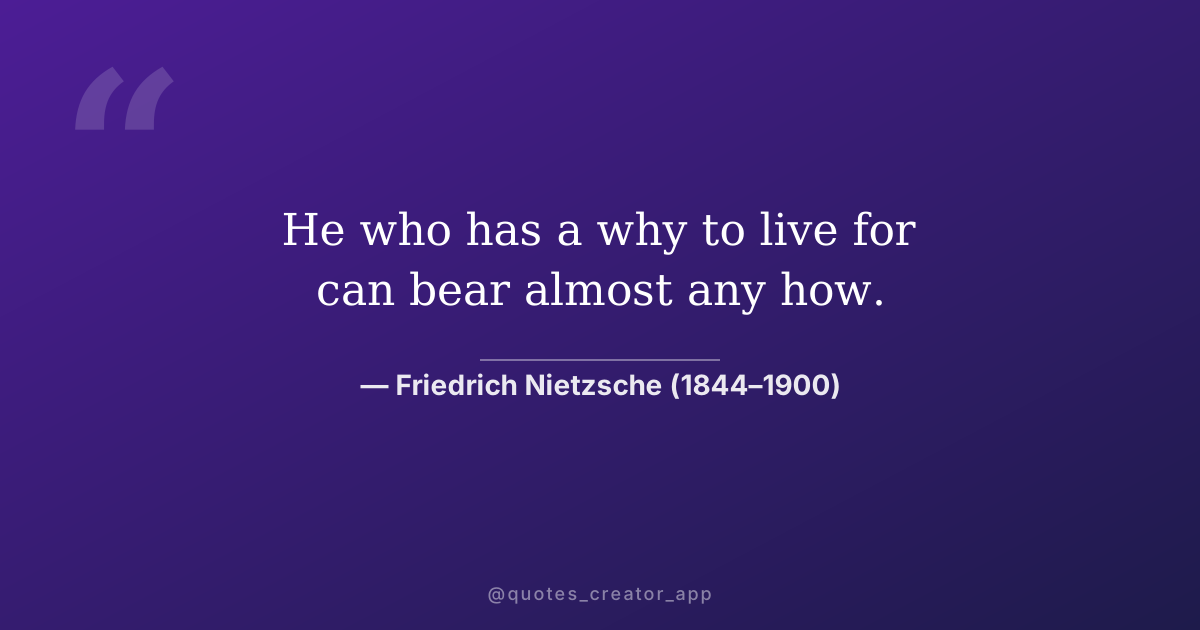
“He who has a why to live for can bear almost any how.”
The context
In the late summer of 1888, Friedrich Nietzsche was 43 years old and living in a modest rented room in Sils Maria, a village in the Swiss Alps. He had resigned his professorship at the University of Basel nearly a decade earlier, driven out by health problems that had plagued him since his twenties: excruciating migraines that could last for days, severe digestive disorders, and deteriorating eyesight that made reading and writing physically agonizing. He had no university salary, no family of his own, and almost no readership. His books sold in the dozens of copies. He paid for their printing himself. And yet the year 1888 would prove to be the most astonishingly productive of his life. Between spring and winter, Nietzsche wrote The Case of Wagner, Twilight of the Idols, The Antichrist, Ecce Homo, and Nietzsche contra Wagner — five books in a single year, written in a state of almost feverish creative intensity while his body continued to fail him.
Twilight of the Idols was written in just over a week, between 26 August and 3 September 1888. Nietzsche described it in a letter as “my philosophy in a nutshell — radical to the point of criminality.” The book’s second section, “Maxims and Arrows,” contains 44 condensed aphorisms, each a self-contained philosophical grenade. Maxim 8 gave the world “What does not kill me makes me stronger.” Maxim 12 delivered a quieter but arguably deeper insight: “He who has a why to live for can bear almost any how.” The original German reads: Hat man sein warum? des Lebens, so verträgt man sich fast mit jedem wie? — literally, “If one has one’s why? of life, one gets along with almost every how?” Nietzsche was not speculating from an armchair. He was writing the autobiography of his own suffering, a man who had found something worth living for and had endured decades of physical torment to keep writing about it.
No one was listening at the time. Twilight of the Idols was printed in January 1889, the very same month Nietzsche suffered his catastrophic mental collapse in Turin. He reportedly saw a horse being flogged in the Piazza Carlo Alberto, rushed to embrace it, and collapsed sobbing. He never recovered. The remaining eleven years of his life were spent in a twilight of his own, first in a Basel asylum, then under his mother’s care, and finally with his sister Elisabeth, who would notoriously distort his legacy to align with her own proto-fascist politics. Nietzsche never saw his books find an audience. He died in 1900, largely unknown. The aphorism he tossed off in a Swiss village in 1888 would have to wait half a century before its truth would be demonstrated in the most gruesome laboratory imaginable — the Nazi concentration camps — by a Viennese psychiatrist named Viktor Frankl.
The meaning
On its surface, the aphorism is a statement about the relationship between meaning and endurance. If you have a compelling reason to get up in the morning — a purpose, a mission, a love, a goal, a person who depends on you — you can withstand almost any form of suffering that the day brings. The “why” is the question of meaning, of what makes a life worth living. The “how” is the question of circumstance: how you live, under what conditions, with what resources, in what degree of comfort or deprivation. Nietzsche’s radical claim is that the second question is almost entirely subordinate to the first. Find a sufficient why, and the how becomes manageable. Fail to find a why, and no amount of comfort will prevent life from feeling unbearable.
The philosophical depth of this idea becomes clearer when you understand what Nietzsche was arguing against. The dominant philosophical tradition of his century, most powerfully expressed by Arthur Schopenhauer, held that life was fundamentally characterized by suffering and that the rational response to this fact was to minimize desire, withdraw from the world, and seek a kind of willed extinction of the self. Nietzsche had been a devoted follower of Schopenhauer in his youth, and the break from that pessimism was the central drama of his intellectual life. Maxim 12 is Nietzsche’s counterargument in its most compressed form: suffering is not the problem. Meaninglessness is the problem. A life of comfort without purpose is more unbearable than a life of suffering with purpose. This was not an abstract philosophical position for Nietzsche. It was the organizing principle of his entire existence — a man who could barely see, whose head throbbed for days at a time, who had no institutional support and no public recognition, and who nevertheless produced some of the most original philosophy in the Western canon because he had a why that could not be extinguished by any how.
The deepest layer of the aphorism is what it implies about human nature. Nietzsche is asserting, against the utilitarians and the hedonists of his day, that human beings are not pleasure-seeking creatures who grudgingly tolerate suffering. They are meaning-seeking creatures who will willingly embrace suffering if it serves a purpose they believe in. This is not a theory. It is an observable fact of human psychology that parents endure sleeplessness for their children, soldiers endure deprivation for their countries, artists endure poverty for their work, and lovers endure distance for the people they love. The question is never “How much will I suffer?” but always “Is it worth it?” Nietzsche was the first philosopher to state this with such crystalline precision, and in doing so he anticipated what would become one of the most important psychological discoveries of the twentieth century.
Why it still matters today
The quote has only grown in relevance as the world has become more comfortable and, paradoxically, more anxious. In much of the developed world, the “how” of life has never been easier: food is abundant, medicine is advanced, entertainment is infinite, physical danger is at historic lows. And yet rates of depression, anxiety, and reported meaninglessness continue to rise. Researchers have a name for this phenomenon: the meaning crisis. People have more ways to live comfortably than any generation in history but fewer compelling reasons to get out of bed. Nietzsche’s aphorism diagnoses the problem with surgical precision. It is not the “how” that is broken. The how is, by historical standards, almost miraculously good. It is the “why” that has gone missing. A society that has optimized for comfort while neglecting purpose has produced the most physically secure and existentially adrift population in human history.
The aphorism also serves as a quiet but devastating critique of modern self-improvement culture, which is overwhelmingly focused on optimizing the how: better habits, more efficient workflows, optimized sleep, biohacked diets, productivity systems, morning routines. None of these are bad in themselves, but Nietzsche’s point is that they are addressing a secondary variable. If you do not have a compelling reason to get up in the morning, no alarm clock app will fix the underlying problem. If you love what you are doing, you will get up whether the alarm goes off or not. The difference between someone who burns out and someone who persists through difficulty is rarely a difference in technique. It is a difference in purpose. The person with a strong why will endure a miserable how. The person without one will find even a comfortable how unbearable. This is not motivational rhetoric. It is a structural truth about human psychology that has been confirmed by decades of research in fields ranging from positive psychology to trauma recovery to gerontology, where a sense of purpose has been consistently linked to better mental and physical health outcomes.
How to apply this in your own life
The most immediate application of this insight is to examine your own life for the whys you are already serving but have never fully acknowledged. Most people have them: a child they want to see grow up, a creative project they feel compelled to finish, a community they want to contribute to, a problem they want to solve, a standard they want to uphold, a person they want to make proud. These whys are already operating in the background of your decisions, shaping what you prioritize and what you sacrifice. The exercise is to bring them from the background into the foreground. Articulate them. Write them down. Make them a conscious compass rather than a buried current. When a difficult how arrives — a professional setback, a personal loss, a period of exhaustion or doubt — the act of explicitly recalling why you are doing what you are doing can be the difference between collapsing and continuing. This is not positive thinking. It is psychological leverage. It is using your own deepest commitments as a source of energy that external circumstances cannot deplete.
The deeper application is to accept that cultivating a meaningful why is not a luxury or a side project. It is the central project of a well-lived life. This means asking yourself regularly, not just in moments of crisis: What am I living for? What would make the suffering inherent in any human life worth bearing? The answer does not need to be grandiose. It can be as specific as being a reliable presence for someone who depends on you, or as humble as completing a body of work that only you can create. What matters is that the answer is genuinely yours — not something you inherited, not something you think you should want, but something that actually compels you forward. Nietzsche did not promise that finding a why would eliminate suffering. He promised something better: that with a strong enough why, you can bear almost any how, and in that bearing, you become someone you could not have become any other way.
Create your own quote graphic with this quote
This is the kind of quote that carries weight. When you pair timeless words with thoughtful design, you create something people want to save, share, and return to. Quotes Creator gives you the tools to turn this quote into a beautiful graphic — custom fonts, gradient backgrounds, and export sizes for every platform.
Why we chose this quote
Nietzsche’s aphorism has a rare quality among famous quotes: it was tested under conditions of extreme duress and found to be not just poetically resonant but empirically true. Viktor Frankl’s observation in the death camps — that prisoners who had a why could survive horrors that destroyed those without one — elevates this sentence from philosophical cleverness to something approaching a law of human psychology. We chose it because it is simultaneously a diagnosis, a challenge, and a promise. It tells you why you feel adrift when your external circumstances are technically fine. It challenges you to stop optimizing the surface of your life and start excavating its depths. And it promises that if you do, the hardships that once threatened to break you will begin to feel like the price of something worth paying.
— ThinkPeak Studio Editorial Team
Create your own quote graphic with this quote
Turn this line into a shareable graphic in seconds — free, no signup needed. For video quotes and 100+ templates, try the Android app.
Advertisement
Enjoyed this article? Get more like it in your inbox.