Quote Explained: “Beauty will save the world.”
By Fyodor Dostoevsky, Russian novelist and philosopher
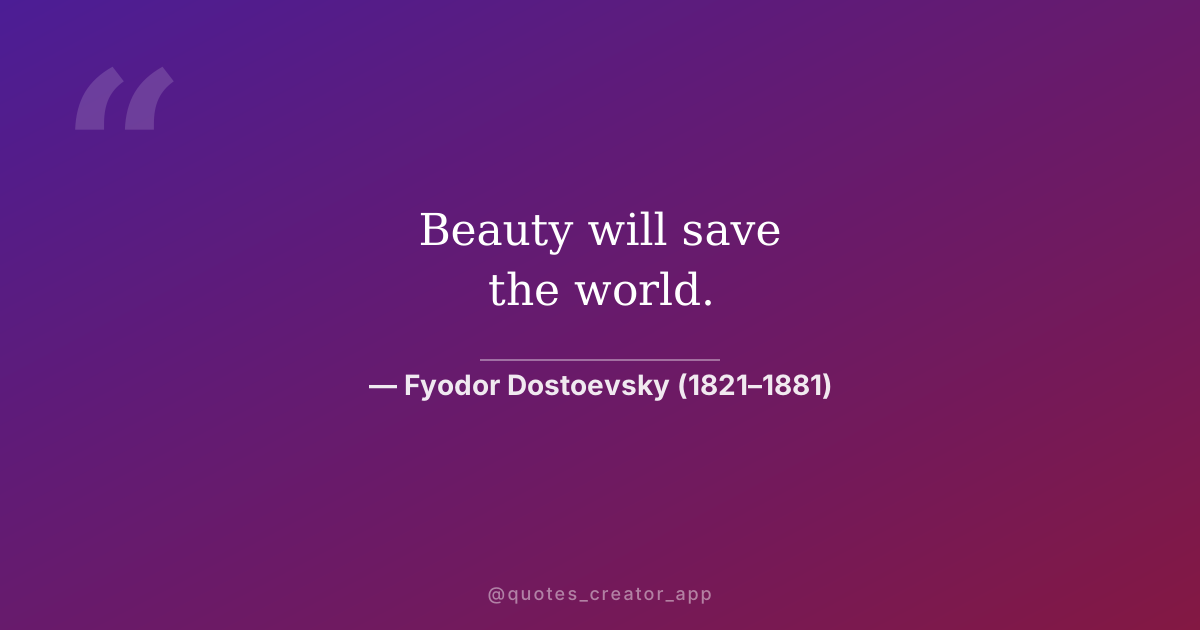
“Beauty will save the world.”
The context
Fyodor Mikhailovich Dostoevsky wrote The Idiot between 1868 and 1869, while living in self-imposed exile across Europe. He had fled Russia primarily to escape creditors — he was perpetually in debt — but also to distance himself from a country that felt increasingly alien to him. Russia was in the grip of profound social upheaval. The emancipation of the serfs in 1861 had shattered the old feudal order, and into the vacuum poured radical ideologies: nihilism, utilitarianism, and atheistic socialism were sweeping through the Russian intelligentsia. Young people were proudly declaring that morality was a fiction, that art was useless, and that the only rational basis for society was self-interest. Dostoevsky, who had narrowly escaped a firing squad in 1849 (he was reprieved at the last moment and spent four years in a Siberian prison camp instead), watched this moral unraveling with growing alarm. He believed that Russia was walking toward an abyss, and that the intellectuals leading the way had no idea what they were doing.
The Idiot was Dostoevsky’s attempt to answer the nihilists. He set out to create a “positively beautiful person” — a character so genuinely good, so morally unblemished, that his very presence would expose the hollowness of the fashionable cynicism around him. The result was Prince Lev Nikolayevich Myshkin, a man whose epilepsy, childlike honesty, and radical compassion lead society to label him an “idiot.” Myshkin is transparently a Christ figure: he returns to Russia from Switzerland (a kind of resurrection), he is surrounded by people who misunderstand and mock him, and his goodness provokes both adoration and destruction. The novel asks whether such a person can survive in a world governed by money, vanity, and self-interest. The answer, devastatingly, is no. Myshkin ends the novel catatonic, having failed to save anyone, least of all himself. And yet, in the middle of this tragedy, Dostoevsky places one of the most audacious claims in all of literature: that beauty will save the world.
The line itself is spoken in a curious way. During a tense gathering at Prince Myshkin’s birthday party, one of the characters, the consumptive teenager Ippolit, says dismissively: “The prince says that the world will be saved by beauty!” He is mocking Myshkin, attributing the idea to him as if it were a piece of naive sentimentality. But the reader knows, by this point in the novel, that the line is no throwaway remark. It has been circulating through the narrative like a thematic undercurrent. Myshkin himself never says it directly; it is reported and repeated by other characters, debated and doubted. The structure of the delivery is important: Dostoevsky does not plant the line as a sermon. He lets it be overheard, contested, almost embarrassed by itself — as if to test whether the reader will dismiss it as Ippolit does, or take it seriously despite the mockery. It is, in miniature, the test of the entire novel.
The meaning
On the surface, the quote seems like a simple piece of aesthetic optimism. Beauty — great paintings, soaring music, the architecture of a cathedral, the quiet of a snowfall — can elevate the human spirit. It can remind us that there is something in the world worth preserving, something that transcends the dreary calculations of utility and self-interest. This is not wrong, but it is far too thin a reading. Dostoevsky was not saying that a nice painting can cheer you up. He was making a claim about the metaphysical structure of reality. Beauty, for Dostoevsky, was not decorative. It was fundamental. In his notebooks he wrote that “the world will become the beauty of Christ,” and in a letter to his niece he stated plainly: “There is in the world only one figure of absolute beauty: Christ.” This is the interpretive key that unlocks the quote. Beauty is not an aesthetic category separate from truth and goodness. It is the visible manifestation of moral and spiritual perfection. A genuinely beautiful act — an act of undeserved forgiveness, of self-sacrificing love, of radical compassion — is beautiful in the same way a painting can be beautiful, except more so, because it participates directly in the ideal.
This is why Prince Myshkin matters. He is not beautiful because he is handsome or charming. He is beautiful because he is good. His refusal to judge, his capacity to see the suffering person behind the offensive behavior, his complete lack of self-regard — these are not just admirable traits; they are, in Dostoevsky’s framework, instances of beauty entering the world. Myshkin embodies a kind of moral radiance that the other characters cannot fully understand and do not know how to receive. They are attracted to it and repelled by it in equal measure. Some want to protect him; others want to destroy him. The tragedy of the novel is that beauty, in this sense, is too powerful for the world to tolerate. It demands a response that most people are unwilling to give — either complete surrender or violent rejection. There is no neutral ground when confronted with the genuinely beautiful. This is what makes the quote so unsettling once you sit with it. It does not promise comfort. It promises a confrontation.
The third and deepest layer of the quote is precisely the paradox it contains. How can beauty save the world if the novel shows beauty being destroyed? This is the question that has occupied Dostoevsky scholars for generations, and the most compelling answer is that the quote is not a prediction but a condition. The world could be saved by beauty — if the world were willing to receive it. The tragedy is not that beauty is weak; it is that the world is hostile. Myshkin is not defeated because his goodness fails. He is defeated because the people around him cannot tolerate the judgment that his goodness implicitly passes on their lives. The same dynamic plays out in Dostoevsky’s later novel The Brothers Karamazov, where the character Dmitri says: “Beauty is a terrible and awful thing! It is terrible because it has not been fathomed — God sets us nothing but riddles. Here the boundaries meet, and all contradictions exist side by side.” Beauty is terrible because it brings us face to face with what we could be, and that is a painful thing to see. Saving the world is possible, but it requires the world to let itself be saved — and that is the hardest thing of all.
Why it still matters today
We live in a culture that is obsessed with beauty and simultaneously starved of it. Social media platforms are built around the curation of the visually pleasing: filtered photographs, aesthetically arranged interiors, perfectly lit meals. An entire economy runs on the promise of making things look better. And yet, the sheer volume of aesthetic content has a curious effect: it flattens beauty into background noise. We scroll past a photograph of a war zone, then a skincare ad, then a sunset, then a friend’s wedding, without registering the difference. Everything is presented in the same frame, at the same resolution, demanding the same three seconds of attention. This is not beauty in Dostoevsky’s sense. It is decoration. It asks nothing of us, changes nothing in us, and leaves no trace when it is gone. Dostoevsky’s beauty, by contrast, is an event. It arrests you. It demands that you stop, look, and reckon with what you are seeing. It cannot be scrolled past without consequence.
In a larger sense, the quote speaks directly to the spiritual condition of modernity. We have more information, more technology, more material comfort than any generation in history, and yet rates of depression, anxiety, and despair continue to rise. We know the facts about climate change, economic inequality, and political corruption, but knowledge alone has not produced the collective will to address them. Dostoevsky’s insight points to something missing in the rationalist toolkit: the conviction that transformation comes not from arguments alone, but from experiences that rearrange your relationship to reality. A person can read a hundred articles about why they should care about the environment and feel nothing. But one walk through an ancient forest, one encounter with a wild animal in its habitat, one moment of genuine awe at the intricacy of the living world — that can change everything. The quote suggests that beauty does what data cannot. It bypasses the defenses of the intellect and speaks directly to the soul. In a world drowning in information and starving for meaning, this is not a quaint Victorian notion. It is a survival strategy.
How to apply this in your own life
The first practical step is the simplest and the hardest: make space for beauty. Not the beauty that algorithms serve you, but the beauty you have to go looking for — the kind that requires attention, silence, and a certain willingness to be moved. Go to a gallery and spend twenty minutes with a single painting. Read a poem aloud, slowly, and let the sounds sit in the room. Walk somewhere without headphones and listen. Look at the face of someone you love without the filter of a phone screen. These are not trivial acts. They are training exercises for a faculty that modern life is doing its best to atrophy: the capacity to be genuinely affected by something that is not selling you anything. Dostoevsky would say that this capacity is not a luxury. It is the engine of moral seriousness. Without it, we become easy to manipulate, because a person who cannot be moved by beauty will be moved by the next available force — anger, fear, tribalism, whatever is loudest.
The deeper application is to become a source of beauty yourself — not in the superficial sense, but in the Dostoevskian sense of embodying goodness in a way that others can see and feel. This sounds grandiose, but it is made of small things. Forgive someone who has not apologized. Tell the truth when a lie would be more convenient. Do excellent work that no one will notice. Be patient with someone who is difficult to love. None of these acts will make headlines, but each one injects a particle of moral beauty into a world that is starving for it. The quote does not ask you to save the world singlehandedly. It asks you to add to the store of beauty rather than the store of ugliness, and to trust that the cumulative weight of those additions matters. Dostoevsky was not naive about evil. He spent four years in a Siberian prison camp among murderers and thieves. He knew exactly how dark the world could be. And yet he wrote, with full knowledge of that darkness, that beauty will save the world. The choice he leaves us with is whether we will be part of the beauty or part of the darkness that opposes it. There is no third option.
Create your own quote graphic with this quote
This is the kind of quote that carries weight. When you pair timeless words with thoughtful design, you create something people want to save, share, and return to. Use our free online quote maker to turn this exact quote into a shareable image in seconds — no signup needed. For advanced features like video quotes and 100+ templates, try the Quotes Creator Android app.
Why we chose this quote
Dostoevsky’s declaration that beauty will save the world is one of those rare lines that is simultaneously famous and barely understood. Most people who quote it mean something like “art is nice,” which is not remotely what Dostoevsky was saying. The real meaning is far more demanding, and far more interesting. For Dostoevsky, beauty and goodness were the same substance viewed from different angles. A selfless act is beautiful. A patient, forgiving love is beautiful. A life lived with moral integrity radiates something that cannot be reduced to utility or explained away by biology. The quote is a gauntlet thrown at the feet of every cynic, every nihilist, every person who has ever concluded that nothing matters. It says: you are wrong. There is something in the world worth saving, and it has the power to save you in return, if only you will let it. We chose this quote because it deserves to be taken seriously — not as a decoration, not as a platitude, but as a philosophical thesis about the nature of reality that rewards every minute you spend thinking about it.
— ThinkPeak Studio Editorial Team
Create your own quote graphic with this quote
Turn this line into a shareable graphic in seconds — free, no signup needed. For video quotes and 100+ templates, try the Android app.
Advertisement
Enjoyed this article? Get more like it in your inbox.