Quote Explained: “In a time of deceit, telling the truth is a revolutionary act.”
By George Orwell, English novelist, essayist, and critic
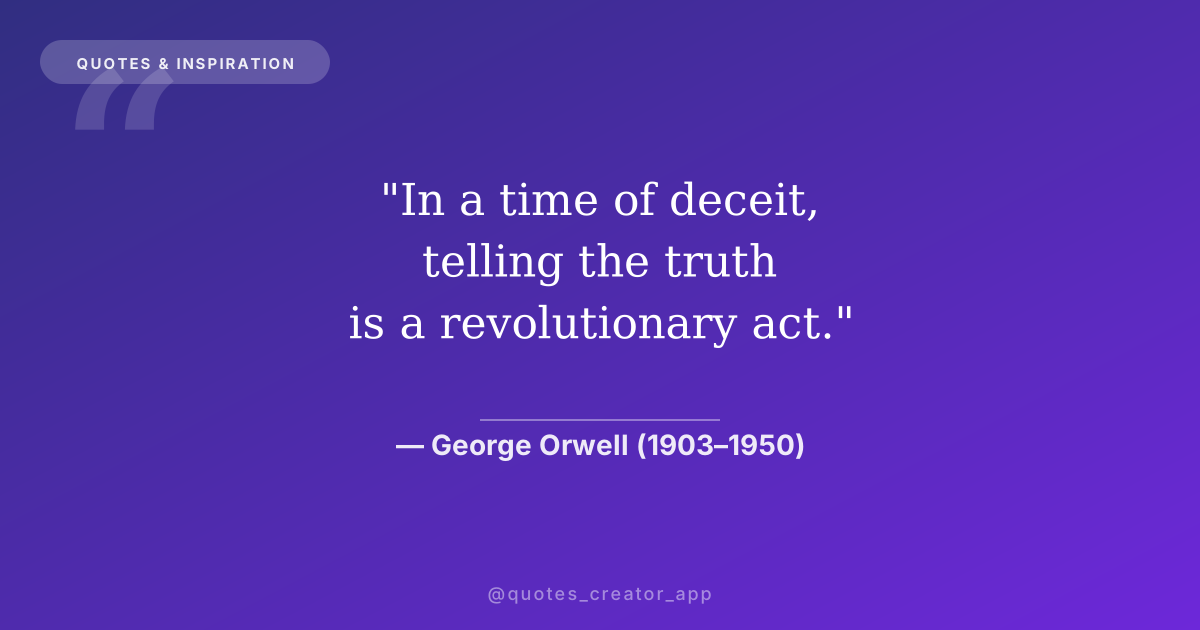
“In a time of deceit, telling the truth is a revolutionary act.”
The context
The line has been quoted so widely, in so many contexts, that it has taken on a life independent of its origins. It appears on protest signs, in political speeches, in social media bios, and on the walls of newsrooms. Few people who repeat it could tell you exactly where Orwell wrote it. In fact, the sentence does not appear verbatim in any of his published books. It is an aphorism that crystallises a theme he returned to obsessively throughout his career — a distillation of an argument he made across essays, novels, and radio broadcasts for nearly two decades. The closest direct source is his 1944 essay “The Freedom of the Press,” drafted as a preface to Animal Farm but suppressed at the time and published only posthumously. There, Orwell wrote that “the most sinister feature of our time” was the systematic manufacture of falsehood, and that anyone who resisted it was performing an act of rebellion. The shorter, sharper version we know today is a paraphrase that, ironically, was shaped by the very process Orwell described: the public’s need for a clear, memorable truth in a world of noise.
Orwell lived through the rise of totalitarian propaganda machines in both Nazi Germany and Stalin’s Soviet Union, and he spent the Second World War working for the BBC’s Eastern Service, broadcasting into Occupied Europe and India. This gave him a front-row seat to the mechanics of state-sponsored deception. He watched regimes rewrite history in real time, disappear inconvenient figures from photographs, and train entire populations to accept contradictions as normal. What distinguished Orwell from other observers was his insistence that these tactics were not simply lies. They were an attack on the very concept of objective truth. When a government can assert that two plus two equals five, and punish anyone who disagrees, it is not merely misleading its citizens. It is claiming the right to define reality itself. This is the insight that runs through Nineteen Eighty-Four, through Animal Farm, and through his journalism. The phrase “revolutionary act” was not hyperbolic. In the world Orwell inhabited, a person who insisted on telling the truth was not being virtuous. They were being dangerous.
The timing of his concern is important. Orwell was writing in the 1940s, an era when radio and mass-circulation newspapers had given governments and political movements unprecedented power to shape public opinion. Propaganda was no longer the clumsy tool of wartime posters. It had become a science, refined by psychologists and communications experts. Orwell understood, earlier than most, that the defining political struggle of the modern age would not be between left and right, or between capitalism and communism, but between those who insisted on verifiable truth and those who sought to abolish it. He did not live to see the internet, social media, or generative AI, but the infrastructure of deceit he diagnosed has only grown more sophisticated. His quote endures because the problem he identified has become the central problem of public life. Every generation discovers Orwell’s line anew because every generation faces its own version of the same crisis.
The meaning
At first pass, the quote sounds like a call to courage: be honest when others are lying, and you are doing something important. But Orwell’s choice of the word “revolutionary” carries a weight that repays closer attention. A revolutionary act is not merely brave. It is an act that challenges the existing order, that threatens the power structure, that seeks to overturn the rules by which society operates. By framing truth-telling as revolutionary, Orwell is making a claim about the nature of power itself. Systems of domination, whether political or corporate or cultural, depend on a population’s willingness to accept the official version of events. When enough people believe what they are told, the system is stable. When they begin to question, the system trembles. The person who speaks the truth is not simply being honest. They are withdrawing consent from the machinery of control. They are refusing to participate in the collective fiction that keeps power in place. This is why Orwell considered the independent writer, the journalist who refused to toe the party line, and the ordinary citizen who said what they actually saw, to be genuine threats to authoritarian rule.
The second layer of meaning concerns language. Orwell was, famously, almost as interested in how things were said as in what was said. His essay “Politics and the English Language” is a sustained argument that sloppy, euphemistic, and dishonest language is not a symptom of political decay — it is a cause. When politicians describe civilian casualties as “collateral damage,” they are not just softening a harsh reality. They are constructing a linguistic distance that makes atrocity feel abstract and therefore tolerable. When a government calls its surveillance apparatus a “safety programme,” it is not just choosing friendly branding. It is making dissent feel ungrateful. Telling the truth, in Orwell’s framework, is therefore also a linguistic act. It means rejecting the euphemisms, the jargon, the comfortable abstractions, and calling things by their real names. This is harder than it sounds. The dishonest language of power does not announce itself. It seeps into everyday speech until it becomes invisible, until even the victims of propaganda begin to use its vocabulary without realising it. The revolutionary act Orwell describes is, in part, an act of linguistic reclamation — a deliberate effort to strip language back to the point where words mean what they say.
There is also a subtle and uncomfortable point embedded in the quote that is rarely discussed. Orwell does not say that telling the truth is revolutionary in all times. He says it is revolutionary “in a time of deceit.” The implication is that the moral weight of truth-telling is proportional to the environment in which it occurs. In a healthy society, where institutions are broadly trustworthy and the flow of information is relatively clean, telling the truth is simply good citizenship. It is expected, routine, unremarkable. But when the public sphere becomes saturated with deliberate falsehood, when the institutions that ought to guard truth become complicit in its destruction, the calculus changes. The same act — stating an observable fact — becomes dangerous, transgressive, and politically charged. This is a warning as much as an inspiration. It tells us that if we find ourselves in a moment where telling the truth feels like rebellion, something has already gone profoundly wrong. The revolutionary quality of honesty is not a sign of virtue. It is a symptom of sickness.
Why it still matters today
In the twenty-first century, the infrastructure of deceit has scaled beyond anything Orwell could have imagined. The gatekeepers who once filtered public information — editors, fact-checkers, academic peer reviewers — have been bypassed by platforms that algorithmically amplify whatever content generates the most engagement, regardless of its accuracy. The result is an information environment in which falsehoods travel farther and faster than corrections, in which the loudest voices are often the least reliable, and in which the sheer volume of content makes it nearly impossible for an ordinary person to distinguish signal from noise. Add to this the emergence of deepfakes, AI-generated text, and automated propaganda bots, and the problem moves from difficult to existential. When audio, video, and photographic evidence can all be fabricated at near-zero cost, the very concept of a “fact” begins to dissolve. Orwell’s line, in this context, is not nostalgia for a lost era of journalistic integrity. It is a cold description of the position in which every honest person now finds themselves. In an environment engineered to deceive, simply describing what is real carries genuine political risk.
But the quote’s contemporary relevance is not limited to politics and media. It applies with equal force to the personal sphere, where social media has created a parallel economy of curated identity. People present versions of themselves online that are carefully edited, filtered, and optimised for approval. The gap between the public performance and the private reality has become a routine feature of modern life, so normalised that many people no longer register it as deception. In this context, telling the truth about oneself — admitting failure, uncertainty, ordinariness — genuinely is a revolutionary act. It cuts against the incentive structure that rewards image management over authenticity. When someone shares a struggle instead of a success, when they admit they do not have the answer, when they refuse to pretend that their life is a highlight reel, they are doing more than being vulnerable. They are, in Orwell’s framework, refusing to participate in the collective fiction. They are making the personal political in the most direct sense possible.
How to apply this in your own life
The most direct application of Orwell’s insight is to audit the language you use and consume. Pay attention to the words that feel vague, sanitised, or designed to make something ugly sound acceptable. When you hear a phrase like “right-sizing” instead of “firing people,” or “enhanced interrogation” instead of “torture,” do not just note the euphemism. Ask yourself what the speaker is trying to prevent you from thinking. The discipline of calling things by their real names is not pedantry. It is a small but genuine act of rebellion. You can practise it in meetings, in emails, in conversation, and in your own internal monologue. The goal is not to be harsh. It is to be clear. Clarity is the enemy of manipulation, and manipulation is the native language of deceit. If you make a habit of insisting that words mean what they mean, you are already doing more than most people to resist the erosion of truth.
The second application is about courage in small contexts. Not everyone will find themselves in a position to expose government corruption or blow the whistle on corporate fraud. But everyone faces moments when the easy thing — the socially smooth, professionally safe, interpersonally comfortable thing — is to stay silent, to nod along, to let a falsehood stand. Orwell’s quote reminds us that those small moments are not trivial. They are the micro-climate in which the larger culture of deceit either thrives or withers. When you correct a misleading statistic in a group chat, when you tell a friend a hard truth instead of what they want to hear, when you refuse to participate in office politics that depend on a shared fiction, you are engaging in the same kind of revolutionary act Orwell described. The scale is different, but the principle is identical. Deceit, like truth, is a collective enterprise. It survives because most people, most of the time, find it easier to comply than to resist. By refusing to comply, even in small ways, you shift the balance. You make honesty a little less lonely, a little more normal, and a little harder for the machinery of deception to ignore.
Create your own quote graphic with this quote
This is the kind of quote that carries weight. When you pair timeless words with thoughtful design, you create something people want to save, share, and return to. Quotes Creator gives you the tools to turn this quote into a beautiful graphic — custom fonts, gradient backgrounds, and export sizes for every platform.
Why we chose this quote
George Orwell’s line has become one of the most quoted sentences of the twentieth century, and yet it is almost never quoted with a full reckoning of its implications. People treat it as a slogan — a bumper-sticker reminder that honesty is good. But the intellectual architecture behind it, drawn from Orwell’s direct experience of totalitarianism, his analysis of language and power, and his conviction that objective truth is the foundation of all political freedom, makes it far more radical than it first appears. We chose this quote because it sits at the intersection of politics, language, and personal integrity, and because the world it describes — a time of deceit — is no longer a historical footnote. It is the water in which we all swim. Orwell’s words are not a comfort. They are a challenge. They ask us to look at our own habits of silence, complicity, and self-deception, and to recognise that the fight for truth begins not in the halls of power but in the everyday choices we make about what to say, what to believe, and what to let pass.
— ThinkPeak Studio Editorial Team
Create your own quote graphic with this quote
Turn this line into a shareable graphic in seconds — free, no signup needed. For video quotes and 100+ templates, try the Android app.
Advertisement
Enjoyed this article? Get more like it in your inbox.