On this page
Quote Explained: “The only thing necessary for the triumph of evil…”
The most famous warning ever credited to Edmund Burke — a sentence that cannot be found anywhere in his writings
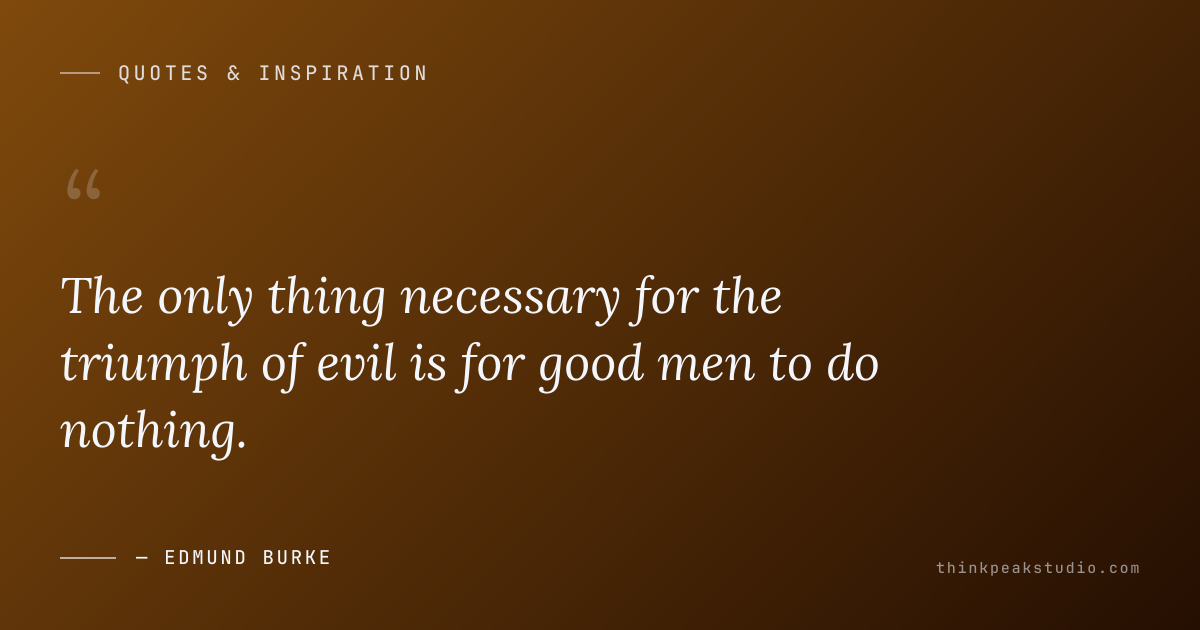
“The only thing necessary for the triumph of evil is for good men to do nothing.”
The context
This is arguably the best-known political warning in the English language, and one of the most confidently misattributed sentences ever written. Presidents have quoted it, memorials have engraved it, protest signs and office posters carry it, and almost every repetition hands it to Edmund Burke. There is only one problem with the attribution, and it is a serious one: no one has ever found the sentence in anything Burke published. Searches of his collected works have failed to turn it up, and a 2021 Reuters fact-check reached the same conclusion. The most famous thing Edmund Burke ever “said” is very likely something he never said.
Burke, born in Dublin in 1729 and dead at Beaconsfield on July 9, 1797, did write something close in spirit. In Thoughts on the Cause of the Present Discontents (1770) he argued that scattered, private resistance is no match for organised ambition, because the ambitious have already combined and the honest have not: “When bad men combine, the good must associate; else they will fall, one by one, an unpitied sacrifice in a contemptible struggle.” The sentiment is unmistakably Burkean. The wording is nothing like the line on the poster. That gap — kindred idea, entirely different sentence — is exactly why the misattribution has survived so long. The line sounds like Burke, and plausibility is the only credential a quotation really needs.
The nearest genuine source is the philosopher and political economist John Stuart Mill. Mill (1806–1873) served as Lord Rector of the University of St Andrews and delivered his inaugural address there on February 1, 1867. Warning against the comfortable belief that staying out of public life keeps one’s conscience clean, he said: “Let not any one pacify his conscience by the delusion that he can do no harm if he takes no part, and forms no opinion. Bad men need nothing more to compass their ends, than that good men should look on and do nothing. He is not a good man who, without a protest, allows wrong to be committed in his name, and with the means which he helps to supply, because he will not trouble himself to use his mind on the subject.” That is the intellectual ancestor of the modern quote, and it is still not the modern quote.
The familiar wording appears to have taken shape in the temperance movement of the early twentieth century. In October 1916 the San Jose Mercury Herald reported a prohibition speech by the Rev. Charles F. Aked, who used the phrase “for evil men to accomplish their purpose it is only necessary that good men should do nothing.” Four years later, on July 5, 1920, a temperance campaigner named Sir R. Murray Hyslop told the Fourth International Congregational Council in Boston: “Burke once said: ‘The only thing necessary for the triumph of evil is that good men should do nothing.’” As far as quotation researchers have been able to trace, that is the first time this wording was pinned to Burke’s name — and it was Hyslop’s attribution, not any document of Burke’s, that carried the sentence into the culture. Bartlett’s Familiar Quotations later supplied a source, a letter to William Smith said to date from 1795; the letter does not contain the words, and after the New York Times language columnist William Safire challenged the citation in 1980, later editions conceded that vigorous searches had failed to find them in Burke’s oeuvre. In 1961 President John F. Kennedy quoted the line in an address to the Canadian Parliament and credited Burke, an endorsement that did more than any other to fix the false attribution in place. The line has since been called the most popular quotation of modern times; the editor of the Oxford Dictionary of Quotations told The Irish Times that in 2009 it headed a poll of favourite quotations, while confirming it has never been found in Burke’s writings.
The meaning
The sentence does more than tell us to care. It makes a precise claim about how evil actually operates — not primarily through the strength of the wicked, but through the permission of the ordinary. The word “necessary” is doing careful work. The line does not say that good people’s inaction is sufficient for evil to triumph, only that evil finds it necessary: that harm runs on the absence of friction, on the reluctance of bystanders to become inconvenient. Read that way, the sentence is less a moral scolding than a description of a mechanism. Cruelty has a logistics problem, and the rest of us are the logistics.
The second move is to refuse the comfort that inaction is neutral. We tend to treat what we do as a choice and what we omit as merely the absence of a choice — the quiet default, nobody’s fault. The line collapses that asymmetry. To look on and do nothing is still to do something: to lend the situation your silence, your legitimacy, your ordinary complicity. Mill’s continuation sharpens the point beyond anything the epigram can manage on its own: “He is not a good man who, without a protest, allows wrong to be committed in his name… because he will not trouble himself to use his mind on the subject.” The failure the line names is not malice. It is the unwillingness to be troubled.
There is a third and subtler meaning, and it is about the quotation itself. The sentence’s authority has never rested on evidence; it rests on the sound of the name attached to it. We assign anonymous wisdom to whoever it resembles, and this line resembles Edmund Burke — sonorous, balanced, faintly Roman. So we gave it to him, and the giving made it quotable, and the quotability made it true-seeming. The misattribution of this particular warning is a demonstration of the warning’s own logic: a false thing survives because good people do nothing about it. Every repetition without a check is a small act of looking on.
Relevance: why it still matters
In 2026 the sentence circulates constantly, captioned over outrage about disinformation, democratic backsliding, climate inaction, and the many failures of institutional courage. Its ubiquity is part of the problem. The line has been flattened into a way of describing a feeling — the frustration of watching something bad happen — and a share or a repost now stands in for the “doing” it demands. But the sentence’s own logic asks a harder question than “did you react?” It asks what action would actually remove the permission that harm is running on. Expression is cheap, and the line is about cost. Where the only available act is performance, evil loses nothing at all.
The line also matters because it is so often aimed at the wrong people. Turned on private individuals, it can become a demand to hold an opinion on everything, at all hours, on the terms set by whoever is shouting loudest — while those who hold real levers of power are never named. The corrected history makes a second, related point for our moment. We are living through an epidemic of confident quotation: a line attached to a famous name travels much further than the same line unattributed, and almost nobody checks. That the most famous moral warning in English is itself a case study in uncritical belief is a lesson in media literacy hiding inside a lesson in ethics.
Application: how to use it in your own life
The first application is to convert concern into something specific enough to be measured. Find one place where you are the good man looking on — the meeting where a decision goes unchallenged, the project whose flaw is whispered about and never filed, the community problem everyone agrees is a shame and no one owns. Then name the smallest action that actually adds friction: the question asked on the record, the review that says no, the report that goes to someone with authority, the vote that gets cast, the money that gets given. The line makes inaction the cause, so the remedy is always particular. It is not a feeling about evil; it is one concrete thing you would rather not do.
The second application is to the quotations you repeat, including this one. Check before you credit. The fact that a sentence this famous cannot be sourced to the man it is named after should make you slower to trust the last quote you saw on a graphic — and slower to pass it on. When you cite, cite accurately; when the source is uncertain, say “attributed to,” which is honest and costs you nothing. Then turn the same standard on your own silence and your own speech, because the line ultimately asks one question: is your goodness a label you wear or a practice you keep? Whichever early twentieth-century preacher first assembled the sentence, the test it sets has not changed. Evil does not require you to be bad. It only requires you to be quiet.
Create your own quote graphic with this quote
This is a sentence built to be seen — short, urgent, and impossible to read without taking a side. When you pair words this precise with clean typography, you get something people want to save, share, and return to. Use our free online quote maker to turn this exact quote into a shareable image in seconds — no signup needed. For advanced features like video quotes and 100+ templates, try the Quotes Creator Android app.
Why we chose this quote
We chose this quote because it is both the most repeated political warning in English and the most instructive case of a false attribution in the language. Almost everyone who says it credits Edmund Burke, and Burke did argue in 1770 that “when bad men combine, the good must associate.” But the sentence as we know it never appears in his writing. Its nearest genuine ancestor is John Stuart Mill’s 1867 St Andrews address; its modern wording surfaced in prohibition-era speeches by Charles F. Aked in 1916 and R. Murray Hyslop in 1920; and it became a commonplace after John F. Kennedy quoted and miscredited it in 1961. That history is not a footnote. It means the quote’s whole authority has always come from a name rather than a source — which is precisely the kind of passive acceptance the sentence itself warns against. The line survives because it is true in substance and because we never checked it. Reading it honestly, we think, makes it sharper: a warning about doing nothing that has spent a century being repeated by people doing exactly that.
— ThinkPeak Studio Editorial Team
Create your own quote graphic with this quote
Turn this line into a shareable graphic in seconds — free, no signup needed. For video quotes and 100+ templates, try the Android app.
Advertisement
Enjoyed this article? Get more like it in your inbox.


