Quote Explained: “I freed a thousand slaves. I could have freed a thousand more…”
By Harriet Tubman, American abolitionist and political activist
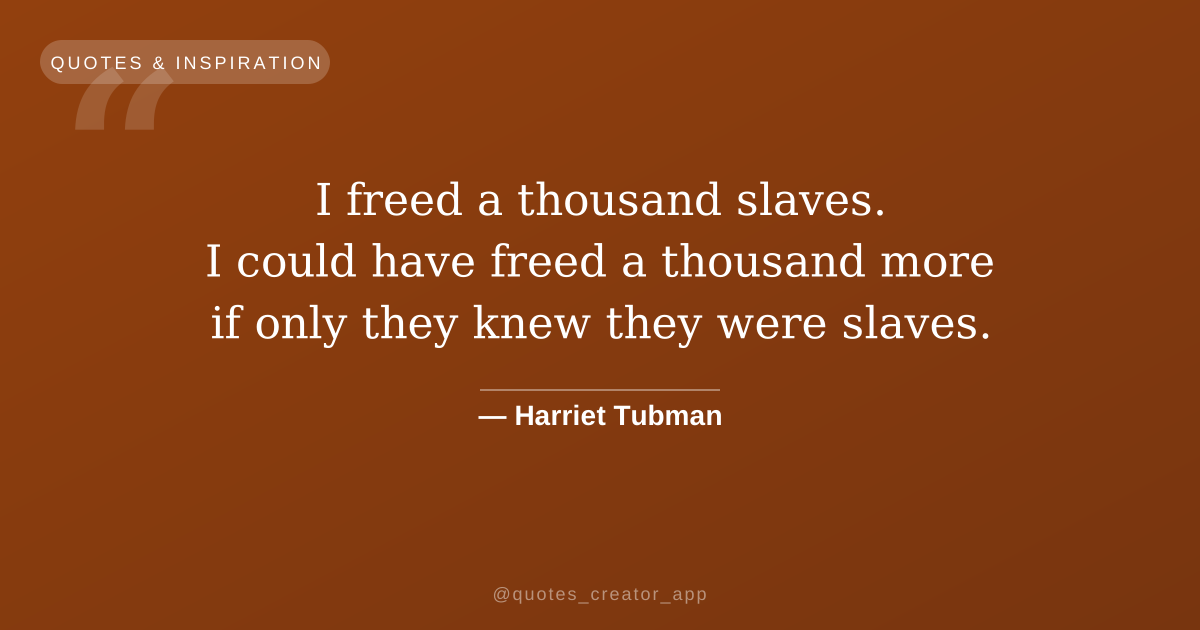
“I freed a thousand slaves. I could have freed a thousand more if only they knew they were slaves.”
The context
Born Araminta Ross around 1822 on a plantation in Dorchester County, Maryland, Harriet Tubman endured a childhood marked by brutal physical violence that would have broken most people. At the age of five or six, she was hired out to neighbors who beat her mercilessly, leaving scars that would last a lifetime. A traumatic blow to the head from a metal weight hurled by an overseer caused severe seizures, headaches, and narcoleptic episodes for the rest of her life. She was not born into freedom, nor was freedom handed to her. She took it, and then she went back for others.
In 1849, Tubman escaped slavery in Maryland, traveling nearly ninety miles to reach Philadelphia, Pennsylvania. She was approximately twenty-seven years old. Freedom was available to her in the North, and most former slaves would have stayed put. Tubman did not. Over the next decade, she made approximately thirteen trips back into the slaveholding South, personally leading roughly seventy enslaved people to freedom through the Underground Railroad — a clandestine network of safe houses, sympathetic abolitionists, and secret routes. She later told biographer Sarah Hopkins Bradford that she had freed about a thousand people, a number that likely includes those she assisted indirectly through her connections and knowledge of the escape network. She never lost a single passenger.
During the Civil War, Tubman served the Union Army in multiple capacities — as a nurse, a cook, a spy, and a scout. In June 1863, she became the first woman in American history to lead an armed military raid when she guided Colonel James Montgomery and his troops up the Combahee River in South Carolina, liberating more than seven hundred enslaved people in a single operation. She was never paid equally for her service and spent decades afterward fighting for a military pension, which she finally received in 1899 — at a fraction of what male soldiers earned. In her later years, she became a fierce advocate for women’s suffrage, established a home for elderly African Americans in Auburn, New York, and continued speaking about freedom and justice until her death in 1913.
The quote comes from the period of her active abolitionist work, a time when she was in constant danger of recapture and death. The South had placed a bounty on her head, and slaveholders had reason to want her destroyed. Yet she returned again and again. When she spoke of freeing a thousand slaves and being able to free a thousand more, she was not boasting. She was describing a reality she had lived, and expressing the frustration that haunted her most deeply: that many of the people she could have helped did not believe they were enslaved, or did not believe freedom was possible for them. The chains she could break were the iron ones around wrists and ankles. The chains she could not break were the ones locked inside minds.
The meaning
The quote operates on two levels simultaneously, and its power comes from the collision between them. On the literal level, Tubman is describing a practical limitation of her rescue work. She could not save people who would not come. If an enslaved person refused to leave — whether out of fear, loyalty to family left behind, disbelief in the Underground Railroad’s existence, or internalized acceptance of their condition — Tubman could not force them. The logistics of escape required willing participants. You could not sneak a resistant person through slave patrols, across rivers, and into safe houses. The freed needed to know they were enslaved before they could become free.
But the deeper meaning of the quote transcends its historical context and enters the realm of psychological truth. Tubman is articulating something that philosophers, psychologists, and spiritual teachers have recognized for millennia: that awareness is the first prerequisite of liberation. A person who does not recognize their cage is not going to try to leave it. A person who has been told their entire life that their condition is natural, deserved, or unchangeable may lack not the physical ability to escape but the imaginative capacity to conceive of escape. The most powerful prisons are the ones that convince their inmates there are no walls.
This insight has layers. There is the obvious case of people who are literally enslaved and have internalized their condition as normal. But there is also the subtler case of people who are enslaved in less visible ways — trapped in abusive relationships they have come to accept, trapped in economic systems that exploit them, trapped in thought patterns and habits that diminish them, trapped in social roles that suffocate them. In each case, the prison is real, but its most effective reinforcement comes from the prisoner’s belief that the prison is all there is. Tubman’s genius was recognizing that the most dangerous form of bondage is not the one that holds your body but the one that holds your perception.
There is also a note of profound sorrow in the quote. Tubman is not expressing contempt for the people she could not save. She is expressing grief. She had seen freedom. She knew what it looked like, tasted like, felt like. She knew the roads, the safe houses, the allies who would help. She had the map in her hands and the knowledge in her bones. And still, some people would not take the journey. The tragedy is not that freedom was unavailable. The tragedy is that it was available and unseen. The sorrow is the sorrow of a doctor who has the cure but cannot convince the patient that they are ill.
Why it still matters today
Tubman’s observation is not a historical curiosity. It is a living diagnosis of a condition that persists in every era, every culture, and every individual life. In the modern world, the forms of slavery have changed but the underlying psychology has not. People remain trapped in systems they do not recognize as exploitative, in habits they do not recognize as destructive, and in beliefs they do not recognize as imposed. The factory worker who has been told that forty years of back-breaking labor for subsistence wages is just “the way things are” is not free, even though no iron chain binds them. The woman who has been taught to measure her worth entirely through male approval is not free, even though she walks the streets without a guard. The child who has internalized the message that their dreams are too big for someone like them is not free, even though no door is literally locked.
The quote is also a powerful commentary on the role of education and consciousness-raising in liberation movements. Tubman understood that you could not simply hand someone freedom and expect them to thrive. If the mental chains remained, the person would rebuild the physical ones. This insight animated the work of later thinkers like Paulo Freire, whose concept of “critical consciousness” argued that the oppressed must first recognize their oppression before they can act to change it. It animated the Black Power movement’s emphasis on self-knowledge and cultural pride. It animated the feminist movement’s insistence that “the personal is political” — that the private sufferings of women were not personal failures but symptoms of systemic oppression. In every case, the principle is Tubman’s: awareness precedes liberation.
In an age of algorithmic manipulation, political propaganda, and relentless advertising, the quote has never been more relevant. Modern systems of control do not need chains. They need distraction, comfort, and the careful cultivation of the belief that the current arrangement is inevitable. When a social media platform designs its interface to maximize addiction and monetize attention, the users who do not recognize what is happening to them are not free — even though they chose to pick up the phone. When an economic system tells workers that fighting for better conditions is ungrateful or unrealistic, the workers who believe it are not free — even though they technically have the right to organize. Tubman’s words cut through the noise: you cannot free people who do not know they are enslaved.
How to apply this in your own life
The first application is to conduct an honest audit of your own life and ask a difficult question: where might I be a slave without knowing it? This is not a comfortable exercise. It requires confronting the possibility that some of your beliefs, habits, and routines are not truly yours — that they were installed by family expectations, cultural conditioning, economic pressure, or past trauma. The person who has never questioned why they work a job they hate, maintain relationships that drain them, or pursue goals that do not actually satisfy them has not yet performed this audit. Tubman’s quote is an invitation to do so. Freedom begins with the willingness to look honestly at your own life and ask whether you are truly choosing it or merely accepting it.
The second application is to seek out perspectives that challenge your assumptions about what is normal and acceptable. Tubman did not develop her understanding of freedom in isolation. She learned from abolitionists, from Quakers, from other freedom seekers, and from the simple, devastating contrast between the brutality of slavery and the dignity of freedom. If you want to recognize your own chains, you need outside perspectives. Read writers who disagree with you. Listen to people whose lives look nothing like yours. Expose yourself to ideas that make you uncomfortable. The person who stays inside their own echo chamber is the person most likely to mistake the walls for the horizon.
The third application is to recognize that awareness alone is not enough. Tubman did not merely identify enslaved people. She freed them. She took action. She risked her life, repeatedly, to translate awareness into liberation. This is the part of the quote that is easy to overlook. Knowing you are enslaved is necessary but not sufficient. You must also be willing to do something about it. In practical terms, this means that once you have identified the chains in your own life — the dead-end job, the toxic relationship, the limiting belief, the destructive habit — you must take concrete steps to break free. Awareness without action is merely a more sophisticated form of imprisonment. It is the difference between reading a map and walking the road. Tubman walked the road, and she walked it over and over again, because she understood that freedom is not a destination. It is a practice.
Create your own quote graphic with this quote
This is the kind of quote that carries weight. When you pair timeless words with thoughtful design, you create something people want to save, share, and return to. Quotes Creator gives you the tools to turn this quote into a beautiful graphic — custom fonts, gradient backgrounds, and export sizes for every platform.
Why we chose this quote
Harriet Tubman’s observation about awareness and slavery sits at the intersection of history, psychology, and moral philosophy. Unlike many famous quotes that lose their power when examined closely, this one grows more urgent the longer you sit with it. It reframes freedom not as a physical state but as a condition of consciousness, and it places the first responsibility for liberation on the awareness of the enslaved. We chose it because in an era saturated with information but starved of genuine self-examination, Tubman’s single sentence does what the best quotes always do: it makes the familiar strange, the comfortable uncomfortable, and the invisible suddenly, unmistakably visible.
— ThinkPeak Studio Editorial Team
Create your own quote graphic with this quote
Turn this line into a shareable graphic in seconds — free, no signup needed. For video quotes and 100+ templates, try the Android app.
Advertisement
Enjoyed this article? Get more like it in your inbox.