Quote Explained: “Whether you think you can or you think you can’t, you’re right.”
By Henry Ford, American industrialist and founder of the Ford Motor Company
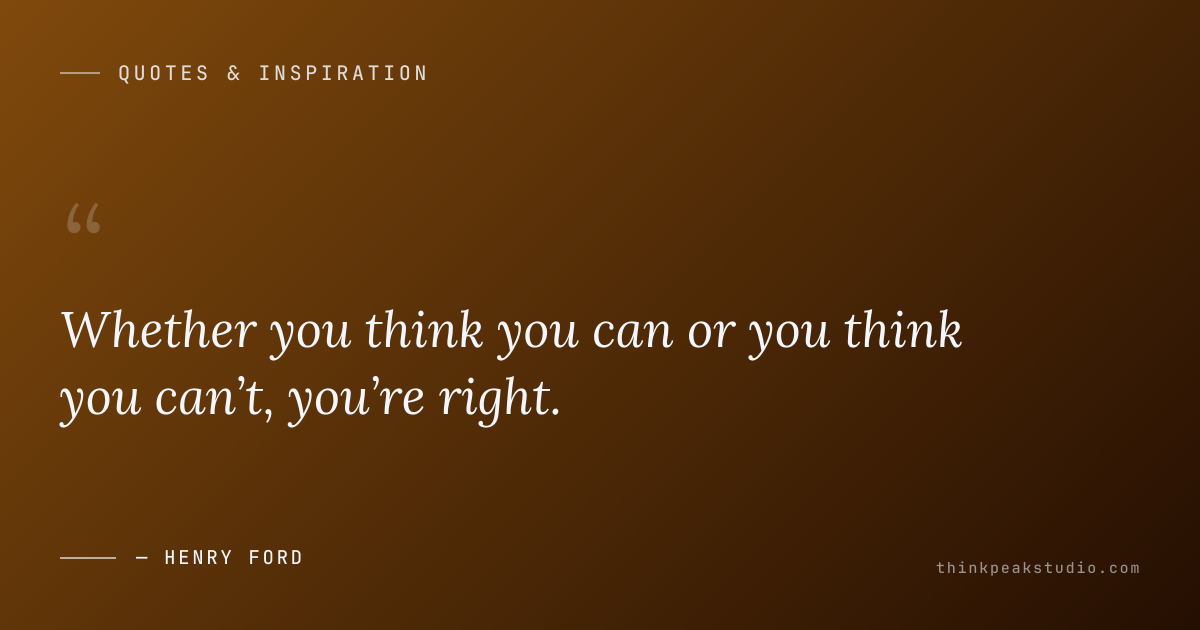
“Whether you think you can or you think you can’t, you’re right.”
The context
Henry Ford is remembered as the man who put the world on wheels, and the title is almost literally true. Born in 1863 on a farm outside Detroit, he grew up tinkering with watches and steam engines, and by the age of sixteen had walked away from the fields to work as an apprentice machinist. He did not invent the automobile, and he never claimed to. What he did was far more consequential: he figured out how to build one cheaply enough, and quickly enough, that ordinary working people could afford it. The Model T, introduced in 1908, and the moving assembly line that produced it, remade manufacturing and, in the process, the entire shape of American life. A farm boy who had once repaired his neighbors’ watches for pocket money became one of the richest and most influential men on earth, and he did it not through genius in the way the world usually means the word, but through an almost unreasonable faith that the thing could be done.
The quote for which he is best remembered did not, as far as anyone can tell, come from a speech or a boardroom. It surfaces in a Reader’s Digest profile of Ford published in 1947, the year he died, where the aged industrialist reflected on a lifetime of building things that had never existed before. The words sound like the man himself: plain, a little folksy, and deceptively simple. Ford was not a philosopher and never pretended to be; he was a mechanic who thought like one, treating ideas the way he treated engines, looking always for the part that made the rest of it move. His autobiography and his collected sayings are full of the same blunt conviction — “if you think you can do a thing or think you can’t do a thing, you’re right” — because it was, for him, not a slogan but a working principle. He had watched, over and over, the difference between the men who believed a machine could be built and the men who were certain it could not.
Why has this one line outlived the cars and the factories and the fortune? Because it says something about the machinery of the human mind that is at once obvious and almost impossible to live by. It is a sentence that sounds like a trick — a piece of folk wisdom, the sort of thing a coach writes on a whiteboard — and yet it has survived a century precisely because it keeps turning out to be true. Ford’s genius was not in inventing the insight, which is old, but in compressing it into a form so tight it cannot be forgotten. In sixteen words he stated the entire logic of the self-fulfilling prophecy, the principle that what we expect of ourselves tends to become what we get. And he stated it without judgment, without cheerleading, in the flat, factual tone of a man reporting what he had observed at the assembly line of his own life.
The meaning
The surface meaning is contained in the sentence’s symmetry. “Whether you think you can or you think you can’t, you’re right.” Belief and doubt, the line suggests, are both correct — not because the world is so accommodating that it rearranges itself to match your mood, but because each expectation sets in motion the behavior that makes it come true. The person who thinks he can tries, and the trying is what produces the result. The person who thinks she can’t does not try, or tries half-heartedly, and the result, when it fails to appear, confirms what she believed all along. Ford is not claiming that optimism is a magic wand that bends reality; he is claiming something more sober and more interesting, which is that your expectation of the outcome is one of the inputs to the outcome. The belief does not do the work. But it decides whether the work gets done.
The deeper meaning lies in what the sentence quietly relocates. Most people imagine that success belongs to the talented, the lucky, the well-connected — to forces outside their control. Ford’s line moves the lever back into the person’s own hands. It says that the first and most decisive variable is not ability but assumption, not the hand you were dealt but the story you tell yourself about the hand. This is why the sentence is genuinely radical, for all its homely tone: it is a statement of agency in a world that loves to explain people by their circumstances. But notice that it is also, in the same breath, a warning. The prophecy works in both directions. Certainty of failure is just as self-fulfilling as certainty of success, and Ford names them with equal weight. The person who is absolutely convinced he cannot is, in the only sense that matters, correct — and the sentence offers him no comfort, only the quiet truth that he built his own cage and then climbed inside it.
There is a final layer, and it is the one most often missed. The sentence is not really about can and can’t at all; it is about the difference between a prediction and a decision. “I can’t” is usually not a fact but a forecast dressed up as one, a guess about the future spoken in the grammar of certainty. Ford’s line exposes the trick by making the forecast visible as a choice. The person who says “I can’t” has not discovered a limitation; he has adopted one. And the person who says “I can” has not ignored reality; he has refused to grant it the power of veto in advance. This is why the quote has never been a license for wishful thinking. It is an instruction to stop confusing a fear about the outcome with knowledge of the outcome, and to recognize that the difference between the two — between what you predict and what you decide — is the entire distance between a life that moves and one that stands still.
Why it still matters today
The quote matters now more than when it was spoken, because we have built an entire culture around the supply of reasons to say “I can’t.” Never in history have people had so much information about what everyone else is achieving, so many curated galleries of other lives to measure themselves against, so many experts ready to explain why the odds are long and the barriers high. The result is a kind of ambient learned helplessness — the quiet, constant conclusion that the climb is too steep and the prize too far. And the strange thing is that the science has caught up with the old mechanic. What Ford said in a sentence, psychology has spent decades confirming under laboratory lights: Albert Bandura’s work on self-efficacy shows that the belief in your own capability is one of the strongest predictors of whether you will act at all; Carol Dweck’s research on mindset shows that people who believe their abilities can grow are the ones whose abilities actually do. The self-fulfilling prophecy is no longer folk wisdom; it is a documented mechanism. Ford, the farm boy with no degree and no special training, had identified a principle that the academy took a century to rediscover.
The quote is also a necessary corrective to two opposite mistakes of the present. On one side sits the cynicism that mistakes pessimism for sophistication — the reflex that treats doubt as a mark of intelligence and hope as a mark of naivety, and so quietly amputates its own ambitions before they have a chance to be embarrassed. On the other side sits the hollow cheerleading that Ford’s line is so often mistaken for, the “manifest it” culture that promises outcomes for thoughts alone and leaves people blaming themselves when the universe fails to cooperate. Ford’s sentence belongs to neither camp. It promises nothing for the belief except that it will get you to the starting line, and it threatens nothing for the doubt except that it will keep you from it. In an age that alternates between fatalism and fantasy, a sentence this honest about the power of belief — and this clear about its limits — reads as something close to wisdom.
How to apply this in your own life
The most practical way to use the quote is to treat it as an audit of your own speech, because the sentence is ultimately about a word — “can’t” — and its unexamined power. For a week, notice every time you say or think “I can’t.” Write the statements down, and then sort them into two piles. In one pile go the genuine constraints — the laws of physics, the facts of a situation, the things that are truly impossible. In the other go the forecasts, the “I can’t” statements that are really “I haven’t tried,” or “I’m afraid I’ll fail,” or “I don’t know how.” Most people are startled to discover that the second pile is enormous and the first is tiny. And then comes the harder move: take one item from the forecast pile and rephrase it, not as a declaration of defeat but as an open question — “how could I?” The shift is not magic; it is simply Ford’s sentence put into practice. “I can’t” closes the inquiry before it begins. “How could I?” opens it, and the opening is the whole point.
The deeper application is to understand that the quote is not a one-time decision but a habit, and that the habit is built by acting on the “can” before the “can” feels true. Belief, in Ford’s formula, is not a feeling you wait to have; it is a wager you place by moving. So take the first step before you feel ready — send the proposal, begin the project, learn the skill, say the difficult thing — because the evidence for “I can” does not arrive before the attempt; it is produced by the attempt. This is what the industrialist meant when he said that enthusiasm is the yeast that makes your hopes shine: the feeling follows the motion, not the other way around. And it is why the quote, for all its simplicity, is a complete philosophy of action in sixteen words. Whether you think you can or you think you can’t, the sentence insists, you are about to be proven right. The only question — the only one that has ever mattered — is which proof you intend to live inside.
Create your own quote graphic with this quote
This is a line built to be taped to a wall and returned to — short enough to memorize, honest enough to sting. When you pair an idea this bracing with thoughtful design, you create something worth keeping close. Use our free online quote maker to turn this exact quote into a shareable image in seconds — no signup needed. For advanced features like video quotes and 100+ templates, try the Quotes Creator Android app.
Why we chose this quote
We chose this quote because it is the rare sentence that is at once an encouragement and a warning, and because it does not flatter the reader. Henry Ford, a man with no special advantages who built an empire on the strength of a conviction, spent his life watching the self-fulfilling prophecy do its quiet work, and he compressed what he saw into sixteen plain words. The line endures because it refuses the comfortable fictions of both our cynicism and our optimism: it promises nothing for belief except a chance to act, and nothing for doubt except a reason to stop. In a world that daily supplies new reasons to say “I can’t,” that honesty — and the reminder that the verdict is, more often than we admit, ours to deliver — has never stopped being necessary.
— ThinkPeak Studio Editorial Team
Create your own quote graphic with this quote
Turn this line into a shareable graphic in seconds — free, no signup needed. For video quotes and 100+ templates, try the Android app.
Advertisement
Enjoyed this article? Get more like it in your inbox.


