Quote Explained: “Not everything that is faced can be changed, but nothing can be changed until it is faced.”
By James Baldwin, American writer, essayist, and civil rights activist
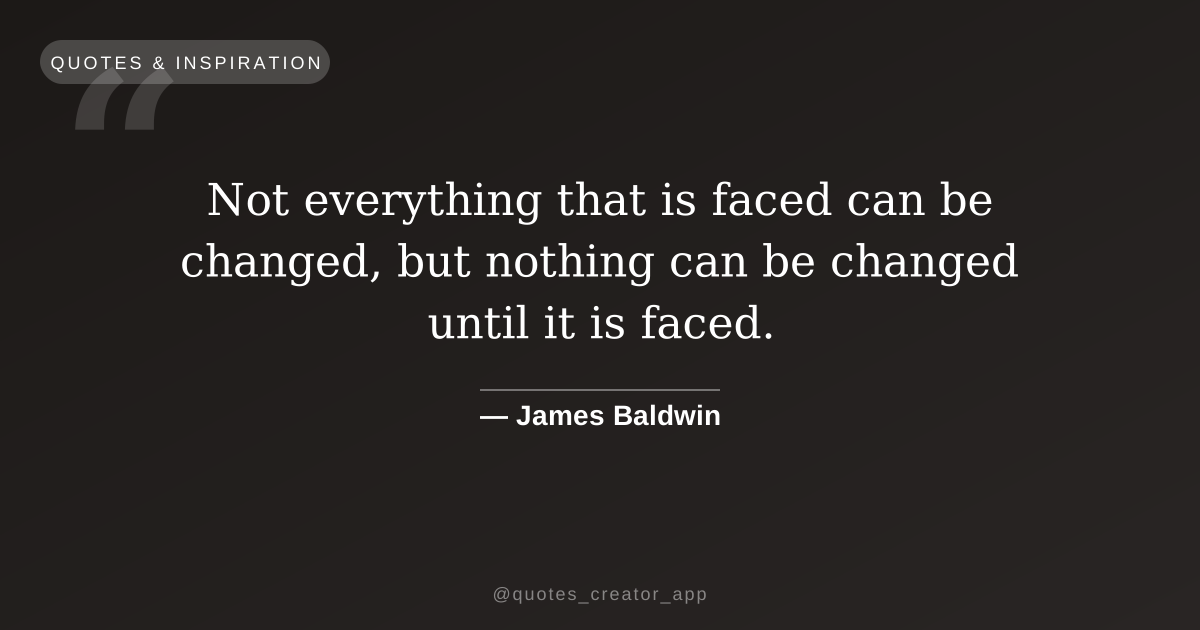
“Not everything that is faced can be changed, but nothing can be changed until it is faced.”
The context
James Baldwin was born in Harlem in 1924, the eldest of nine children, and by the time he was fourteen he had been a child preacher in the Pentecostal church, absorbing the cadences of biblical prophecy and the moral urgency that would define his prose. He left the ministry at seventeen, but he never left the pulpit of the written word. Baldwin wrote his first essays in his twenties while living in Greenwich Village, where he encountered a literary establishment that was willing to publish Black writers only as long as they stayed inside the boundaries white readers found comfortable. He refused those boundaries. In 1948, at the age of twenty-four, he moved to France on a fellowship and what he called “the purest desperation,” carrying seventy dollars and the conviction that he needed to survive as a writer before he could survive as a Black man in America. He stayed in France for most of the next four decades, returning to the United States often but always retreating across the Atlantic to the distance that allowed him to see his country clearly.
That distance shaped everything. From Paris, Baldwin wrote Notes of a Native Son, The Fire Next Time, Giovanni’s Room, and Another Country — works that refused to separate the personal from the political, the sexual from the racial, the American from the universal. He was a Black gay man writing at a time when both categories—Blackness and queerness—were enough to get you dismissed, attacked, or erased. He did not retreat from either identity. Instead, he insisted that the nation’s sickness was its refusal to look squarely at what it had done and who it was. He debated William F. Buckley Jr. at Cambridge in 1965 in what became one of the most famous intellectual confrontations of the century, and he won not by shouting but by forcing the audience to see what they had spent their lives avoiding. Baldwin’s entire career was an extended meditation on the sentence that became his most enduring aphorism: nothing can be changed until it is faced.
The quote itself appears in a 1962 New York Times essay titled “As Much Truth As One Can Bear,” in which Baldwin reflected on the role of the writer in society and the moral cost of self-deception. It was published at a pivotal moment in American history — the Freedom Rides were crisscrossing the South, James Meredith was integrating the University of Mississippi, and the Civil Rights movement was shifting from legal strategy to mass confrontation. Baldwin, watching from his apartment in Saint-Paul-de-Vence, understood that the country was about to be forced to face the reality of its racial caste system. His sentence was both a warning and a promise: the facing would be painful, and many of the wounds exposed would not heal overnight. But the alternative — continued denial — made change impossible. The only door to transformation was the one you were most afraid to walk through.
The meaning
On its surface, the sentence has the structure of a paradox. If facing something does not guarantee change, why bother? Baldwin’s answer is that the question is framed backward. The purpose of facing a painful truth is not to produce an immediate solution; it is to end the lie that prevents any solution from being attempted. A country that refuses to acknowledge its history of racial violence cannot begin the work of racial justice. A person who refuses to admit they have an addiction cannot begin recovery. A relationship that refuses to confront a pattern of betrayal cannot be rebuilt. Baldwin understood that denial is not a neutral state — it is an active force that consumes the energy needed for change. The first step of any transformation is not action; it is acknowledgment. Before you can fix what is broken, you must admit that it is broken in the first place.
The second half of the sentence does subtler work. By saying “not everything that is faced can be changed,” Baldwin inoculates his wisdom against the accusation of naivete. He is not offering a bumper-sticker optimism that promises a happy ending to every courageous confrontation. He is offering something more honest: a realism that refuses to let the possibility of failure become an excuse for inaction. This is the mature voice of someone who has spent his life staring into the abyss of American racism and knows that the abyss will not be filled by any single generation’s effort. Baldwin faced segregation, wrote about it with unmatched clarity, and lived to see legal segregation dismantled. But he also lived long enough to see Northern de facto segregation harden, mass incarceration expand, and the country elect leaders who ran on the votes of people who had called him a slur. He knew that facing a truth does not guarantee its resolution. What it does is clear the ground for a fight that is at least honest, a struggle conducted in the light rather than in the dark.
There is also a psychological dimension to the quote that is easy to miss. Baldwin was deeply influenced by the Protestant sermons of his childhood and by the psychoanalytic currents that ran through mid-century intellectual life. He understood that what individuals and nations refuse to face does not disappear. It festers. A secret that is never spoken becomes a more powerful force than one that is dragged into the open. A wound that is never examined becomes infected. Baldwin’s sentence is a diagnosis of the cost of avoidance: the thing you will not look at owns you. The moment you look at it, you reclaim a measure of agency, even if you cannot immediately fix what you see. The shift from being a victim of a hidden truth to being a witness to it is itself a form of liberation. Baldwin’s quote promises nothing easy. But it promises that the first step of freedom is the willingness to see.
Why it still matters today
In an era saturated with information but starved of honesty, Baldwin’s insight is more urgent than ever. We live in a culture that has perfected the art of looking without seeing. Social media feeds are filled with footage of police violence, climate disasters, and political corruption, and yet the sheer volume of exposure has not translated into proportionate change. Baldwin would recognize this dynamic immediately. He knew that “facing” something is not the same as scrolling past it, sharing it, or expressing outrage about it for an afternoon. Real facing is what happens when you let the truth rearrange your life. It is the difference between being aware of a problem and being implicated in it. The quote is an indictment of performative awareness — the kind that mistakes visibility for action and information for transformation.
The quote also speaks with devastating clarity to the modern crisis of avoidance. We avoid difficult conversations with family members whose politics we despise. We avoid examining our own complicity in systems we claim to oppose. We avoid sitting with the discomfort of our own failures, our own mortality, our own mediocrity. The tools of distraction have never been more sophisticated. Every phone is a machine for not facing the thing that matters most. Baldwin’s sentence lands in this landscape like a voice from another century that somehow saw ours coming. He reminds us that avoidance is not a strategy; it is a kind of slow spiritual death. The thing you will not face will not simply wait for you to be ready. It will grow, calcify, and eventually act on you in ways you cannot control. The only way to break its power is to turn toward it, even if you know you cannot defeat it alone, even if you know the battle will outlast you.
In social justice movements, Baldwin’s quote has become a kind of unofficial motto, and for good reason. Every struggle for equity runs into the same obstacle: the people who benefit from an unjust system have no incentive to face the truth about it. The quote is a tool for naming that dynamic. It does not shame people for their resistance; it simply states a fact. If a society refuses to face its history of dispossession, that society will never redistribute what was stolen. If an institution refuses to face its patterns of exclusion, that institution will never become inclusive. The facing must come first. Baldwin understood that this is not a moralistic demand but a practical one. You cannot treat a disease you refuse to diagnose. You cannot fix a machine whose broken parts you will not inspect. The first act of repair is always the same: you look.
How to apply this in your own life
The most direct application of this quote is to identify one thing in your life that you are avoiding, and to name it out loud. It could be a financial problem you have not looked at, a relationship you have let drift, a health concern you have not investigated, a career change you have been too afraid to consider. Baldwin’s point is that the avoidance itself is doing more damage than the problem. The terror of the unknown is almost always worse than the known. When you finally open the envelope, check the account balance, or have the conversation, you will not necessarily solve the problem. You may discover that the situation is worse than you feared. But you will have crossed the threshold from helpless anxiety to empowered clarity. You will be in a position to act, even if the only action available is to endure honestly. That is what Baldwin means by change. It is not always victory. It is always the end of the lie.
A second practice is to examine the difference between “knowing” and “facing.” Most people know their flaws. They know they drink too much, or that they are coasting in a job they have outgrown, or that they have not forgiven someone who hurt them. Knowing is cheap. Facing is expensive. Facing requires you to stop observing the problem from a safe distance and step into the room where it lives. Baldwin’s quote challenges you to ask, in every area of stagnation: have I actually faced this, or have I merely acknowledged its existence while keeping it at arm’s length? The answer will tell you why you are stuck and what the next move must be.
Finally, the quote offers a framework for patience in the face of slow progress. Because not everything that is faced can be changed, you will inevitably do the hard work of confrontation and still find the problem unresolved. Baldwin’s wisdom prevents this outcome from becoming a reason to give up. The change that follows facing may be partial, delayed, or invisible. But it is the only kind of change that is real. The alternative — change imposed by force or denial — is not change at all; it is rearrangement. The sentence is a commitment to the long game: face the truth, accept that you may not live to see the full transformation, and do it anyway, because the only world worth building is one built on what is real.
Create your own quote graphic with this quote
This is the kind of quote that carries weight. When you pair timeless words with thoughtful design, you create something people want to save, share, and return to. Quotes Creator gives you the tools to turn this quote into a beautiful graphic — custom fonts, gradient backgrounds, and export sizes for every platform.
Why we chose this quote
James Baldwin spent his life doing the thing his most famous sentence describes: he faced the truth about his country, his identity, and his era, and he refused to look away even when looking broke his heart. We chose this quote because it is rare wisdom that works at every scale — from the most intimate personal struggle to the largest questions of collective justice. It offers no false comfort and no quick fix. What it offers is a doorway. On the other side of the door is the possibility of genuine change, and the only way through is the courage to look clearly at what is actually there. In a world that prefers illusion, Baldwin’s sentence is a call to the difficult but liberating work of seeing things as they are, so that we might begin the even harder work of making them what they ought to be.
— ThinkPeak Studio Editorial Team
Create your own quote graphic with this quote
Turn this line into a shareable graphic in seconds — free, no signup needed. For video quotes and 100+ templates, try the Android app.
Advertisement
Enjoyed this article? Get more like it in your inbox.