Quote Explained: “You do not rise to the level of your goals…”
By James Clear, American author, speaker, and creator of the Atomic Habits framework
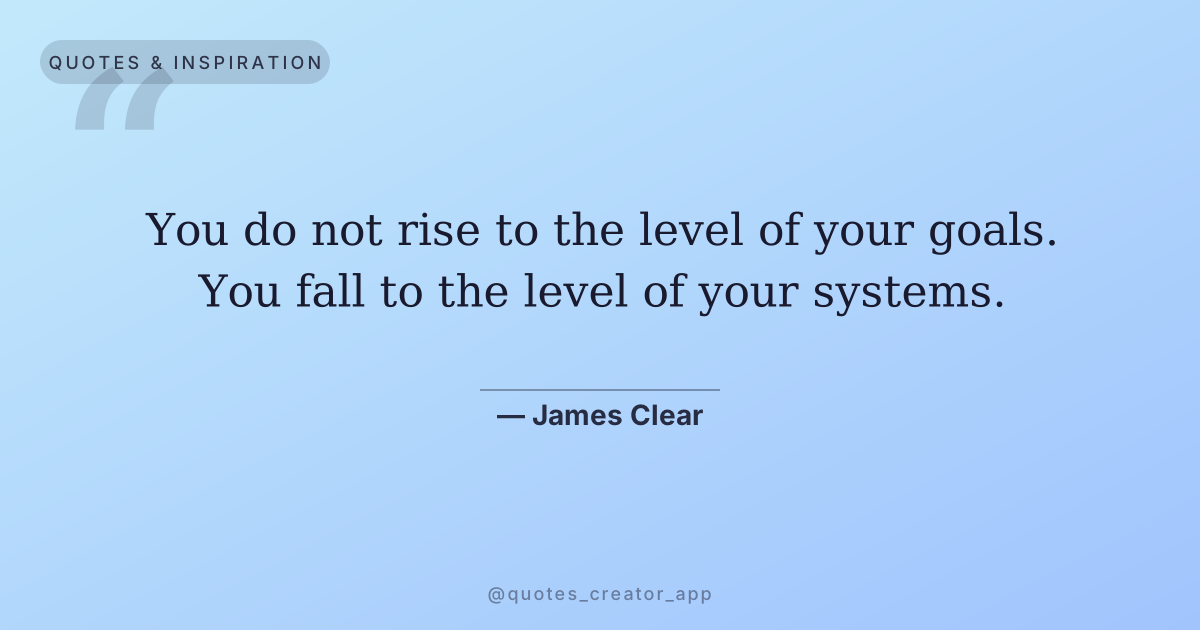
“You do not rise to the level of your goals. You fall to the level of your systems.”
The context
October 2018. James Clear publishes Atomic Habits: An Easy & Proven Way to Build Good Habits & Break Bad Ones, and within months the book becomes a global phenomenon. It spends over three years on the New York Times bestseller list, sells more than 20 million copies, and is translated into over 50 languages. The book’s title was carefully chosen: the word “atomic” carries a double meaning — something tiny and indivisible, and also something with enormous latent power. Clear’s entire thesis rests on this duality. The smallest behavioral changes, compounded over time through consistent systems, produce results that look like overnight transformations to outsiders.
Clear arrived at this framework through practice, not theory. Before writing the book, he had spent years building an audience of millions through his blog and weekly newsletter, where he wrote about the science of habits, decision-making, and human performance. He wasn’t a tenured psychologist or a Silicon Valley guru — he was a writer who had built his career through the very systems he would later codify. He didn’t set a goal to write a bestseller; he built a system of writing two articles per week, every week, for years, and let the outcomes follow. This experience gave his writing a rare quality: it felt not just insightful but lived.
The quote — “You do not rise to the level of your goals. You fall to the level of your systems” — appears early in the book and functions as its thesis statement. It was not, at first glance, a radical idea. Behavioral psychologists from B.F. Skinner to Daniel Kahneman had long demonstrated that human behavior is shaped more by environment, reinforcement, and automatic processes than by conscious intention. What was radical was the phrasing. Clear took a dry academic insight and distilled it into a single sentence so sharp that millions of readers felt an immediate, bodily recognition: this is why my resolutions keep failing.
The meaning
On the surface, the quote draws a clean distinction between outcomes and processes. Goals tell you where you want to go; systems determine whether you get there. But Clear is making a stronger and more subversive claim than “both matter.” He is asserting that when it comes to actual results — the things that show up in your bank account, on the scale, in your body of work — systems dominate goals entirely. You don’t ascend to what you wish for. You sink, every time, to what your daily routines, environmental design, and behavioral defaults make inevitable. The word “fall” is devastatingly accurate. It captures the gravitational pull of habit. Without a system pulling you upward, you drift inexorably downward, toward the path of least resistance.
Consider the person who sets a goal to get fit but has no workout schedule, no gym bag packed by the door, no meal-prep routine, no accountability partner, and no plan for what happens on days when motivation evaporates. They haven’t set a goal — they’ve made a wish, dressed in the language of ambition. Six months later, their fitness hasn’t risen to the level of their goal. It has fallen, precisely as Clear predicts, to the level of their nonexistent system. The insight is humbling and liberating in equal measure: if results are downstream from systems, then fixing your results doesn’t require more ambition or bigger dreams. It requires better defaults. It requires changing what happens automatically before you even have a chance to decide.
There is a deeper philosophical layer as well. The quote reframes achievement not as a goal-setting problem but as an identity question. When Clear says “you fall to the level of your systems,” he is really saying: your outcomes are a lagging measure of the person your daily habits have been sculpting. Goals are about results; systems are about becoming. A writer who has a system of producing 500 words every morning isn’t chasing a word-count target — they are becoming a person who writes. And the person who writes every day will, over time, produce a body of work no amount of goal-setting could match. The system doesn’t just make the outcome likely. It makes the outcome a byproduct of who you are. This is what Clear calls identity-based habits — and this one sentence captures the entire idea.
Why it still matters today
In 2026, the systems-over-goals insight has arguably become more relevant than when the book was first published. The modern workplace is drowning in goal-setting frameworks — OKRs, SMART goals, KPIs, quarterly targets, annual themes — while the systems that actually produce results remain chronically underinvested. Companies set ambitious revenue goals without building the sales processes, product development rhythms, customer feedback loops, and hiring pipelines that generate revenue. They declare a vision and then wonder why quarterly results fall short. The quote diagnoses this failure with surgical precision: the organization didn’t rise to the level of its stated goals. It fell, as organizations always do, to the level of its operational systems.
The quote also pushes back against the comparison culture amplified by social media. Platforms are designed to surface other people’s goals and achievements — the book deal announcement, the before-and-after photo, the revenue milestone. Everyone declares their destination; almost no one shares the vehicle that got them there. This asymmetry creates a distorted perception of how achievement works, leading people to believe that the deciding factor is ambition, vision, or even luck. Clear’s quote cuts through that distortion by redirecting attention from the visible (goals, outcomes, final products) to the invisible (daily reps, environment design, behavioral architecture). In an era defined by economic volatility, AI disruption, and geopolitical uncertainty, focusing on what you can control — your daily systems — rather than what you cannot is itself a form of psychological resilience. It is the difference between hoping for calm seas and learning to build a better boat.
How to apply this in your own life
The most immediate application is to conduct a “systems audit” for one area of your life that feels stuck. Pick a goal you’ve been struggling with — fitness, writing, saving money, learning a skill — and ask honestly: what system do I have in place to support this? What happens automatically, without me having to decide, in the first hour of my day, my week, my month? If the answer is “willpower” or “motivation,” you don’t have a system — you have a wish, and you are already falling. Then, using Clear’s Four Laws of Behavior Change, design a system with minimal friction: make the desired behavior obvious (set out your running shoes the night before), make it attractive (bundle it with something you enjoy), make it easy (start with a two-minute version of the habit), and make it satisfying (track your streak, reward consistency). The goal is not to become a superhuman who never skips a day. The goal is to build an environment where skipping a day requires more effort than showing up.
The deeper shift is one of self-conception. Most of us think of ourselves in terms of what we want: I want to be fit, I want to write a book, I want to save more. Clear’s framework invites a reframe: I am the kind of person who exercises, I am a writer, I am someone who lives below their means. Goals provide direction, but identity provides propulsion. Every time you execute your system — every time you show up for the habit — you are casting a vote for the kind of person you are. The votes accumulate. The identity solidifies. And somewhere down the line, you look up and realize the outcome you once set as a distant goal has arrived — not because you chased it, but because you became the person for whom that outcome was inevitable. This is the quiet revolution buried inside one sentence: you don’t need better goals. You don’t need more ambition. You need a system that makes the right thing the easy thing. Change the system, and the results will take care of themselves.
Create your own quote graphic with this quote
Some quotes deserve to be seen. When you pair timeless words with thoughtful design, you create something people want to save, share, and return to. Use our free online quote maker to turn this exact quote into a shareable image in seconds — no signup needed. For advanced features like video quotes and 100+ templates, try the Quotes Creator Android app.
Why we chose this quote
James Clear has written many memorable lines, but this one is the key that unlocks the entire Atomic Habits framework. It is not merely a quotable aphorism — it is a diagnostic tool. When something in your life isn’t working, this sentence asks you to stop interrogating your ambition and start interrogating your environment. The quote has been shared millions of times across social media, saved in countless note-taking apps, and printed on office walls, because it does what the best quotes do: it names a truth you already sensed but couldn’t quite articulate. And once you hear it, you can’t unhear it. Every stalled project, every abandoned resolution, every gap between intention and action suddenly has the same explanation: the system wasn’t there to catch you.
— ThinkPeak Studio Editorial Team
Create your own quote graphic with this quote
Turn this line into a shareable graphic in seconds — free, no signup needed. For video quotes and 100+ templates, try the Android app.
Advertisement
Enjoyed this article? Get more like it in your inbox.