Quote Explained: “You do not rise to the level of your goals. You fall to the level of your systems.”
By James Clear, author of Atomic Habits
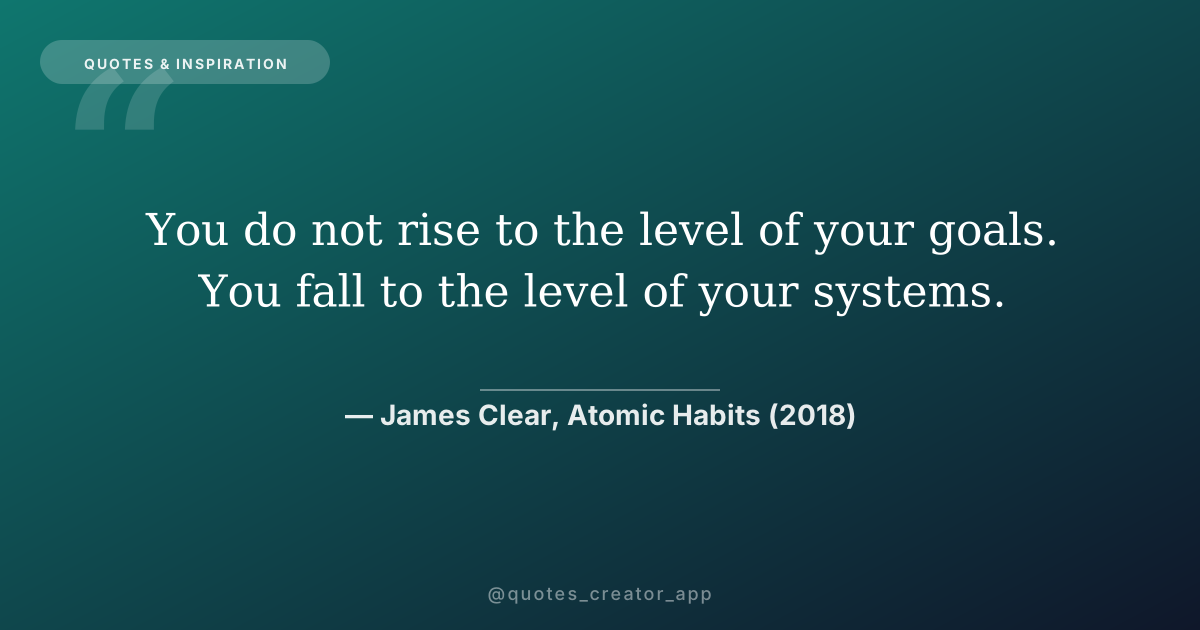
“You do not rise to the level of your goals. You fall to the level of your systems.”
The context
The origin story of this quote is inseparable from a near-fatal accident. On the final day of his sophomore year of high school, James Clear — a promising baseball pitcher — was struck in the face by a teammate’s bat during a misplayed practice drill. The blow shattered his nose, fractured his eye socket, and sent bone fragments into his brain. He was airlifted to a hospital, placed in a medically induced coma, and, when he woke, faced a grueling question: whether he would ever fully recover, let alone play again. The answer did not come from ambition. It came from a quiet, almost unglamorous discipline. Unable to do much else, he began stacking tiny, repeatable routines — getting to the gym when he did not feel like it, making his bed, keeping a small journal — and watched as these small systems, compounded over months and years, reconstructed both his body and his confidence. That teenage lesson became the seed of everything he would later write.
Clear eventually returned to the mound and became a starting pitcher at Denison University, but his real calling lay elsewhere. He began writing about habits, decision-making, and continuous improvement on a blog that grew into one of the largest audiences in the self-improvement space. In October 2018 he published Atomic Habits, a book that synthesized decades of behavioral science — from B. J. Fogg’s research on tiny behaviors to Charles Duhigg’s popularization of the habit loop to the psychology of implementation intentions — into a single, deceptively simple framework. The book became a phenomenon: more than 20 million copies sold, years on bestseller lists, translations into dozens of languages. The two-sentence quote at its heart is the book’s thesis compressed into a memorable aphorism: a statement that takes aim at the entire goal-setting industry and, in eleven words, redirects the reader’s attention from the outcome to the process.
To understand why the line landed, you have to see what it was up against. For decades, self-help had been dominated by the cult of the goal — SMART goals, vision boards, New Year’s resolutions, the “dream big” ethos of motivational culture. Clear arrived at a moment when that model was showing its fatigue. People set the same resolutions every January and abandoned them by February; companies wrote elaborate strategic plans that changed nothing on the ground; individuals collected aspirations they never converted into behavior. Clear’s insight was not that goals are worthless — he is careful to grant them a purpose — but that they are not the mechanism of change. They are the destination, and a destination tells you nothing about the road. The quote became a kind of corrective to an entire era of wishful thinking, which is precisely why it spread far beyond the book.
The meaning
The quote’s power is in its symmetry and its verbs. It is two short sentences, each a complete observation, mirroring each other in structure while opposing each other in direction. “You do not rise to the level of your goals.” The word “rise” flatters us — it speaks to our self-image, our ambitions, our belief that wanting something badly enough will elevate us. Then the second sentence drops the hammer: “You fall to the level of your systems.” “Fall” is the key. We are not pulled upward by our aspirations; we sink down to the level of what we actually do, day after day. The contrast between “rise” and “fall” does all the philosophical work. Goals are aspiration; systems are gravity. And in the end, gravity always wins. Your outcomes are not determined by the height of your intentions but by the quality of the routines that carry you through the ordinary days when no one is watching.
What the quote really dismantles is the assumption that desire is the scarce resource. It is not. Everyone, Clear observes, wants the same broad things — to be healthy, wealthy, free, respected, loved. Olympic gold medalists and last-place finishers shared the same goal of winning; that is what made them competitors in the first place. If goals were the differentiator, the medalists and the also-rans would be indistinguishable, because they wanted the same thing. What separates them is invisible and unglamorous: the training schedule kept in the rain, the recovery routine, the sleep discipline, the thousands of small decisions that nobody applauds. The quote is an attack on the romance of the outcome and a defense of the dignity of the process. It insists that the question “what do you want?” is far less useful than “what are you willing to do every day, whether or not it feels good?”
Beneath this lies a deeper insight about identity and compounding that most casual readers miss. Clear’s framework is not merely about mechanics — it is about who you are becoming. A system is not a to-do list; it is a vote, cast daily, for a particular kind of person. You do not become a writer by finishing a book; you become a writer by writing, and the person who writes a little every day is a writer long before the book exists. Similarly, outcomes lag behind systems. A single workout changes almost nothing; a year of workouts changes a body. A single paragraph changes almost nothing; a year of paragraphs changes a career. The quote is therefore also a warning about the invisible cost of poor systems: just as good habits compound quietly into success, bad habits compound quietly into failure, and by the time the results arrive, the habits that produced them are long entrenched. You are always falling to the level of your systems — the only question is whether that level is rising or sinking.
Why it still matters today
In 2026, the quote is more urgent than when it was written because the environment has been engineered to reward the absence of systems. The attention economy — social media feeds, streaming platforms, notification-driven apps — is built to interrupt routines and hijack the very consistency the quote champions. Every ping is a small assault on your system. Meanwhile, the tools of the modern workplace have blurred the boundary between aspiration and execution: everyone has a productivity app, a habit tracker, a beautifully color-coded calendar, and yet rates of distraction, burnout, and “quiet quitting” continue to climb. The proliferation of goal-tracking technology has not produced a generation of goal-achievers; if anything, it has produced a generation that is excellent at declaring intentions and mediocre at sustaining them. Clear’s insight cuts through the noise by redirecting attention to the one thing that still works in a distracted world: the boring, unshareable, repeatable routine.
The quote also speaks directly to a cultural moment obsessed with announcements over evidence. Social media rewards the declaration of a goal — the launch post, the before picture, the “new chapter” caption — with immediate dopamine, long before any result exists. This inverts the psychology Clear describes: people get the feeling of accomplishment from stating a goal rather than from building the system that would achieve it. The quote is a quiet rebuke to this entire dynamic. It reminds us that nothing about your life changes when you set a goal; it changes only when your daily defaults change. In an era where individuals and organizations alike are drowning in mission statements, OKRs, and vision documents, the message that “you fall to the level of your systems” is a bracing call to look not at what you say you will do, but at what you actually do, automatically, when motivation runs out.
How to apply this in your own life
The practical application begins by shifting the unit of attention from the outcome to the repetition. Clear’s own method offers a concrete starting point: make it obvious, make it easy, make it attractive, make it satisfying. Reduce the friction in front of good habits and increase the friction in front of bad ones. If you want to read more, place a book on your pillow and delete the social media app from your home screen. If you want to exercise, decide on a two-minute version — two minutes is the system; two hours is the goal. The point is not to rely on willpower, which is a finite and unreliable resource, but to design an environment where the desired behavior is the path of least resistance. Then track the streak, not the result: the person who writes every day, regardless of quality, is building a system; the person waiting for inspiration is not. The discipline is to stop asking “did I reach my goal?” and start asking “is my system producing movement, however small?”
The deeper application is existential, and it inverts the way most people live. Most of us spend our lives in the future tense — we will be happy when we get the job, the body, the book deal, the relationship. Clear’s quote relocates the whole enterprise to the present tense. You are not rising toward a future self; you are falling, right now, to the level of the person your current habits are building. Every day is a vote for the kind of person you are becoming, and no one ever becomes a goal; they become a system of habits wearing a name. The invitation is to choose your identity first and let the goals follow — to decide “I am the kind of person who writes,” “I am the kind of person who exercises,” “I am the kind of person who keeps their word” — and then let each small action be evidence for that identity. The goal is the destination, and it will be reached or abandoned. The system is the road, and the road is where you actually live. That is why the quote endures: it is not a trick for getting more done. It is a way of understanding, with ruthless clarity, who you are actually becoming.
Create your own quote graphic with this quote
This is the kind of quote that changes how you measure your life. When you pair an idea this clarifying with thoughtful design, you create something worth saving and returning to. Use our free online quote maker to turn this exact quote into a shareable image in seconds — no signup needed. For advanced features like video quotes and 100+ templates, try the Quotes Creator Android app.
Why we chose this quote
Most people encounter James Clear through clipped social-media snippets that reduce Atomic Habits to a list of life hacks, missing the philosophical architecture underneath. We wanted to treat the quote as what it actually is: not a productivity tip but a complete account of how character is formed, one ordinary repetition at a time. The sentence is rare in that it is both a comfort and a confrontation — it relieves you of the burden of perfect motivation while holding you ruthlessly accountable for your daily defaults. In a culture that endlessly celebrates declaring goals, it is a reminder that nothing changes until your systems change, and that the person you are becoming is decided in the boring, invisible moments no one ever posts about. That is why it stays with people long after the book is closed.
— ThinkPeak Studio Editorial Team
Create your own quote graphic with this quote
Turn this line into a shareable graphic in seconds — free, no signup needed. For video quotes and 100+ templates, try the Android app.
Advertisement
Enjoyed this article? Get more like it in your inbox.