Quote Explained: “The difficulty lies, not in the new ideas, but in escaping from the old ones”
By John Maynard Keynes, British economist and philosopher
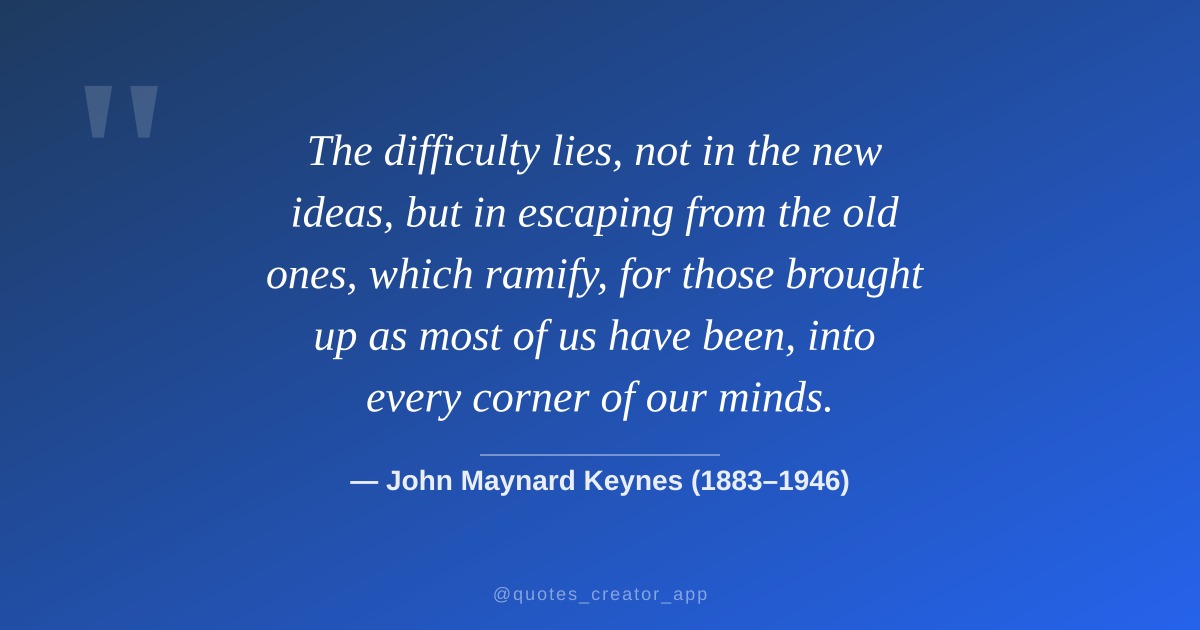
“The difficulty lies, not in the new ideas, but in escaping from the old ones, which ramify, for those brought up as most of us have been, into every corner of our minds.”
The context
On December 13, 1935, John Maynard Keynes signed off on the preface to a book that would reorganize the economic thinking of the twentieth century. The General Theory of Employment, Interest and Money was published two months later, in February 1936, into a world that classical economics could no longer explain. The Great Depression was in its seventh year. Unemployment in Britain had exceeded twenty percent of the insured workforce; in the United States it had peaked at roughly a quarter of all workers. The prevailing orthodoxy insisted that markets were self-correcting — that wages would fall, prices would adjust, and full employment would return on its own if governments simply stayed out of the way. Millions of idle workers and shuttered factories testified, year after year, that something in that theory was broken. Keynes wrote the General Theory to explain what, and the preface was his warning to readers about how hard the explanation would be to accept.
What makes the sentence remarkable is who Keynes was aiming it at — including himself. He was not an outsider throwing stones at the establishment. He was the establishment: educated at Eton and Cambridge, a student of Alfred Marshall (the father of the very orthodoxy he was now dismantling), a celebrated author, a Treasury adviser, and the man whose The Economic Consequences of the Peace (1919) had made him world-famous for predicting the disaster of the Versailles settlement. In the same preface, he described the book as “a long struggle of escape” from “habitual modes of thought and expression.” The theory he was overturning was the theory he had been trained in, taught, and defended for most of his career. The quote is therefore not a boast about having new ideas. It is a confession about how painful it was to give up old ones.
The immediate audience was his fellow economists — the preface says explicitly that the book is “chiefly addressed to my fellow economists” — and the reception proved his point. Senior figures in the profession, including his own former teachers’ circle at Cambridge and the London School of Economics, resisted the book fiercely; it was the younger generation, less invested in the old framework, who adopted it with something like evangelical enthusiasm. Paul Samuelson later famously observed that the General Theory caught most economists under the age of thirty-five “with the unexpectedness of a virulent disease.” Within a decade, Keynesian economics had become the operating system of Western economic policy — a vindication not just of the book’s ideas, but of the preface’s psychological insight into why new ideas take a generation to win.
The meaning
On the literal level, Keynes is making a claim about where intellectual resistance actually lives. We tend to imagine that the hard part of progress is invention — the flash of genius that produces the new idea. Keynes says the opposite. In the sentence immediately before this one, he insists that his ideas are “extremely simple and should be obvious.” The genuine obstacle is the demolition work: dislodging the old ideas already in place. And his choice of verb is precise. Old ideas “ramify” — they branch, like roots, “into every corner of our minds.” They are not stored in one drawer that can be emptied. They are woven through our vocabulary, our assumptions, our sense of what a reasonable person believes. You cannot simply delete an old idea, because it is load-bearing; other beliefs rest on it.
The deeper insight is that this is a theory of learning, not just a remark about economics. Keynes is describing what philosophers of science would later formalize: Thomas Kuhn’s The Structure of Scientific Revolutions (1962) argued that science advances not by smooth accumulation but by paradigm shifts, in which an old framework must collapse before a new one can be seen at all — and that the old guard often never converts, but simply retires. Keynes anticipated this by a quarter century, and added the crucial psychological detail: the difficulty is greatest “for those brought up as most of us have been.” Expertise itself is the trap. The more thoroughly you were trained in a framework, the more corners of your mind it occupies, and the more expensive it becomes — professionally, socially, emotionally — to escape it. The novice’s advantage is not intelligence; it is the absence of roots.
There is also a quiet humility in the sentence that gives it its emotional force. Keynes does not say the difficulty lies in your old ideas. He says “our minds” — including his own. He frames the whole book as an escape he barely managed, not a summit he conquered. That framing disarms the reader: instead of being lectured by a genius, you are being invited into a struggle by a fellow prisoner. It is why the quote resonates far beyond economics. Anyone who has tried to change a belief they were raised with — about money, religion, family, their own limitations — recognizes the sensation Keynes describes: the new idea is easy to state and almost impossible to live, because the old one answers first, automatically, in every corner of the mind.
Why it still matters today
Nearly a century later, the quote has become a touchstone in conversations that have nothing to do with monetary theory. It is cited in business books on innovation and organizational change, where “unlearning” has become a discipline in its own right — futurist Alvin Toffler’s often-repeated claim that the illiterate of the twenty-first century will be “those who cannot learn, unlearn, and relearn” is essentially Keynes’s preface restated for the information age. It appears in discussions of why incumbent companies miss disruptive technologies: Kodak invented the digital camera and shelved it; Blockbuster passed on Netflix; established firms in every industry have watched newcomers seize opportunities that their own veterans were too well-trained to see. In each case the failure was not a shortage of new ideas — the ideas were often generated in-house — but an inability to escape the old ones that defined how the business understood itself.
The quote speaks just as directly to the present moment of technological and social upheaval. The rise of artificial intelligence is forcing professionals in law, medicine, education, and software to re-examine assumptions about what their work fundamentally is — and the loudest resistance often comes not from those who understand the technology least, but from those whose expertise is most deeply rooted in the old way of working. The same dynamic shapes public life: polarized debates persist not because better arguments are unavailable, but because the old ideas on each side have ramified into identity itself, so that changing one’s mind feels like losing oneself. Keynes’s sentence remains the most elegant diagnosis we have of why facts alone rarely change minds: the battle is never between a new idea and empty space. It is between a new idea and an old one that got there first and built fortifications.
How to apply this in your own life
The first application is diagnostic: when you find yourself instantly rejecting a new idea, treat the speed of your rejection as data. A conclusion reached in half a second was not reasoned; it was retrieved. Ask yourself Keynes’s implicit question — not “is this new idea right?” but “which old idea of mine is it threatening?” Naming the incumbent belief is half the work, because old ideas draw their power from operating invisibly, as “common sense” rather than as claims that could be wrong. A practical exercise: write down three beliefs you hold about your career, your finances, or your abilities that you acquired before the age of twenty-five, and ask honestly what evidence would change your mind about each. If the answer is “nothing,” you have found a root system worth examining.
The second application is structural: since escaping old ideas is genuinely difficult — Keynes called it a “long struggle,” not a decision — build habits that make escape easier. Seek out intelligent people who were trained differently from you, because their blind spots and yours will not overlap. When facing a major decision, run a “clean sheet” test: if you were arriving at this situation today, with no history and no sunk costs, what would you do? The gap between that answer and what you are actually doing measures how much of your behavior is serving old ideas rather than current reality. And extend to yourself the patience Keynes extended to his colleagues: expect the old ideas to answer first, again and again, and count it as progress each time you notice them doing so. Escaping is not a single act of insight. It is a practice of repeatedly choosing the new thought after the old one has already spoken.
Create your own quote graphic with this quote
This is the kind of quote that carries weight. When you pair timeless words with thoughtful design, you create something people want to save, share, and return to. Use our free online quote maker to turn this exact quote into a shareable image in seconds — no signup needed. For advanced features like video quotes and 100+ templates, try the Quotes Creator Android app.
Why we chose this quote
We featured Keynes earlier this summer for his most famous line — “In the long run we are all dead” — but this sentence from the General Theory preface may be the more useful one to actually live by. It explains why smart people resist good ideas, why experts miss revolutions happening in their own fields, and why changing your mind feels less like updating a file and more like pulling up roots. Written by a man in the act of dismantling his own life’s training, it carries an honesty that most advice about “innovation” lacks. In a year when new tools and new realities are arriving faster than our mental models can absorb them, Keynes’s ninety-year-old warning reads like it was written this morning.
— ThinkPeak Studio Editorial Team
Create your own quote graphic with this quote
Turn this line into a shareable graphic in seconds — free, no signup needed. For video quotes and 100+ templates, try the Android app.
Advertisement
Enjoyed this article? Get more like it in your inbox.