Quote Explained: “Not all those who wander are lost.”
By J.R.R. Tolkien, English writer and philologist
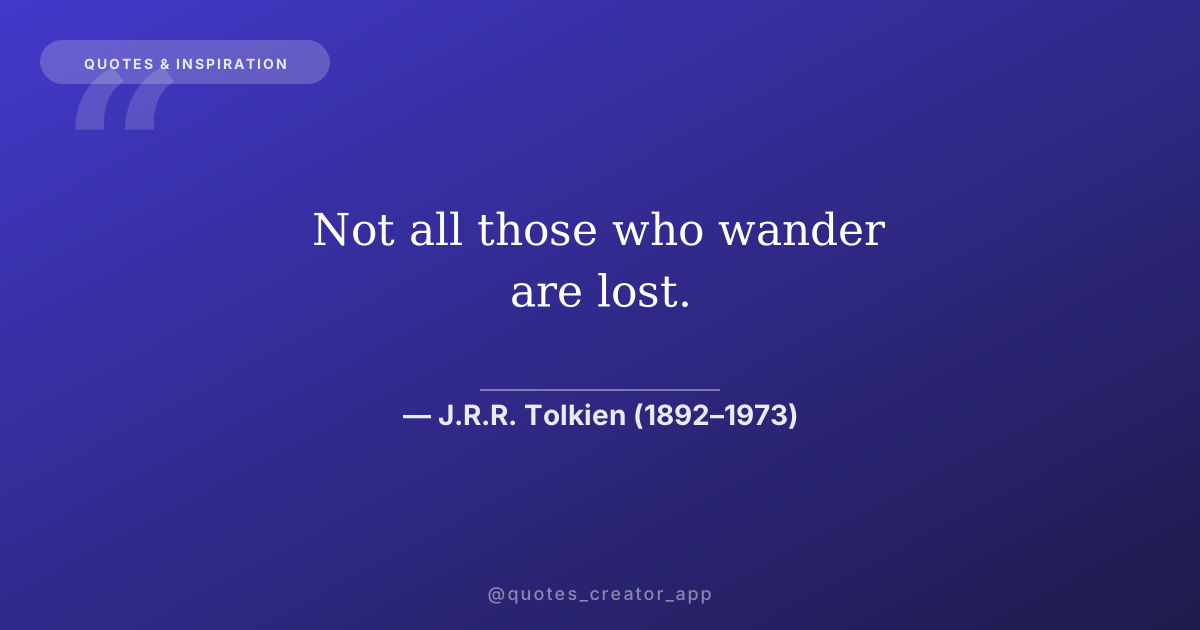
“Not all those who wander are lost.”
The context
The line comes from a riddle, though most of the people who now quote it have never read the poem it belongs to. In The Fellowship of the Ring, the hobbits arrive at the village of Bree and find a letter left for them by the wizard Gandalf, warning them not to trust strangers and enclosing a poem about a mysterious Ranger named Strider. The poem — “All that is gold does not glitter” — runs only eight lines, and it is written to reassure the hobbits that this weather-beaten, unimpressive man with a sword and a pipe is not what he appears to be. He is Aragorn, heir to the throne of Gondor, and he has spent decades wandering the wild in disguise, protecting lands whose people do not know his name. The second line, “Not all those who wander are lost,” is spoken about him — a defense of a man who looks aimless to everyone who sees him but is, in fact, walking the only path that could ever lead him home.
The context of Tolkien’s own life gives the line its deeper gravity. Before he became the author of the best-selling novel of the twentieth century, Tolkien was a philologist and Oxford professor who spent decades writing an enormous private mythology — The Silmarillion and its surrounding legends — that almost no one had read and that publishers had little interest in. He was, by any conventional measure, a man who had wandered: through two world wars (he fought in the trenches of the Somme), through a career spent teaching dead languages, through a vast creative project that appeared to be going nowhere. The Hobbit was published almost by accident, and The Lord of the Rings took him twelve more years to finish, delayed by the war, by doubt, and by the sheer scale of the thing. The man who wrote “Not all those who wander are lost” was writing from hard experience about what it feels like to be told, for decades, that your wandering is a waste of a life.
The poem itself inverts a proverb — “all that glitters is not gold” — and in doing so it quietly dismantles the logic of appearances. The whole riddle is built on the difference between what a person is and what a person looks like: gold that does not glitter, a king who looks like a vagrant, roots that survive a frost nobody can see. Tolkien was a deeply Catholic and deeply conservative medievalist, but he was also a man who had learned that the world rewards the wrong things — that the brightest surfaces are often the shallowest, and that the most valuable people are frequently the ones the world has chosen to overlook. That is the ground from which the line grows. It is not a slogan about travel or backpacking. It is a poem written by a soldier and a scholar who had been lost and found his way again, and who wanted the people he loved to know that looking lost is not the same as being lost.
The meaning
The sentence works because of a single, deceptively careful word: all. Tolkien does not say that wandering is good, or that everyone who wanders knows where they are going. He says that not all who wander are lost — which means the line concedes, with complete honesty, that some of them are. Some wandering is genuine drift, genuine escape, genuine refusal to grow up. The line refuses to pretend otherwise. What it insists on is something narrower and more precise: that you cannot tell which kind of wandering a person is doing just by looking. The outward behavior — the moving without an obvious destination, the years spent off the map, the life that refuses to march in a straight line — is identical in both cases. The difference is invisible. It lives in the direction a person is facing on the inside, which no observer can measure and no algorithm can track.
There is also a quiet argument buried in the word “wander” about the relationship between purpose and certainty. The modern imagination tends to treat them as the same thing: a person with a purpose is a person with a plan, a destination, a five-year strategy, a clear and public trajectory. Tolkien’s line separates them. To wander is not to be without direction; it is to hold your direction without yet knowing the exact shape of the road. Aragorn wanders for decades precisely because he has a purpose — he is guarding the Shire, waiting for the moment when he must reveal himself, preparing in obscurity for a task that only he can do. His wandering is not the absence of a destination but the patient, unglamorous work of a man whose destination is a long way off. The line insists that a life can be full of purpose and still look, from the outside, like it is going nowhere — because some journeys are too long, and too important, to be explained to the people watching from the road.
Beneath all of this is Tolkien’s larger philosophy of the “long defeat” — his conviction that the most important work is often the kind that does not finish in a single lifetime, that the world is not mended by a single dramatic victory but by countless small, unseen acts of faithfulness. “Not all those who wander are lost” is the personal, individual version of that belief. It is a promise that there is a difference between delay and failure, between the long way and the wrong way, between being patient and being stuck. It gives permission for a life to take time — to circle back, to try the wrong road, to spend years in the wilderness before arriving anywhere worth staying. And it does so without ever pretending that the wandering is the point. The wandering is not romanticized into an end in itself; it is honored as the path, sometimes the only path, that leads a person to the place they were always meant to be.
Why it still matters today
The line has become one of the most quoted sentences in English — printed on travel posters, tattooed on wrists, stitched onto journals, pinned above a million Pinterest boards — and it has achieved that reach for reasons both beautiful and slightly uncomfortable. On the surface it is a reassurance for an age of permanent comparison, in which every person can see, in real time, everyone else’s highlight reel: the promotions, the engagements, the perfectly curated lives that make any period of uncertainty feel like failure. Into that landscape, Tolkien’s line lands like permission. It tells a generation raised on straight-line success stories that not having it all figured out is not the same as being broken — that a life which looks delayed, meandering, or off-course from the outside may simply be taking the long road. That is the beautiful reason, and it is a genuine one.
But the line also matters because of how it has been diluted, and understanding that dilution is part of understanding the quote. Stripped of its poem, reduced to a caption under a photograph of a beach, the line can easily be made to serve the opposite of what Tolkien meant — a soft defense of aimlessness, an excuse for never committing to anything, a gentle way of saying that wandering is an end in itself. Tolkien would have rejected that reading completely. For him, the whole point of the line is that the wandering is justified by its destination — that Aragorn is not lost because he is, however invisibly, on his way somewhere. In an age that has turned both wandering and certainty into commodities, the line endures because it holds two truths in balance at once: you are allowed to be on the long road, and the road still has to lead somewhere. It is precisely that tension — patience without drift, direction without rigidity — that keeps the quote from becoming either a self-help cliché or a slogan for giving up.
How to apply this in your own life
The most honest application is not to print the line on a poster and stop there, but to ask what it actually demands. If not all who wander are lost, then the question the quote puts to you is not “am I moving?” but “am I moving toward something?” — and that question cannot be answered by anyone watching from the outside. Take an honest inventory of the parts of your life that look like wandering: the career that has not settled, the project that has taken years, the relationship that has not followed the expected timeline. For each one, ask whether it is Aragorn’s kind of wandering — patient, purposeful, pointed somewhere real even if hidden — or genuine drift, movement without a destination that you are using to avoid the harder question of where you want to go. The line is not a permission slip for drift; it is a request for honesty about which kind of traveler you are.
The second application is to extend Tolkien’s charity to other people. The whole riddle exists because Gandalf must persuade frightened hobbits to trust a man who looks like a threat — to see past the surface of a stranger and recognize the king underneath. Most of us are far quicker to judge someone else’s wandering than our own: the friend who changed careers, the sibling who is taking too long, the colleague whose path does not look like ours. The quote, read generously, is an instruction to withhold that judgment — to remember that the value of a life is not visible on its surface, that “all that is gold” does not always glitter, and that the person who looks most lost may simply be on the longest and most important road of all. You cannot know from the outside whether a wanderer is lost. The only person whose direction you can ever truly judge is yourself — so judge yourself honestly, judge others gently, and keep walking.
Create your own quote graphic with this quote
This is a quote that stops people mid-scroll. When you pair timeless words with thoughtful design, you create something people want to save, share, and return to. Use our free online quote maker to turn this exact quote into a shareable image in seconds — no signup needed. For advanced features like video quotes and 100+ templates, try the Quotes Creator Android app.
Why we chose this quote
Tolkien is usually quoted as escapism — reduced to hobbits and dragons, dismissed by critics who could never accept that fantasy might carry philosophy. But “Not all those who wander are lost” is the opposite of escape: it is a hard-won piece of realism written by a man who survived the Somme and spent decades on a creative project everyone thought was a dead end. We wanted to restore the line to its riddle, to the soldier and scholar who wrote it, and to the balance it insists on — that a life may take the long road, but only if the road is still leading somewhere. In a culture obsessed with visible success and instant results, this is a quote that defends the unseen, the patient, and the slow — and it deserves to be read as the serious philosophy it actually is.
— ThinkPeak Studio Editorial Team
Create your own quote graphic with this quote
Turn this line into a shareable graphic in seconds — free, no signup needed. For video quotes and 100+ templates, try the Android app.
Advertisement
Enjoyed this article? Get more like it in your inbox.