Quote Explained: “A journey of a thousand miles begins with a single step.”
By Lao Tzu, ancient Chinese philosopher
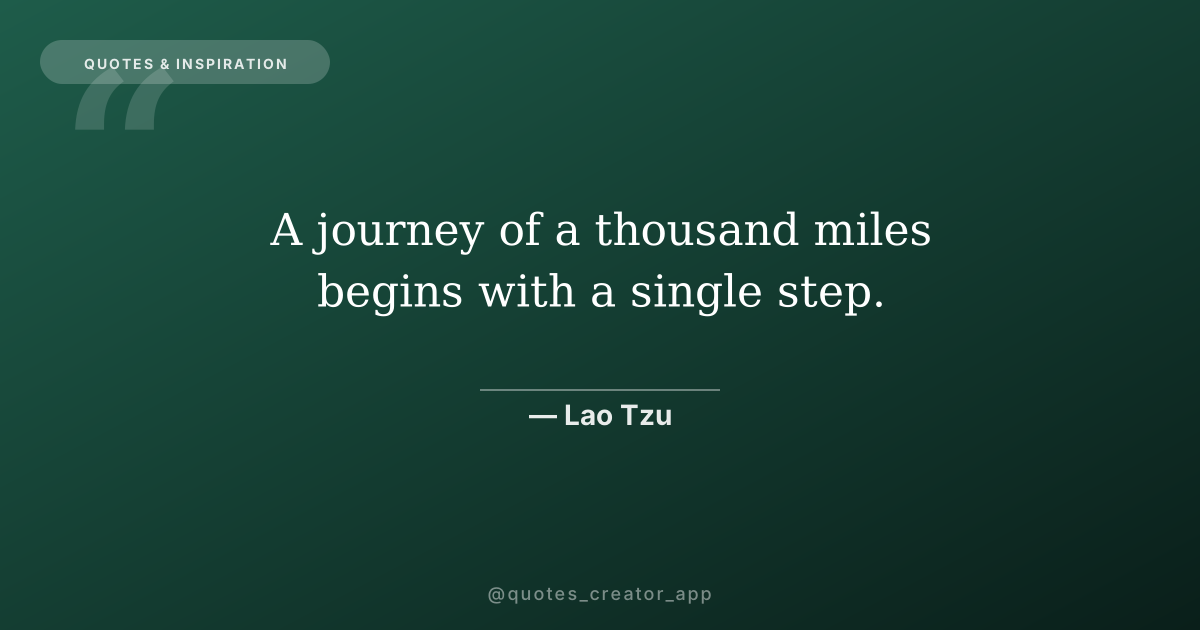
“A journey of a thousand miles begins with a single step.”
The context
The line comes from the sixty-fourth chapter of the Tao Te Ching, the slender book of eighty-one verses that has been called the most translated text on earth after the Bible, and the founding document of Taoism. Almost everything we think we know about its author is legend. Lao Tzu — literally “the Old Master” — was said to have served as keeper of the royal archives at the court of the Zhou dynasty, where a lifetime of reading left him quietly disillusioned with the vanity of worldly ambition. According to the oldest account, when he finally resolved to leave civilization behind and ride an ox toward the western mountains, the border guard begged him to leave a record of his wisdom before vanishing. Lao Tzu sat down and, in a single sitting, wrote out the whole of the Tao Te Ching — then crossed the pass and was never seen again.
Whether or not any of that happened, the book itself is real enough, and its sixty-fourth chapter is one of its most practical. It is a meditation on the power of the small and the early. “Deal with it before it happens,” it begins. “Set things in order before there is confusion.” Then it piles image upon image, all pointing the same direction: a tree as great as a man’s embrace grows from a tiny shoot; a terrace nine storeys high rises from a single basket of earth. And finally, the image that escaped the page and entered every language on the planet: a thousand-mile journey begins beneath one foot. The proverb is not a motivational slogan. It is the conclusion of an argument Lao Tzu has been quietly building — that great things do not announce themselves as great, but arrive disguised as beginnings too small to fear.
The context of Taoist thought sharpens the line further. Lao Tzu taught wu wei, often translated as “effortless action” or “non-doing” — not passivity, but the art of moving with the grain of things rather than against it. In that light, the “single step” is not merely the first unit of a long toil. It is the natural place to begin precisely because it is the one thing that requires no heroism, no force, and no guarantee. The river does not leap to the sea; it begins by moving. Lao Tzu is describing how the world actually works — and inviting us to stop arguing with it.
The meaning
At its most literal, the proverb dismantles an illusion: that any great achievement is a single, indivisible, overwhelming act. It is not. It is an accumulation of small acts, and the smallest of them is the first. The “thousand miles” names the whole of the undertaking — the intimidating, distant, finished thing — while the “single step” names the only part of it that can actually be performed right now. By placing them side by side, Lao Tzu performs a quiet feat of reframing. The journey does not shrink, but it stops being a wall and becomes a path. You do not have to travel a thousand miles today. You only have to take one step. That reframing is precisely what the paralyzed mind needs, because paralysis is almost never caused by the size of the task itself but by the demand to hold its whole size in view at once.
The deeper wisdom is about the nature of process. The first step is the only step that does not yet exist as momentum. Every step after it is easier, because it rides on the one before. Lao Tzu understood something that modern behavioral science would not formalize for another two millennia: that the hardest part of any endeavor is not the middle, where effort is habitual, but the threshold, where effort must be willed into being against the inertia of inaction. The proverb therefore contains a subtle and liberating asymmetry. The size of the goal and the size of the first action are not in proportion to each other, and they do not need to be. A life’s work can begin with a sentence. A marriage can begin with a hello. The step is small precisely because the journey is large, and it is enough.
There is a final layer, and it is distinctly Taoist. The line is not really about productivity; it is about alignment with how things grow. A seed does not hurry, and it does not skip ahead to the flower. It begins. Lao Tzu is telling us that the moment of beginning is not a trivial inconvenience on the way to the real thing — it is the real thing, the point where intention becomes motion and the abstract becomes actual. The thousand miles is not somewhere else, waiting at the end. It is folded, entire, inside the first step, in the same way the oak is folded inside the acorn. To begin is not to start the journey. It is, in a sense, to already be on it.
Why it still matters today
The line has never been more necessary than now, because no age has ever made the distance between desire and action feel so wide while making the world look so effortless. We live inside a feed of finished products: overnight successes, overnight bodies, overnight fortunes, all compressed into highlight reels that hide the thousands of invisible steps beneath them. The effect is a kind of ambient paralysis. People abandon dreams not because they cannot do the work but because the gap between where they stand and the polished result feels unbridgeable. Lao Tzu’s proverb, surfacing on a poster or in a friend’s advice, does its work by collapsing that gap. It reminds the overwhelmed that the bridge is not built in a single span, and that no one — not the founder, the artist, or the athlete — ever traveled it any other way than one step at a time.
Its resurgence also tracks a modern, evidence-based rediscovery of ancient patience. The explosion of interest in habit formation — the “two-minute rule,” “tiny habits,” the Japanese concept of kaizen, the “one percent better every day” philosophy — is, in large part, a rediscovery of what Lao Tzu wrote down two and a half millennia ago. Behavioral scientists now confirm what the Tao Te Ching always knew: that small, immediate, almost trivial actions are the reliable engine of enormous change, and that grand resolutions are its most common graveyard. In a culture that glamorizes the leap, the quote is a quiet act of rebellion on behalf of the step. It tells the burnt-out, the stuck, and the self-doubting that the only meaningful measure of progress today is whether you began — and that beginning is always within reach.
How to apply this in your own life
The most honest way to honor the proverb is to let it shrink your next beginning down to a size you cannot refuse. Take the thing you have been postponing — the book, the business, the degree, the health reset, the reconciliation — and instead of planning it, perform the smallest possible version of its first step right now. Write one sentence. Send one message. Put on your shoes. Open one account. The rule is that the step must be so small that the part of your mind that makes excuses finds nothing to argue with. Lao Tzu’s genius is not in demanding a heroic first step; it is in revealing that the first step needs no heroism at all. The aim is not to finish, but to begin — because beginning, not finishing, is the step that most people never take, and it is the only one that cannot be taken for you.
The second application is to stop measuring yourself against the thousand miles. So much suffering comes from comparing your first, clumsy step to someone else’s completed journey. Lao Tzu asks you to keep your eyes on the step, not the summit — to trust that the tree grows from the shoot, the terrace from the basket of earth, the journey from the foot. Practice the discipline of the ordinary day: do the small thing well, repeat it, and let momentum be the argument. The proverb is not a promise of speed; it is a promise of sufficiency. It does not say the journey is short. It says the journey is possible, and that possibility is yours the moment you move. Whatever has been waiting for you — the career, the calling, the change — has already been waiting long enough. It does not need you to be ready for all of it. It needs you to take one step.
Create your own quote graphic with this quote
Few lines travel across time the way this one does — simple enough to remember, deep enough to live by. When you pair timeless words with thoughtful design, you create something people want to save, share, and return to. Use our free online quote maker to turn this exact quote into a shareable image in seconds — no signup needed. For advanced features like video quotes and 100+ templates, try the Quotes Creator Android app.
Why we chose this quote
Lao Tzu is quoted everywhere, but he is usually quoted as decoration — reduced to a comforting line on a mug, stripped of the argument that gives the line its force. We wanted to treat this proverb as what it actually is: the conclusion of an entire philosophy of beginning, earned over a chapter about shoots and terraces and the quiet power of the small. “A journey of a thousand miles begins with a single step” is one of the few sayings that has outlived its author, its civilization, and its language — and it has only grown more urgent in an age that mistakes the size of a dream for the size of the effort required to start it. We chose this quote because it does not flatter ambition; it hands the stuck and the overwhelmed the one thing they actually need — permission to begin.
— ThinkPeak Studio Editorial Team
Create your own quote graphic with this quote
Turn this line into a shareable graphic in seconds — free, no signup needed. For video quotes and 100+ templates, try the Android app.
Advertisement
Enjoyed this article? Get more like it in your inbox.