On this page
Quote Explained: “Well-behaved women seldom make history.”
By Laurel Thatcher Ulrich, the historian who wrote it in a scholarly article before it became a slogan
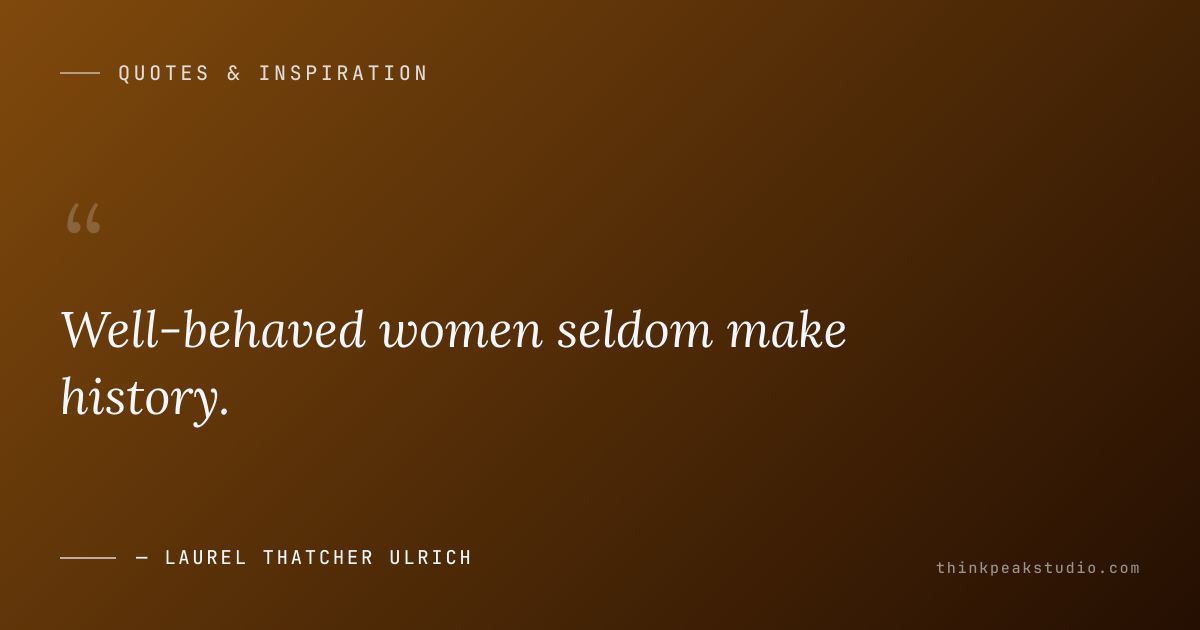
“Well-behaved women seldom make history.”
The context
The sentence was not written to be a slogan. It appeared in the spring of 1976, in the opening paragraph of an article in the journal American Quarterly, written by a graduate student who was then at the University of New Hampshire working toward a doctorate in history. The article was called “Vertuous Women Found: New England Ministerial Literature, 1668–1735,” and its subject was not rebellion but absence. It examined the pious Puritan women who were described, at length, in the funeral sermons and devotional works of their ministers — women who were praised for their meekness, their secrecy in prayer, their devotion to home and congregation — and who left, for the historian, almost nothing of their own. Laurel Thatcher Ulrich was born in Sugar City, Idaho, on July 11, 1938, and by the time she wrote those words she was raising five children while she worked toward her degree. The voice in the line belonged to someone who had gone looking for ordinary women in the archive and found the trail going cold.
What she wrote, in full, was this: “Cotton Mather called them ‘The Hidden Ones.’ They never preached or sat in a deacon’s bench. Nor did they vote or attend Harvard. Neither, because they were virtuous women, did they question God or the magistrates. They prayed secretly, read the Bible through at least once a year, and went to hear the minister preach even when it snowed. Hoping for an eternal crown, they never asked to be remembered on earth. And they haven’t been. Well-behaved women seldom make history; against Antinomians and witches, these pious matrons have had little chance at all.” Read in its setting, the sentence is not a rule of conduct. It is a diagnosis of a record. The women who entered the history books were, overwhelmingly, the ones who broke the rules — the dissenters, the accused, the notorious. The virtuous majority left too little evidence behind to be seen, and Ulrich was explaining, in a single clause, why the sources she needed were so hard to find.
Then the sentence escaped. Over the following decades it moved from the scholarly journal into popular culture, printed on T-shirts, mugs, bumper stickers, greeting cards, placemats, and plaques, often without attribution and sometimes reassigned to Marilyn Monroe, Eleanor Roosevelt, or even Anne Boleyn — none of whom has any documented connection to it. By the 2000s Ulrich was receiving a steady stream of emails about a line she had long ago set aside, and in September 2007 she published a book with the phrase as its title, using it to explain what she had actually meant. By then her larger career had made the irony sharper still: A Midwife’s Tale: The Life of Martha Ballard, Based on Her Diary, 1785–1812 (1990) won the 1991 Pulitzer Prize for History and the Bancroft Prize, a MacArthur Fellowship followed in 1992, she joined Harvard in 1995, served as president of the American Historical Association in 2009, and retired in 2018 as the university’s 300th Anniversary University Professor, Emerita. The historian of the hidden had become, herself, one of the most decorated names in the field.
The meaning
The most important word in the sentence is seldom, and it is the one most often swapped out. The popular versions say “rarely,” or, more often, “never” — and “never” turns a careful observation into a false one, because plenty of well-behaved women are remembered. Saints are remembered. Queens and mothers and dutiful wives are remembered. Seldom makes a claim not about possibility but about frequency, and therefore about the machinery of memory: on the whole, the record favors the disruptive. “Well-behaved” is likewise doing precise work. In the article it is a near-synonym for the archaic word in the title, vertuous — meaning the conforming, the pious, the unremarkable majority whose virtue was, by design, private. The line sounds like a proverb. It functions as a methodological complaint.
The phrase “make history” carries two meanings at once, and the sentence depends on the collision between them. To make history can mean to do things that history records; it can also mean to do the work of history — to write it, to decide what counts, to keep the record. Ulrich’s entire scholarship is an argument that the second sense governs the first. History is not the past; it is the surviving evidence of the past, and that evidence is shaped by who held the pen and who was thought worth writing about. Mather’s name for these women, “the Hidden Ones,” is perfect because their invisibility was not a quirk of temperament. It was the predictable output of a system that rewarded a virtue which produces no documents. The women behaved; the archive forgot them; and the forgetting then looked like proof that there had been nothing to remember.
That is why the slogan’s most popular reading is also its most misleading. Detached from the article, the line was taken as encouragement — permission to be difficult, to break the rules, to raise your voice, on the theory that history only remembers the troublemakers. Ulrich has said plainly that this is not what she meant: the phrase points to the reasons women’s lives are underrepresented in historical narrative, not to a strategy for being remembered, and in its original setting it was not advice to anyone. The sentence indicts the archive, not the women it describes. Its real provocation is epistemological, not moral. It asks us to notice that what we call history is a selection made under conditions of inequality, and that the quiet lives missing from it were not unworthy of the record. They were excluded from it.
Relevance: why it still matters
The line has outlived its occasion because the mechanism it names has only accelerated. Where Ulrich described a selection pressure operating across centuries of sermons and diaries, we now run the same pressure in seconds. The feed rewards the extreme, the loud, and the photogenic; the ordinary, the measured, and the private disappear — not because anyone decided they should, but because nothing in the system records them. The “hidden ones” of the present are everyone whose life does not perform well online. And the misattribution problem has become a general condition: a sentence that circulates with the wrong name attached is a small model of how ideas now travel, stripped of their sources, flattened into slogans, and reshaped to fit whatever the reader already wanted to hear. The quote is a case study in how meaning mutates on its way to becoming popular.
It also matters as a corrective to a very contemporary confusion — the equation of being seen with mattering. The line is often quoted in the register of personal branding, as a license to stand out and make noise. Read in context, it is closer to a warning. It describes the cost of a world that remembers only the loud, and it names the blind spot of the people doing the remembering. In an age of curated selves and machine-generated content, Ulrich’s question is still the right one, and it is not “how do I get remembered?” It is “who is doing the remembering, and what are they missing?” That question was alive in a stack of seventeenth-century funeral sermons, and it is alive in a recommendation algorithm. The vocabulary changes; the structure does not.
Application: how to use it in your own life
The most literal application is the one Ulrich learned as a researcher: what is not written down disappears. If your work, your family’s history, your community, or your values matter to you, treat documentation as part of the work rather than as vanity. Write the letters, keep the notebooks, label the photographs, save the small records of an ordinary life. This is not about self-promotion; it is about leaving evidence for the people who will one day try to understand what you did and why. The quiet lives that vanish from the record rarely vanish because they were unimportant. They vanish because no one thought the details were worth keeping.
The deeper application is to refuse the equation of visibility with worth — in your own ambition and in what you choose to notice. Ask who is missing from the record you consume: whose labor, whose ordinary days, whose quiet competence. Then go looking, the way Ulrich went looking, in the mundane places where real history actually accumulates. And when you are tempted to make the loud kind of history, decide which one you truly want — the kind that gets recorded, or the kind that matters. Her method is a wager that the second lives in the daily, the repetitive, and the unglamorous. The point of the sentence was never to tell women to misbehave. It was to tell us to look harder, and to make sure the record is a little less of a lie.
Create your own quote graphic with this quote
This is a sentence that rewards being carried around — short enough to remember, sharp enough to argue with. When you pair an idea this durable with thoughtful design, you create something worth keeping close. Use our free online quote maker to turn this exact quote into a shareable image in seconds — no signup needed. For advanced features like video quotes and 100+ templates, try the Quotes Creator Android app.
Why we chose this quote
We chose this line because almost everyone has seen it and almost no one has read it where it began. The version on the mug is usually wrong twice over — the word is “seldom,” not “never,” and the author is Laurel Thatcher Ulrich, not Marilyn Monroe or Eleanor Roosevelt — and those two errors happen to erase the sentence’s actual subject. What Ulrich wrote in 1976 was not a dare to break the rules. It was the plainest possible statement of a historian’s frustration: the virtuous left no trace, and so the record filled up with the disruptive. That observation has only become more useful as the archive has turned into a feed. In an age that mistakes attention for significance and treats the unposted life as no life at all, the quote keeps asking the uncomfortable question its misquoters skip: not whether you will be remembered, but who is doing the remembering, and what the record is leaving out.
— ThinkPeak Studio Editorial Team
Create your own quote graphic with this quote
Turn this line into a shareable graphic in seconds — free, no signup needed. For video quotes and 100+ templates, try the Android app.
Advertisement
Enjoyed this article? Get more like it in your inbox.


