Quote Explained: “All of humanity is living in a dream world, but suffering real consequences.”
By Lauryn Hill, rapper, singer, and one of the most uncompromising voices in modern music
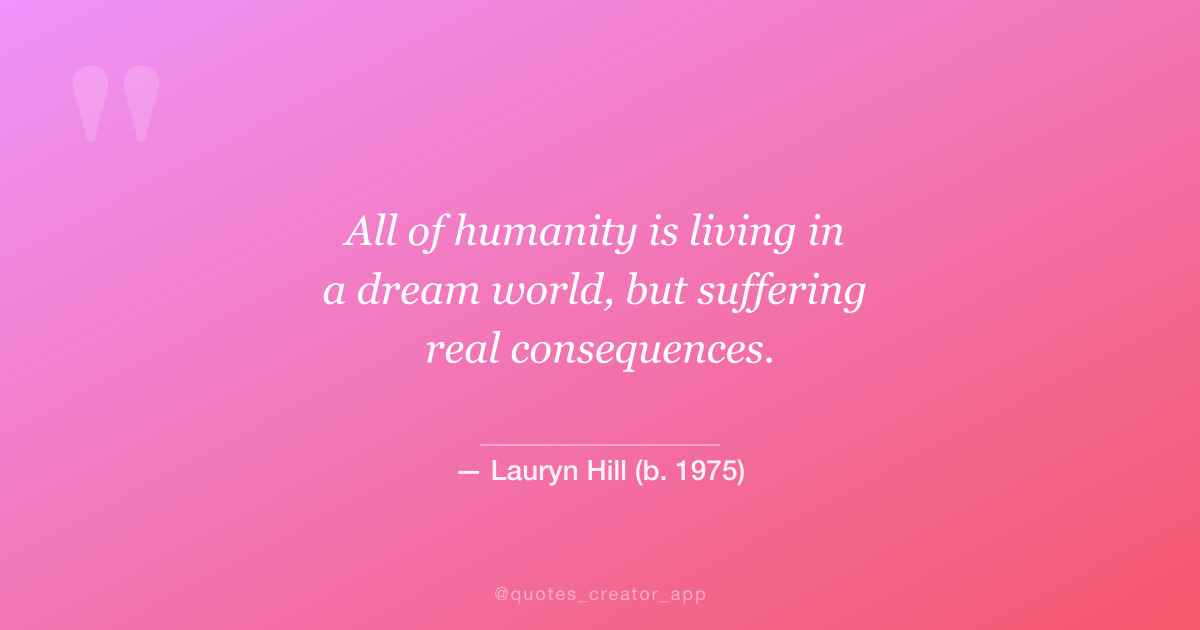
“All of humanity is living in a dream world, but suffering real consequences.”
The context
The line comes from The Middle Man, a politically charged spoken-word and rap track Lauryn Hill released in 2003 at the height of her public withdrawal from the music industry. By that point, Hill had spent the better part of two years dismantling, in real time, the version of herself the public had been sold. Her 1998 debut solo album, The Miseducation of Lauryn Hill, had made her the first woman to win five Grammys in a single night and one of the bestselling artists in the world. Then, instead of capitalising on that success, she walked away from the machinery. The MTV Unplugged 2.0 performance in 2002 was the visible fracture: raw, confessional, hostile in places, and almost entirely stripped of the hit-making warmth of Miseducation. The Middle Man came after that, released quietly online rather than through a label.
The world she was speaking into was one in which the United States had just invaded Iraq on the basis of intelligence that turned out to be false; in which the post-9/11 consensus had welded patriotism, consumerism, and media spectacle into a single package; and in which a young Black woman who had been celebrated for her artistry was being torn apart in tabloids for the perceived crime of refusing to be grateful. Hill was not writing from a place of detachment. She was naming, with a kind of exhausted clarity, the gap she saw between the stories cultures tell themselves and the costs those stories actually exact on real people.
The audience for The Middle Man was the same one she had built with the Fugees and with Miseducation, except that audience had fractured. Some listeners heard it as proof she had lost her mind; others heard it as the first honest thing a major artist had said in years. Both reactions, in their own way, confirmed the song’s thesis. A line that lands as prophecy to one person and delusion to another is, by definition, a line that is arguing with the dream world in which most people are still comfortably asleep.
The meaning
Read literally, the sentence describes a paradox. A dream world is a place where the normal rules of cause and effect are suspended: things happen in it that could not really happen, and the dreamer does not have to pay for them. To say that all of humanity is living in such a world is to claim that the everyday stories we tell ourselves about how the world works — about money, about safety, about merit, about progress — are fundamentally fictional. We are, collectively, dreaming.
The second half of the sentence refuses the comfort of that dream. Suffering is not fictional. Consequences are not fictional. Wars still happen, climate systems still shift, bodies still break, and debts still come due, regardless of whether the people who set those things in motion were awake when they did it. Hill is making a distinction that a lot of political and spiritual language blurs: the cause can be unreal, and the effect can still be real. The lie does not have to be true for the damage to land. In fact, the more convincingly we dream, the more devastating the consequences tend to be, because we are not even keeping a record of what we are doing to ourselves.
There is also a quieter, more personal register inside the line. Hill was by 2003 a person whose own dream — of being a beloved pop star, of a music industry that would treat her as a full artist and not a product, of a country that would let a young Black woman be a genius without punishing her for it — had clearly broken. The line reads as a kind of farewell to that dream, written by someone who had woken up inside it. The line hurts not because it is cynical but because it is sad: it is the observation of a person who once believed, and who is now watching everyone else, including herself, pay for the things they once believed in.
Why it still matters today
More than two decades on, the sentence has aged in the direction Hill intended, not the direction her critics hoped. The dream world she described — in which a global audience can be persuaded to ignore what is happening in front of them if the framing is friendly enough — has only deepened. Algorithms now personalise the dream, so that no two people in the same country are necessarily looking at the same version of reality. Climate scientists have spent twenty years describing, in increasingly precise language, the difference between the world we are collectively imagining and the world we are physically producing. Political cycles keep rewarding politicians who promise to keep the dream comfortable, while quietly offshoring the consequences to people who were never going to vote for them anyway.
The line is also useful as a private diagnostic. Almost every important decision in a person’s life — what to buy, what to eat, who to trust, what to be afraid of, what to be angry about — is shaped by stories the person did not choose and cannot fully see. The question Hill is quietly posing is not are you in a dream (her answer to that is a flat yes), but which part of the dream are you going to keep paying for, and which part are you willing to wake up from. The fact that the line still circulates — in classrooms, in therapy offices, in protest art, in graduation speeches — is evidence that a lot of people are still trying to answer that question.
How to apply this in your own life
The first practical move is humility about your own certainty. If a sentence this short, written by a single person in 2003, can still be arguing with the prevailing story twenty-three years later, then any story you currently hold with total confidence deserves to be tested. That does not mean abandoning your values. It means being willing to ask, on a regular basis, which of your beliefs are things you have actually examined and which are things you have absorbed. The dream world survives on unexamined repetition. Waking up is mostly a matter of paying attention to what you have agreed to without reading the contract.
The second move is to stop outsourcing the consequences. Most of the worst outcomes in a modern life are not sudden; they are slow, distributed, and described in language designed to make them sound inevitable. Climate is the largest example, but the pattern shows up in personal finance, in health, in relationships, in cities. Hill’s line is, in the end, a call to take the bill seriously even when the dinner is being served in a soft-focus dream. The consequences are real. They will arrive. The only real question is whether you will meet them as a person who saw them coming, or as a person who is shocked, again, that the world is not in fact the story you were told about it.
Create your own quote graphic with this quote
This is the kind of quote that carries weight. When you pair timeless words with thoughtful design, you create something people want to save, share, and return to. Quotes Creator gives you the tools to turn this quote into a beautiful graphic — custom fonts, gradient backgrounds, and export sizes for every platform.
Why we chose this quote
We have already featured Lauryn Hill once on Quote of the Day, with a short lyric from Doo Wop. We wanted to come back to her for a deeper dive, because her quieter, more political writing — the work that came after the Grammy sweep, the work that cost her — is where the most enduring version of her thinking lives. This line from The Middle Man is, in our reading, the most compact statement she ever made: thirteen words, no chorus, no hook, just a thesis about how a species can be wrong about reality and still pay for being wrong. It is the kind of line that, once you have heard it, you start hearing everywhere else, which is the highest compliment you can pay a piece of writing.
— ThinkPeak Studio Editorial Team
Create your own quote graphic with this quote
Turn this line into a shareable graphic in seconds — free, no signup needed. For video quotes and 100+ templates, try the Android app.
Advertisement
Enjoyed this article? Get more like it in your inbox.