Quote Explained: “Be the change you wish to see in the world.”
By Mahatma Gandhi, Indian independence leader and philosopher
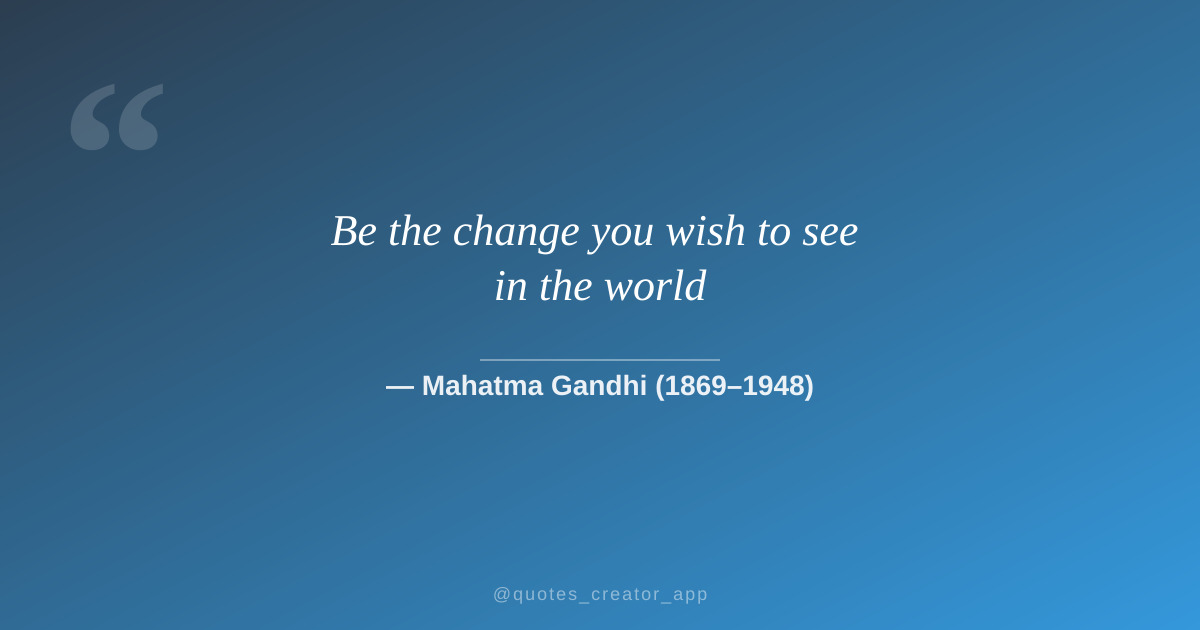
“Be the change you wish to see in the world.”
The context
“Be the change you wish to see in the world” is one of the most quoted lines in modern history, appearing on posters, social media bios, and motivational speeches worldwide. Yet surprisingly, Mahatma Gandhi never spoke these exact words. The closest verifiable source is a passage he wrote in Gujarati for his South African newspaper Indian Opinion on August 9, 1913: “We but mirror the world. All the tendencies present in the outer world are to be found in the world of our body. If we could change ourselves, the tendencies in the world would also change.” The familiar phrase we know today is a condensation of this idea, refined through decades of retelling.
Gandhi wrote these words while living in South Africa, where he had spent two decades fighting racial discrimination against the Indian community. This was the crucible that forged his philosophy of Satyagraha — nonviolent resistance rooted not in passive acceptance but in active, disciplined moral force. He had recently led a successful campaign against the Asiatic Registration Act and was about to launch the Great March of Indian miners in 1913. The idea that personal transformation precedes political change was not theoretical for him; it was the strategic insight of his life’s work, tested in the streets of Pretoria and the courts of Johannesburg.
The audience for that 1913 article was the Indian diaspora in South Africa — a community of traders, laborers, and indentured workers facing systematic oppression. Gandhi was not speaking to philosophers or politicians; he was speaking to people who felt powerless. His message was radical not because it demanded sacrifice, but because it insisted that the power to change the world already resided within each of them. They did not need to wait for the empire to reform itself.
The meaning
On its surface, the quote issues a simple moral directive: stop waiting for others to improve, and improve yourself instead. But this reading misses the deeper philosophical architecture beneath the words. Gandhi was not advocating for isolated self-improvement. He was describing a metaphysical conviction that the individual and the universe are fundamentally interconnected — a belief rooted in the Hindu doctrine of Advaita (non-duality), which holds that the self (Atman) and the ultimate reality (Brahman) are one. When he writes “we but mirror the world,” he means this literally.
This is the crucial insight: Gandhi believed that changing yourself literally changes the world because there is no ultimate separation between self and world. When you shift your own thoughts, habits, and character, you alter the total moral field of humanity. The world is not something outside you to be fixed; it is a reflection of the collective consciousness that each person participates in. This is why the word “be” matters so much more than “do” in the famous paraphrase — the transformation must happen at the level of being, not merely of action.
This creates a profound inversion of how most people think about change. Conventional wisdom holds that external conditions must improve before people can be better — that peace requires peace treaties, that justice requires new laws, that equality requires structural reform. Gandhi argued the opposite: peace requires peaceful people. Justice requires just individuals. The world changes when enough people embody the change they wish to see, because the boundary between the personal and the political is ultimately an illusion. Means and ends must be identical; you cannot reach a good destination through bad methods.
Why it still matters today
In an era of overwhelming global challenges — climate crisis, political polarization, systemic inequality — the temptation is to feel powerless and wait for structural solutions from above. Gandhi’s words cut through this paralysis with a counterintuitive message: you are not a passive observer. Every choice you make about how you live — what you consume, how you treat others, where you direct your energy — is either part of the problem or part of the solution. This is why the quote has been embraced by movements from environmentalism to conscious capitalism, from social justice organizing to mental health advocacy.
Modern psychology has caught up with Gandhi’s intuition. Research in social contagion theory and behavioral science confirms that attitudes, behaviors, and even emotional states spread through social networks like invisible weather patterns. Compassion is contagious. Integrity radiates. The person who quietly embodies their values — without lecturing or forcing — exerts a gravitational pull on everyone around them. Gandhi’s insight, once considered mystical, now has empirical support: the smallest unit of meaningful change is a single human being living by conviction.
How to apply this in your own life
Applying this quote means starting with what you can control: your own behavior. If you want more kindness in the world, be kinder today — not when conditions permit, but now. If you want transparency in institutions, practice transparency in your own dealings. If you want a cleaner planet, examine your own consumption before demanding others change. The radical act is to stop treating the world’s problems as external to you and start treating your daily choices as the front line of meaningful change.
This does not mean abandoning collective action or structural reform. Gandhi himself led mass movements against the British Empire. But he insisted that the effectiveness of any external campaign is limited by the internal state of its participants. A movement for peace built by angry, intolerant people will produce neither peace nor tolerance. The practical takeaway is clear: before you try to change the world, ask yourself whether you are willing to become the kind of person who belongs in the world you want to create. That is where change begins, and that is where it must always return.
Create your own quote graphic with this quote
This is the kind of quote that carries weight. When you pair timeless words with thoughtful design, you create something people want to save, share, and return to. Quotes Creator gives you the tools to turn this quote into a beautiful graphic — custom fonts, gradient backgrounds, and export sizes for every platform.
Why we chose this quote
We chose this quote because it is perhaps the most misunderstood famous saying of the modern era. People repeat it as a platitude, unaware that it arises from a sophisticated philosophical system challenging our deepest assumptions about the relationship between self and society. In a time when despair about the state of the world is common, Gandhi’s words offer not comfort but a challenge — and that challenge is exactly what makes them timeless.
— ThinkPeak Studio Editorial Team
Create your own quote graphic with this quote
Turn this line into a shareable graphic in seconds — free, no signup needed. For video quotes and 100+ templates, try the Android app.
Advertisement
Enjoyed this article? Get more like it in your inbox.