Quote Explained: “The impediment to action advances action. What stands in the way becomes the way.”
By Marcus Aurelius, Roman emperor and Stoic philosopher
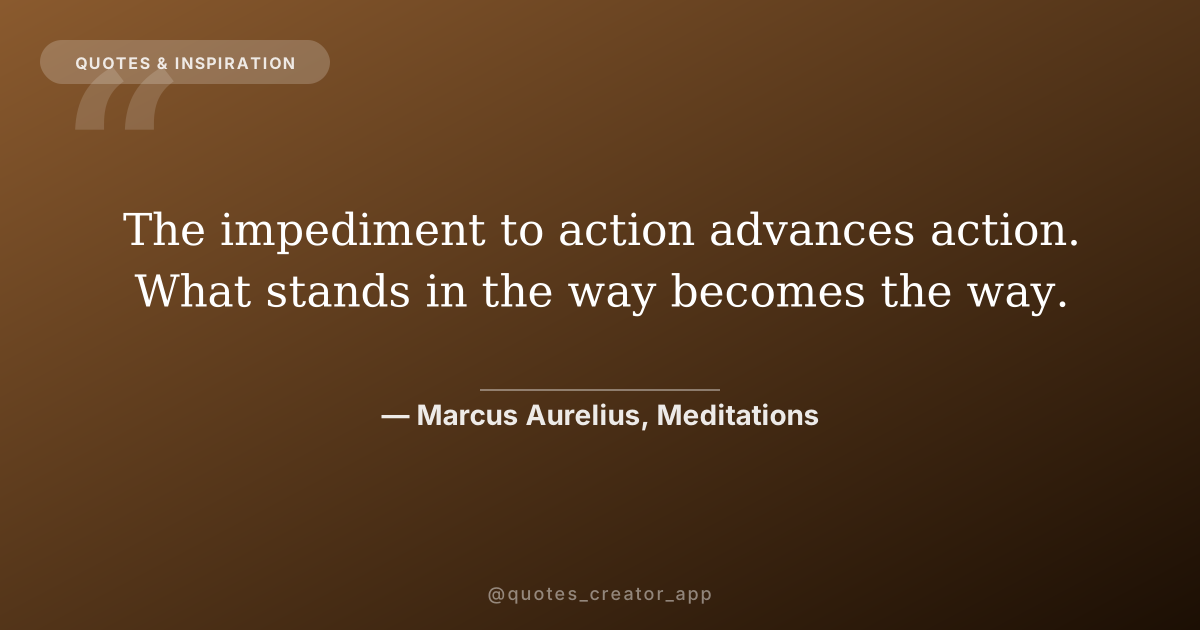
“The impediment to action advances action. What stands in the way becomes the way.”
The context
The sentence was never meant for an audience. Marcus Aurelius wrote it in Greek, in a private notebook, in the cramped quarters of a military camp somewhere along the Danube frontier, while commanding a Roman army through a decade of war, plague, and political treachery. Meditations — the book we now read with the reverence due a philosophical classic — was originally a set of notes the emperor wrote to himself, a kind of nightly discipline for a man who had more power than anyone alive and less privacy than almost anyone else. It was not titled, not structured, and almost certainly not intended for publication. Its working title, preserved in fragments, translates to something like “the things addressed to himself.” What we have is not a finished argument but a mind arguing with itself, and it is precisely this unpolished intimacy that has let the text outlive the empire it was written to serve.
The man behind the notebook was born in 121 CE into a family that was noble, wealthy, and soon to be bound to the throne. He was adopted into the line of succession, tutored relentlessly in rhetoric, philosophy, and law, and became emperor at forty after the death of his adoptive father Antoninus Pius. By the time he wrote the lines of Meditations, he had buried more than one of his own children, endured the revolt of a man he trusted, and spent most of his reign not in Rome’s marble halls but on campaign, sleeping in a tent, sick for much of the time, facing a people he neither loved nor fully understood. The Stoicism he practiced was not an intellectual ornament. It was load-bearing. It was a set of tools for a man who could not afford the luxury of despair, because millions of lives hung on his composure. That is the context that gives this quote its weight: it is not a slogan from a seminar but a field note from a man operating at the very edge of what a human being can be asked to endure.
The specific line comes from the fifth book, in a passage where Marcus is reminding himself how to respond when circumstances refuse to cooperate. In the Gregory Hays translation that popularized it for modern readers, it reads in full: “The impediment to action advances action. What stands in the way becomes the way.” The idea is pure Stoicism, and it descends directly from the tradition’s founders — from Zeno, who first taught that virtue is the only good, and from Epictetus, the former slave whose Enchiridion insisted that while we control nothing external, we always control the judgment we place upon it. Marcus’s genius was to compress that entire discipline into two short clauses and write them down not for a student, but for himself, in a moment when he plainly needed to hear them.
The meaning
Read casually, the line sounds almost like wordplay — a neat paradox, the kind of thing that looks good stitched on a pillow. But it is a precise and radical claim about the structure of reality. The common view treats obstacles as interruptions: you are walking a road toward a goal, and something falls across it, and now you are blocked. The obstacle is defined by what it prevents. Marcus inverts the whole picture. In his account, the obstacle does not stand outside your path, a foreign object to be removed. It becomes the path. The very thing that seemed to block you turns out to be the material out of which your progress is made. A river that blocks a road forces the building of a bridge, and the bridge outlives the road. A competitor who seems unbeatable becomes the teacher who sharpens you. A failure that looks like an ending becomes the information that corrects your aim. Nothing is wasted, because everything — including, and especially, the thing that resists you — can be converted into forward motion.
The first clause explains the mechanism. “The impediment to action advances action” means that the pressure of resistance is not merely something to be endured; it is a source of energy. An obstacle concentrates the mind. It forces you to abandon the comfortable and the habitual, to strip a problem down to what actually matters, to find the resources you did not know you had because you had never before been asked to reach for them. This is why the Stoics could face catastrophe without collapsing: they had trained themselves to ask, in every setback, not “why is this happening to me?” but “what is this giving me the chance to do?” The impediment advances action because it converts a vague intention into a specific demand, and specific demands are what actually get answered.
The second clause — “what stands in the way becomes the way” — is the conclusion, and it is even more demanding. It is not a promise that everything will work out; it is a refusal to grant any event the power to make you a victim. Marcus is not denying that the world can be cruel, unfair, and genuinely painful. He buried too many children to believe otherwise. What he is claiming is subtler: that the meaning of any event is not fixed by the event itself but assigned by the judgment you place on it. If the impediment becomes the way, then there is no such thing as a blocked life — only a life that has not yet learned to see its own obstacle as raw material. This is the deepest form of freedom the Stoics believed in: not the freedom to control events, which no one has, but the freedom to refuse to be defeated by them, which everyone can practice.
Why it still matters today
Nearly two thousand years later, the line has never had a wider audience — or a more urgent purpose. The modern Stoic revival, carried by figures from Ryan Holiday to the millions who have made Meditations a perennial bestseller, has found its slogan in exactly this sentence, and for a reason that speaks to the character of the age. We live in a time of ambient anxiety: economic precarity, algorithmic attention capture, a news cycle that manufactures a new crisis by the hour, and a pervasive sense that the ground is shifting under our feet faster than we can adjust to it. In such a climate, the instinct is to wish the obstacles away — to wait for the market to recover, the politics to settle, the uncertainty to pass. Marcus’s line is a correction to that waiting. It tells us that the obstacle is not a temporary inconvenience on the way to a calmer future; it is the actual substance of the work ahead, and the only productive question is how to use it.
The quote also cuts against a specific, and specifically modern, failure of imagination. We are surrounded by messages that treat difficulty as a sign that something has gone wrong — that a smooth life is the normal, expected baseline and a hard one is a malfunction to be diagnosed. This framing quietly robs people of resilience, because it teaches them to meet hardship with resentment and surprise rather than with skill. Marcus offers the opposite framing: difficulty is not evidence that the system has failed; it is evidence that you are alive and engaged in something that matters. What stands in the way becomes the way. For an era that talks constantly about “pivot,” “resilience,” and “antifragility,” this sentence remains the cleanest statement of the underlying idea — and the humbling reminder that the idea was already fully formed in a Roman tent two millennia before we gave it a TED Talk.
How to apply this in your own life
The most direct application is to install the line as a question you ask in moments of frustration. When something blocks you — a rejection, a delay, a budget cut, an injury, a person who refuses to cooperate — the Stoic practice is not to ask “how do I get rid of this?” but “what does this obstacle make possible?” Run the question like an algorithm, and you will find that it almost always produces an answer the original goal never contained. The rejection frees your time for a better fit. The delay gives you a chance to do the thing properly. The budget cut forces a creativity that abundance would have suppressed. This is not positive thinking; it is engineering. It treats every input, however hostile, as a resource that can be routed toward the objective, and it converts the energy you would have spent on complaint into energy spent on movement. The discipline is simple to describe and hard to sustain, which is precisely why it must be practiced daily, in small moments, until it becomes reflex.
The deeper application concerns what you choose to believe about your own limits. Most of the walls that stop people are not external; they are internal verdicts — the story you tell yourself about what you are not good enough, or young enough, or brave enough to attempt. Marcus’s line applies there too, because the impediment you have been carrying for years can itself become the way. The fear of public failure can become the reason you finally speak; the insecurity about your past can become the material of the work that helps others; the thing you most want to hide can become the thing you are most qualified to say. What stands in the way becomes the way. The phrase is an invitation to stop treating your hardest circumstances as a detour and start treating them as the assignment. You do not have to be glad for them. You only have to be willing to build with them — and the emperor who wrote this sentence, surrounded by war and plague and grief, is proof enough of what that willingness can produce.
Create your own quote graphic with this quote
Some lines are so compressed that they carry an entire philosophy in two clauses — and this is one of them. When you pair an insight this durable with thoughtful design, you create something people want to save, share, and return to. Use our free online quote maker to turn this exact quote into a shareable image in seconds — no signup needed. For advanced features like video quotes and 100+ templates, try the Quotes Creator Android app.
Why we chose this quote
We chose this quote because it is the rare sentence that works on every scale of life at once. It is a survival tool for a soldier, a creative principle for an artist, a leadership doctrine for a founder, and a quiet comfort for anyone mid-crisis — all in eleven words written by a man to himself. Marcus Aurelius never intended it to be famous, which is part of why it endures: it was not composed to impress, but to function. In a culture that treats obstacles as aberrations and comfort as the norm, this line is a small, necessary act of correction. It does not flatter you with the promise of an easy life; it equips you for the life you actually have.
— ThinkPeak Studio Editorial Team
Create your own quote graphic with this quote
Turn this line into a shareable graphic in seconds — free, no signup needed. For video quotes and 100+ templates, try the Android app.
Advertisement
Enjoyed this article? Get more like it in your inbox.