Quote Explained: “The impediment to action advances action…”
By Marcus Aurelius, Roman emperor and Stoic philosopher
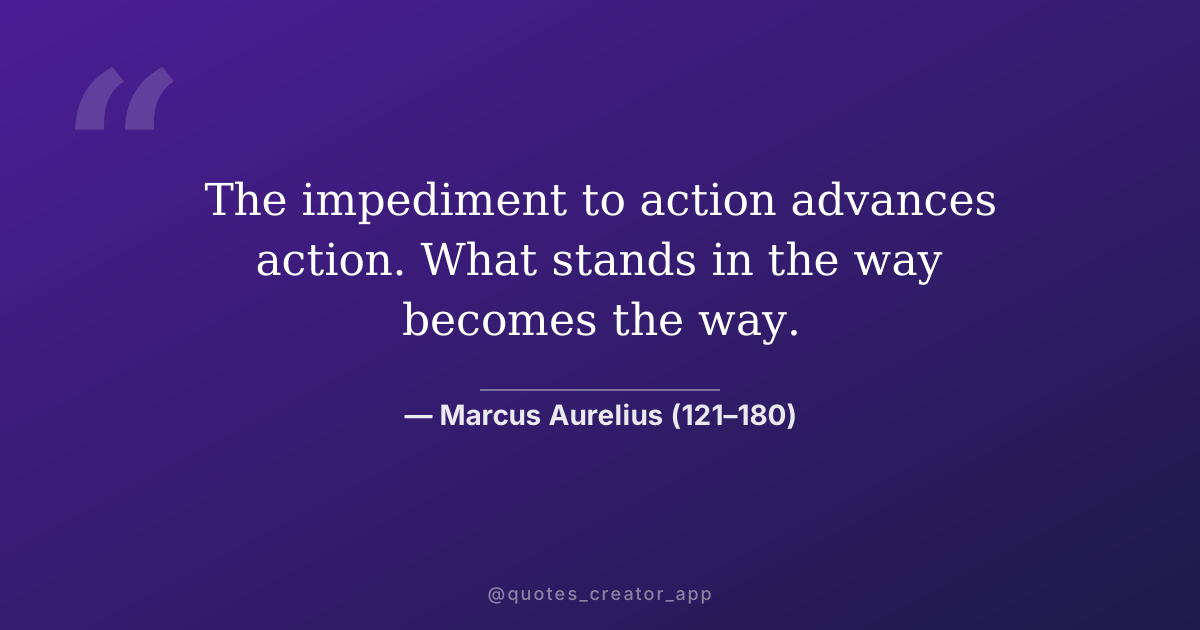
“The impediment to action advances action. What stands in the way becomes the way.”
The context
Marcus Aurelius wrote these words not from the comfort of a philosopher’s study, but from a military tent on the frozen frontier of the Roman Empire. By the time he composed Book V of the Meditations, he had been emperor for over a decade and was deep into the Marcomannic Wars—a grinding series of campaigns against Germanic tribes threatening Rome’s northern borders. The man who never wanted to be a soldier was spending years of his life commanding legions through mud, disease, and brutal combat. Plague had already ravaged the empire upon his accession; now war stretched his resources thin. He was aging, often ill, and acutely aware that death could claim him at any moment—not in Rome as a celebrated philosopher-king, but in some distant camp at the edge of the known world.
Meditations was never meant for publication. It was a private journal, written in Greek (not his native Latin), a nightly conversation with himself about how to live with virtue despite the chaos pressing in on every side. The text has no narrative arc, no chapter structure. It is raw, repetitive, and urgent—the inner monologue of a man trying desperately to stay grounded in his principles while the world around him burned. Book V, where this passage appears, is especially concerned with the relationship between external events and internal response. Marcus was wrestling with a fundamental problem: how do you keep moving forward when circumstances seem designed to stop you?
The audience for this passage was himself alone. That is what makes it so powerful. When Marcus Aurelius reminded himself that “the impediment to action advances action,” he was not delivering a polished lecture to students. He was steeling his own resolve against very real obstacles—supply lines cut by guerilla attacks, allies who betrayed him, illness that left him bedridden in camp, and the sheer exhaustion of endless war. The Stoic discipline of reframing adversity was not a theoretical exercise; it was survival. And somehow, in the margins of military maps and casualty reports, he found the clarity to distill this truth into one of the most quoted passages in the history of philosophy.
The meaning
On the surface, the quote is deceptively simple: obstacles do not merely block you; they reveal the path. The thing that seems to stop you is, in fact, the very thing that propels you forward—once you change your relationship to it. Marcus is articulating the Stoic principle that events themselves have no moral character; only our judgments about events carry value. An impediment is not inherently bad. It is raw material. What we do with it determines whether we stall or advance. The barrier that looks like a wall is actually a corridor—if you are willing to walk through it rather than around it.
But the deeper layer is more radical. Marcus is not merely saying “look on the bright side” or “find the silver lining.” He is claiming something far bolder: the obstacle itself is the mechanism of progress. It is not that we overcome the obstacle and then advance—the overcoming is the advance. The struggle is the growth. This flips our natural instinct on its head. When a writer faces a blank page, the blankness is not the enemy—it is the invitation. When an athlete trains against resistance, the resistance does not hinder strength—it creates it. The impediment is not an interruption of the action; it is the action’s fuel. Marcus recognized that human beings are forged in friction, not in comfort, and that the thing we most want to avoid is often the thing we most need to engage.
There is also a profound acceptance embedded in this idea. By declaring that what stands in the way becomes the way, Marcus is rejecting the fantasy of a smoother path. He is not saying “once you get past this, things will be easier.” He is saying that difficult things are the whole point. The Stoics believed that virtue is the only good and that it can only be exercised in the presence of difficulty. Courage requires fear. Patience requires frustration. Discipline requires temptation. Without impediments, there is nothing to act upon—and therefore no meaningful action at all. The obstacle is not a detour from a meaningful life; it is the terrain on which meaning is built.
Why it still matters today
In the twenty-first century, this passage has experienced a remarkable renaissance. Ryan Holiday’s 2014 book The Obstacle Is the Way took Marcus’s insight and translated it for a modern audience of entrepreneurs, athletes, and creatives, making Stoicism’s central promise—that inner freedom is always available regardless of outer circumstances—accessible to millions. The book became a manual for the NFL’s New England Patriots, Silicon Valley founders, and military leaders alike. In an era of information overload, economic precarity, and social fragmentation, the idea that obstacles can be metabolized into forward momentum resonates with unusual force. It offers a kind of agency that external conditions cannot take away.
More urgently, the quote speaks to the quiet crisis of modern life: learned helplessness. So many people feel stuck—by debt, by career dead ends, by relationships that are draining, by political systems that feel immovable. The natural response is paralysis or blame. Marcus’s formula cuts through both. It does not promise that the obstacle will disappear. It promises something better: that the obstacle, once faced squarely, will become the engine of transformation. In a culture saturated with messages about finding shortcuts and hacks, the Stoic insistence that difficulty is the point is almost subversive—and deeply liberating. It reframes adversity from a verdict on your worth into an assignment for your growth.
How to apply this in your own life
Start by identifying the single obstacle in your life that feels most immovable right now. It might be a project you keep postponing, a difficult conversation you are avoiding, or a skill you have convinced yourself you cannot learn. Instead of asking “how do I get past this?” ask “what is this obstacle asking of me?” The writer’s block might be asking for a new routine. The difficult colleague might be asking for clearer boundaries. The fitness plateau might be asking for a different kind of training. When you treat the obstacle as a teacher rather than a wall, you stop exhausting yourself looking for ways around it and start extracting the lesson embedded within it.
Then practice the reframe in real time. The next time you hit a setback—a rejection, a delay, a failure—pause and say to yourself: this is not a detour. This is the path. It will feel forced at first. But over time, the habit of converting obstacles into action becomes second nature. You will find yourself almost welcoming difficulty, because you will have experienced firsthand that every meaningful advance in your life came not despite obstacles but because of them. Marcus Aurelius did not write these words because he had figured everything out. He wrote them because he was struggling and needed the reminder. Two thousand years later, so do we.
Create your own quote graphic with this quote
This is the kind of quote that carries weight. When you pair timeless words with thoughtful design, you create something people want to save, share, and return to. Use our free online quote maker to turn this exact quote into a shareable image in seconds — no signup needed. For advanced features like video quotes and 100+ templates, try the Quotes Creator Android app.
Why we chose this quote
Marcus Aurelius has never been more popular than he is right now, but most people encounter his wisdom through summaries and paraphrases. We wanted to return to the source text itself—not “The obstacle is the way” as a slogan, but the full sentence as he wrote it, in its original context of a man fighting a war on two fronts: the external one against Germanic tribes, and the internal one against his own despair. What we found was not just a self-help soundbite but a complete philosophical argument about the nature of action itself. The obstacles in your life are not accidents. They are the curriculum.
— ThinkPeak Studio Editorial Team
Create your own quote graphic with this quote
Turn this line into a shareable graphic in seconds — free, no signup needed. For video quotes and 100+ templates, try the Android app.
Advertisement
Enjoyed this article? Get more like it in your inbox.