Quote Explained: “You have power over your mind — not outside events.”
By Marcus Aurelius, Roman emperor and author of Meditations
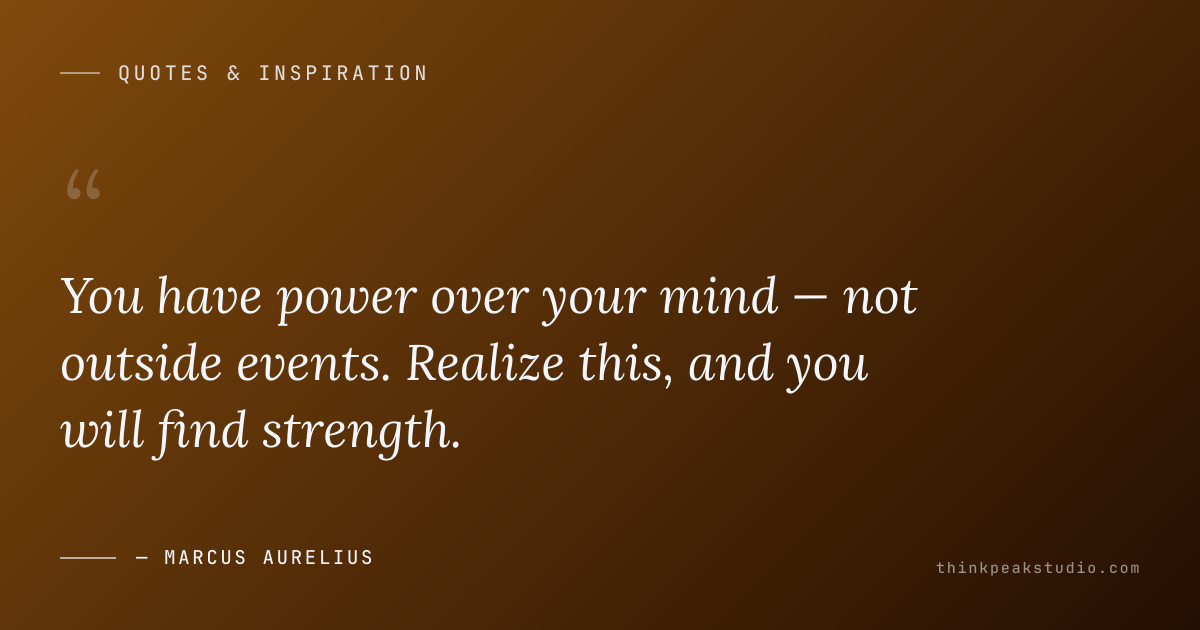
“You have power over your mind — not outside events. Realize this, and you will find strength.”
The context
Few books in history have arrived with as little fanfare and gone on to matter as much as Meditations. Marcus Aurelius did not write it for an audience; he almost certainly never intended it to be read by anyone at all. Born in 121 CE and raised in the imperial household of Rome, he became emperor in 161, the last of the so-called Five Good Emperors, and spent nearly his entire reign at war — most of it in the damp, hostile camps along the Danube frontier, where he led Rome against the Marcomanni and their allies in a grinding conflict that would consume the rest of his life. It was there, in the margins of a life of extraordinary power and crushing responsibility, that he kept a private notebook. He wrote not as a philosopher publishing a system of thought but as a man talking to himself: reminding himself, night after night, of what he was trying to be, and correcting himself when he fell short. The result is a document without precedent — a Roman emperor, the most powerful man in the known world, writing privately about the fact that he controlled almost nothing.
The notebook was not given a title by its author; the name Meditations was attached long after his death, and the text itself survived by accident, passed down through Byzantine scribes for centuries before the printing press rescued it from obscurity. What it preserves is Marcus’s working practice of Stoicism — a philosophy he had absorbed since boyhood from the writings of Epictetus, a former slave whose teachings Marcus’s own tutor, Junius Rusticus, had introduced to him. The quote at the heart of this analysis is one of the purest distillations of that tradition. It restates, in the plainest possible language, the single idea that Stoicism is built upon: the division of the world into what is up to us and what is not. Marcus returned to this division obsessively, because he knew — from the throne, from the battlefield, from the deaths of his children and the betrayals of his generals — how desperately hard it is to remember, and how much of a life’s peace depends on getting it right.
To understand why the line has endured for nearly two thousand years, you have to see what it was up against — and what it is still up against. Marcus wrote it in an age when power appeared to be the ultimate prize and the emperor appeared to possess it all. He could command armies, order executions, raise cities and raze them. Yet the whole thrust of his philosophy was that none of this was real power in any lasting sense. The throne, the legions, the wealth of Rome — all of it was an “outside event,” indifferent to his will and certain to pass away. The only empire he truly ruled, he kept insisting, was the small one between his own ears. That inversion — the most powerful man in the world declaring that his only real power was over his own mind — is what gives the quote its quiet, almost scandalous force. It is not the platitude of a comfortable theorist. It is the hard-won conclusion of someone who had everything the world offers and found that none of it was what he actually needed.
The meaning
The quote’s power lies in its ruthless clarity about where strength actually comes from. The first clause — “You have power over your mind” — is not a boast; it is a precise claim about the one thing that is genuinely ours. By “mind” Marcus means what Epictetus before him meant: our judgments, our interpretations, our desires, our aversions, our choices — the entire inner workshop where the raw material of life is turned into meaning. This is the only territory over which a human being has complete authority. The second clause — “not outside events” — draws the boundary with equal precision. Health, wealth, reputation, other people, the weather, the outcome of a battle, the opinion of the crowd: all of it lies beyond our control, indifferent to our wishes, and no amount of effort can change that basic fact. The sentence is, in effect, a map. It tells you exactly where your jurisdiction begins and ends, and it insists that most of the suffering in a life comes from trying to rule territory that was never yours to rule.
Beneath this division lies an even more surprising claim: that events themselves are neither good nor bad. A Stoic would argue that what happens to you is neutral raw material — it is your judgment about what happens that colors it as a blessing or a catastrophe. Two people can lose the same job, and one is destroyed while the other is liberated; the event is identical, and the difference is entirely in the mind. This is why Marcus insists the power is over the mind and not over events: because the events were never the point. The point is what you tell yourself about them. “Realize this,” he writes, “and you will find strength.” The word is worth pausing on. He does not promise happiness, or success, or the removal of difficulty. He promises strength — and he locates it not in the ability to change the world but in the ability to respond to it with equanimity, no matter what it does. Strength, in this view, is not the power to control your circumstances. It is the power to remain yourself in the midst of circumstances you cannot control.
There is a subtlety here that casual readers often miss, and it separates Stoicism from fatalism. The quote is not an argument for passivity, for shrugging and doing nothing because nothing matters. It is an argument for redirection. Marcus did not sit in his tent and decline to fight the Marcomanni on the grounds that the war was an outside event. He fought, and fought hard. The point is subtler: he fought without handing his inner peace over to the outcome. You can pour everything into a goal while simultaneously understanding that the result is not entirely up to you. In fact, the Stoic insight is that you are more effective, not less, when you stop wasting energy on what you cannot change. Anxiety about the future, resentment of the past, obsession with the opinion of others — these are all forms of trying to control the uncontrollable, and they drain exactly the reserves you need for the part that is yours. The quote is a call to reclaim that energy: to take all the effort you were spending on things you cannot govern and pour it into the one thing you can, which is how you think, how you choose, and how you carry yourself through the day.
Why it still matters today
In 2026, the quote has never been more urgent, because the modern world has engineered an unprecedented assault on the boundary it describes. We carry in our pockets a device that delivers, every few minutes, a fresh batch of outside events — headlines, notifications, opinions, outrage, comparison — and invites us to form a judgment about each one. The result is a population that is, in Stoic terms, trying to exert power over an infinite stream of things it cannot control, and exhausting itself in the attempt. Doomscrolling is not really a bad habit; it is a philosophical error. It is the belief, enacted thousands of times a day, that the state of the world is something you can and must manage, when in fact it is the very definition of an outside event. Marcus’s sentence cuts through this confusion like a clean line drawn through noise. It is a reminder that the only part of the news that is actually yours to govern is the reaction happening inside your own skull.
The quote also speaks directly to the central psychological crisis of the age — the feeling of powerlessness that sits beneath so much modern anxiety. The Stoic insight, revived in recent years by writers like Ryan Holiday and by a broader cultural return to ancient philosophy, has quietly reshaped how a generation thinks about mental health, largely because it anticipated what modern psychology would later formalize. The division between what you control and what you do not is the theoretical foundation of the concept of an internal locus of control, and Epictetus’s teachings directly influenced the pioneers of cognitive behavioral therapy, the most empirically validated treatment for anxiety and depression. The quote’s relevance, then, is not merely literary. It is practical and, in the most literal sense, therapeutic. It offers a way out of the exhaustion of modern life: stop trying to rule the world, and you will find the strength to rule yourself.
How to apply this in your own life
The practical application begins with a single, repeatable act of discernment. When you feel yourself tightening — angry at a headline, anxious about an outcome, wounded by someone’s opinion — pause and ask the Stoic question: is this up to me, or is it not? If it is not up to you — and almost everything outside your own choices is not — name it as an outside event and let it be exactly that, rather than a threat to your peace. This is not indifference; it is precision. You can still act, still speak, still fight for what matters, but you do so with the understanding that the result was never entirely yours to command. Epictetus’s students practiced this with what the Stoics called the “reserve clause” — intending to do something while silently adding “if nothing prevents it,” so that the mind is prepared for either outcome. Try the same habit for a week: before any undertaking, silently attach “if nothing prevents it,” and notice how much of your anxiety was actually a refusal to accept that outcomes are not in your hands.
The deeper application is to relocate your sense of self entirely. Most of us build our identity on the outside events Marcus warns us about — our job title, our followers, our net worth, the opinion of others — and then wonder why we feel so fragile. Every one of those things can be taken away by forces beyond our control, which is precisely why a life built on them is a life lived in fear. Marcus’s quote invites you to build on firmer ground: to define yourself not by what happens to you but by how you respond to what happens. The person who understands that their only real power is over their own mind has, in a profound sense, become unassailable — because no one and nothing can reach the one place where their worth is kept. This is not arrogance; it is the deepest kind of freedom. You cannot always control what the day brings. But you can always control the dignity, the patience, and the courage with which you meet it — and that, Marcus insists, is where every true strength has always lived. The world will do what it does. You are the only empire that matters, and you are the only one who rules it.
Create your own quote graphic with this quote
This is the kind of quote that quietly hands your power back to you. When you pair an idea this clarifying with thoughtful design, you create something worth saving and returning to. Use our free online quote maker to turn this exact quote into a shareable image in seconds — no signup needed. For advanced features like video quotes and 100+ templates, try the Quotes Creator Android app.
Why we chose this quote
Most people encounter Marcus Aurelius through clipped social-media snippets that turn Stoicism into a set of motivational slogans — “stay hard,” “control your emotions” — and in doing so miss the profound vulnerability underneath. We wanted to treat this sentence as what it actually is: not a self-help bumper sticker but the entire Stoic worldview compressed into two clauses, written by a man at the absolute peak of worldly power who had discovered that none of it was what he needed. The line is rare in that it is both a comfort and a confrontation — it relieves you of the exhausting burden of trying to control the world while holding you accountable for the one thing you were always meant to govern. In a culture that has turned attention into a battlefield, it is a reminder that the only empire that truly matters is the one between your ears, and that no one rules it but you. That is why it has survived two thousand years, and why it still stops people cold today.
— ThinkPeak Studio Editorial Team
Create your own quote graphic with this quote
Turn this line into a shareable graphic in seconds — free, no signup needed. For video quotes and 100+ templates, try the Android app.
Advertisement
Enjoyed this article? Get more like it in your inbox.


