Quote Explained: “Nothing in life is to be feared, it is only to be understood. Now is the time to understand more, so that we may fear less.”
By Marie Curie, the first woman to win a Nobel Prize
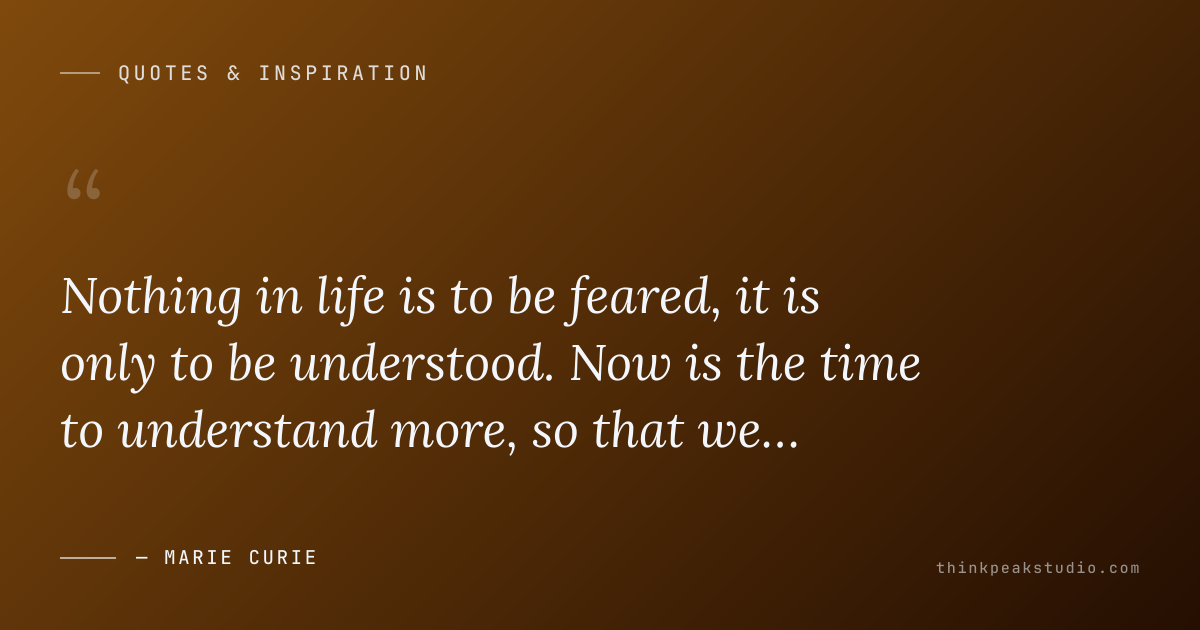
“Nothing in life is to be feared, it is only to be understood. Now is the time to understand more, so that we may fear less.”
The context
Marie Curie lived her entire life at the edge of the unknown, and she learned early that the unknown is not an enemy but an invitation. She was born Maria Skłodowska in Warsaw in 1867, when Poland had been erased from the map by the Russian Empire and when higher education was closed to women by law. Undeterred, she and her sister enrolled in a clandestine network of underground classes called the Flying University, where women met in secret, shifting locations to evade the authorities, and taught one another science in the half-light. It was there, denied a laboratory and a degree, that the young Maria first learned the habit that would define her life: that what you are told to fear or forbidden to know can be understood anyway, if you are willing to learn it in the dark. That conviction carried her to Paris, to the Sorbonne, and eventually into a freezing shed of a laboratory where she would change the course of science.
It was in that shed that Curie and her husband Pierre did the work that made the quote inevitable. In 1898, after the discovery of X-rays and of the strange energy Henri Becquerel had noticed in uranium, Marie Curie set out to find the source of that energy. She processed tons of pitchblende by hand, stirring boiling vats with an iron rod, and emerged with two new elements — polonium, named for her lost homeland, and radium, named for its eerie glow. She coined the word radioactivity. The discoveries won her the Nobel Prize in Physics in 1903 and a second, in Chemistry, in 1911 — the first woman ever honored, and the only person in history to be so honored in two different sciences. Yet the public that celebrated her was also afraid of what she had found: radium, glowing and invisible, seemed like a kind of sorcery. She spent her career reassuring an anxious world that the unknown, once studied, loses its power to terrify.
The quote itself is a distillation of that lifelong argument, and it carries the weight of someone who had earned the right to say it. Curie was no naive optimist. She knew danger intimately — the very radiation that made her famous was slowly destroying her body, a toll she paid without complaint until her death from aplastic anemia in 1934. So when she said that nothing is to be feared, she was not denying that things can hurt us. She was making a subtler and braver claim: that fear is a response to ignorance, not to reality, and that the cure for it is not courage in the abstract but understanding in the specific. The line endures because it is the testimony of a woman who walked into the unknown with a beaker and a notebook and came out with two Nobel Prizes and a new element of nature.
The meaning
The quote is built on a single, radical redefinition. Fear, Curie suggests, is not a verdict that reality hands down; it is a symptom of not yet understanding. The first sentence performs this reversal with surgical economy. “Nothing in life is to be feared, it is only to be understood.” Notice the word only. It does not say that nothing is dangerous, or painful, or worthy of caution. It says that fear, as an emotion, is a placeholder — the feeling that occupies the space where knowledge has not yet arrived. A child is afraid of the dark because the dark is illegible; a patient is afraid of a diagnosis because it is a name they cannot yet read; a society is afraid of a new technology because it has not yet mapped what the technology is. In every case, fear is not information about the world. It is information about a gap in our understanding, and the gap can be closed.
The second sentence turns the observation into a command, and it is the command that gives the quote its urgency. “Now is the time to understand more, so that we may fear less.” There are two imperatives folded together here. The first is temporal — now — a refusal to defer understanding until the crisis has passed, because the crisis will never pass on its own. The second is directional — understand more, not everything. Curie does not promise total knowledge; she knows that is impossible. She promises that the direction of motion matters more than the destination, that every increment of understanding subtracts a measure of fear, and that the person who keeps learning is, at every moment, a little less afraid than the person who does not. Fear, in this account, is not overcome in a single heroic act. It is eroded, incrementally, by curiosity.
There is also a deeply personal meaning beneath the surface, one that casual readers often miss. Curie was not speaking to a comfortable audience from a position of safety; she was speaking from inside the danger. She understood the radiation that was killing her better than anyone alive, and that understanding did not save her body — but it saved her from terror. She worked with radium every day without the trembling fear that gripped the public, not because she was reckless but because she knew precisely what it was and what it did. This is the quote’s deepest insight: understanding does not always remove the threat, but it always removes the dread. The thing that paralyzes us is never the danger itself; it is the shape of the danger in the dark. Turn on the light, and the monster in the closet becomes, simply, a coat.
Why it still matters today
In 2026, the quote reads less like nineteenth-century advice and more like a diagnosis of the present. We live in a culture that has industrialized fear. The attention economy runs on it: algorithms are optimized to surface whatever terrifies us, because fear is the most reliable way to stop a thumb mid-scroll. News feeds trade in worst-case scenarios, half-explained risks, and headlines designed to alarm before they inform. The result is a population drowning in anxiety about things it has not been given the tools to understand — artificial intelligence, climate systems, economic volatility, novel diseases, the machinery of our own technology. Curie’s line is a quiet rebuke to this entire system. It reminds us that fear is manufactured in the gap between what we experience and what we comprehend, and that the same machinery that manufactures the fear could be turned toward the understanding that dissolves it.
The quote also speaks directly to a deeper crisis of trust in expertise. We are told, correctly, that the world is too complex for any one person to understand, and too many of us have responded by outsourcing our fear to whoever shouts the loudest. Conspiracy theories, pseudoscience, and panic spread not because people are gullible but because fear is uncomfortable and certainty, even false certainty, is soothing. Curie offers a third path between blind belief and paralyzing doubt: the patient, incremental work of understanding. She does not ask us to trust experts; she asks us to become curious enough to ask questions, to learn enough to tell the difference between a real risk and an imagined one. In an age when fear has become a product, the discipline of “understand more, fear less” is an act of resistance — a way of refusing to let the people who profit from our panic set the terms of our lives.
How to apply this in your own life
The most practical application begins with a single question, asked the moment fear appears: what am I not understanding here? Treat anxiety not as a signal to run but as a signal to investigate. When a headline frightens you, read the study behind it. When a diagnosis frightens you, learn the actual statistics and the range of outcomes, not just the worst one. When a new technology frightens you, spend an hour learning what it actually does before deciding how you feel. The discipline is to convert fear into curiosity, to notice that the tightening in your chest is asking a question rather than giving an answer, and then to go answer it. Curie’s method was not to suppress fear but to interrogate it — to ask, every time, what precisely it is that I do not yet know. The fear does not vanish all at once, but it shrinks in proportion to what you learn, and the thing that once kept you awake at night becomes, eventually, a subject you could teach.
The deeper application is existential, and it changes the posture of an entire life. Most of us navigate the world defensively, braced against everything we cannot predict or control, and the result is a life lived in a state of low-grade siege. Curie’s quote invites us to turn around and face the unknown with an instrument in hand instead of a shield. It does not promise safety — Curie herself was killed by the very thing she illuminated — but it promises something better than safety: meaning. The person who spends a life understanding more is not merely less afraid; she is more alive, more engaged, more awake to the texture of a world that fear would flatten into a threat. The invitation of the sentence is to make curiosity your default response to the universe, to meet the dark not with a flinch but with a light, and to trust that the light, however small, is always enough to take the next step by. That is why the quote endures: it is not really about science. It is about the kind of courage that is available to everyone — the courage to understand.
Create your own quote graphic with this quote
This is the kind of quote that reframes an entire emotional life — turning fear from a verdict into a question. When you pair an idea this clarifying with thoughtful design, you create something worth saving and returning to. Use our free online quote maker to turn this exact quote into a shareable image in seconds — no signup needed. For advanced features like video quotes and 100+ templates, try the Quotes Creator Android app.
Why we chose this quote
Marie Curie is too often reduced to a first — the first woman to win a Nobel Prize — and the profound philosophy underneath her achievements gets lost in the trivia. We wanted to treat the quote as what it actually is: not a slogan of naive optimism but the hard-won conclusion of a woman who spent her life illuminating exactly the things that frightened the world most. The sentence is rare in that it is both a comfort and a challenge — it relieves you of the burden of fear while demanding the discipline of curiosity. In a culture that profits from our panic and rewards our certainty, it is a reminder that fear is not information about the world but about our own ignorance, and that the cure for it has never been bravery. It has always been understanding. That is why it stays with people long after the biography is closed.
— ThinkPeak Studio Editorial Team
Create your own quote graphic with this quote
Turn this line into a shareable graphic in seconds — free, no signup needed. For video quotes and 100+ templates, try the Android app.
Advertisement
Enjoyed this article? Get more like it in your inbox.


