Quote Explained: “Who you are is defined by what you’re willing to struggle for.”
By Mark Manson, author of The Subtle Art of Not Giving a F*ck
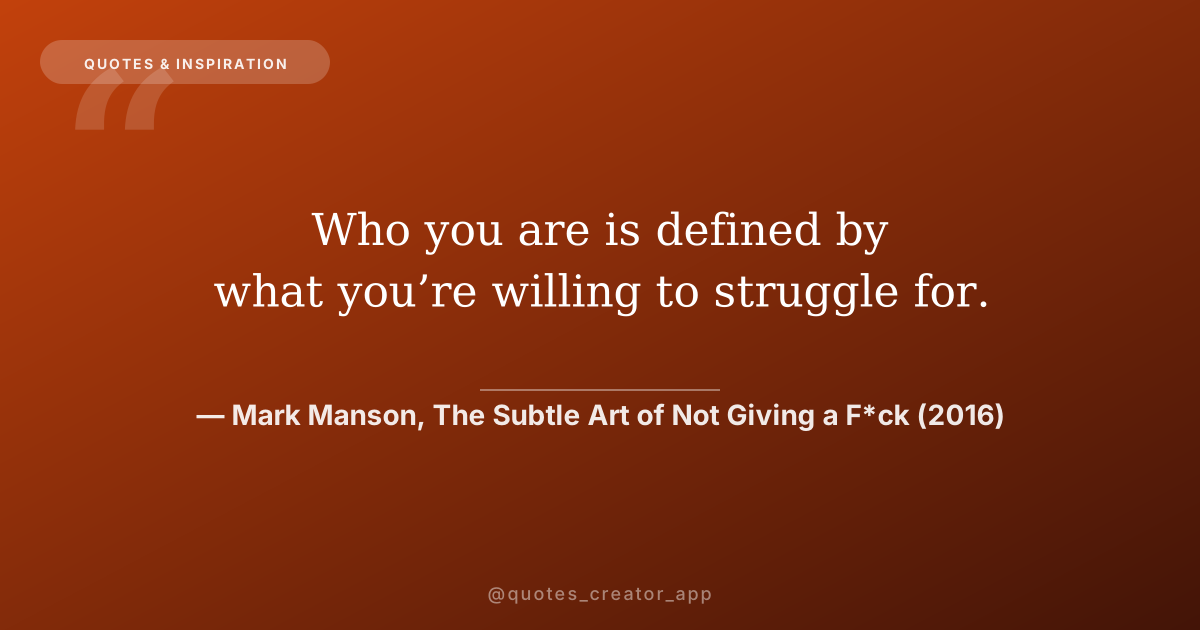
“Who you are is defined by what you’re willing to struggle for.”
The context
Mark Manson did not set out to write a self-help book. He was a travel blogger with a confrontational streak, publishing essays on dating, happiness, and personal development that had begun to attract a cult following precisely because they refused to flatter the reader. Where the self-help industry promised that you could have, be, and feel anything if only you believed hard enough, Manson wrote the opposite: that most of the things we chase are not worth chasing, that you cannot care about everything, and that the relentless pursuit of happiness is the surest way to make yourself miserable. His posts went viral not in spite of their negativity but because of it — millions of readers, exhausted by affirmations and gratitude journals, found relief in someone finally telling them the truth about how unsatisfying the “positive thinking” industry actually is.
In 2016 he condensed that decade of writing into The Subtle Art of Not Giving a F*ck, a book whose profane title was itself an argument — a signal that this was not another pastel-colored manual for manifesting your dreams. It became an instant and enormous success: a fixture on the New York Times bestseller list for years, more than 20 million copies sold, translations into dozens of languages, and a franchise of follow-up books and courses. The quote at its center is the book’s thesis stripped to a single sentence. It appears in the opening chapter, delivered almost as a throwaway line, and yet it quietly reorganizes everything that follows: if you want to know who someone really is, do not ask what they want. Ask what they are willing to suffer for.
To understand why the line landed, you have to see the culture it was written into. The self-help of the preceding decades — from The Secret to the endless stream of “choose happiness” content — had been built on a single assumption: that discomfort is the enemy and comfort is the goal, and that with enough optimism you can have the second without ever enduring the first. Manson arrived at the exact moment that assumption was beginning to show its seams, as a generation raised on relentless positivity found itself more anxious and more dissatisfied than the one before it. His quote is a direct rebuttal to that entire worldview. It insists that struggle is not an obstacle standing between you and the good life — it is the raw material the good life is made of, and the only question that ever mattered is which struggles you choose.
The meaning
The quote’s force comes from what it refuses to let you do: define yourself by your preferences. We are all fluent in the language of wanting — we want love, wealth, health, freedom, respect, a meaningful career — and because everyone wants roughly the same things, those desires reveal almost nothing about us. A preference is cheap; it costs you nothing to hold. What actually distinguishes one person from another is the price they are willing to pay. The aspiring artist who never paints, the entrepreneur who never risks anything, the person who claims to value fitness but has not exercised in a year — none of them are defined by what they want, because wanting is invisible. They are defined, Manson argues, by the struggle they are actually willing to show up for: the rejections, the failures, the boring repetitions, the painful trade-offs. Identity, in this view, is not declared. It is paid for.
Beneath this lies a paradox that Manson borrows from the philosopher Alan Watts, which he calls the “backwards law.” The harder you chase a positive experience — happiness, confidence, love — the more elusive it becomes, because the chase itself is a statement of lack. The path to a good life, therefore, does not run through the avoidance of struggle but through its selection. Happiness is not the absence of problems; it is the presence of problems you enjoy solving. When Manson says you are defined by what you are willing to struggle for, he is also saying that you are defined by the problems you choose to keep. The person who chooses the struggle of raising a family, the struggle of building a business, or the struggle of mastering a craft is not suffering more than the person who avoids commitment — they are simply paying a price they have chosen, toward an outcome they value, rather than paying a price chosen for them by fear.
There is a subtler, more uncomfortable implication that casual readers often miss. If you are defined by your struggles, then refusing to choose a struggle is itself a choice — and usually the worst one. Avoiding all pain does not deliver you into a painless life; it delivers you into a smaller life, haunted by the quiet, ambient suffering of regret and wasted potential. The man who avoids the struggle of intimacy to escape the risk of rejection does not avoid heartbreak; he merely trades acute heartbreak for chronic loneliness. The quote is therefore not an invitation to suffer more, but a demand to suffer deliberately. It is a claim that agency lies not in what you desire but in what you decide is worth hurting for — and that a person without a chosen struggle is not free, but adrift.
Why it still matters today
In 2026, the quote has grown sharper than when it was written, because the culture has engineered comfort to an unprecedented degree while anxiety has climbed alongside it. We live in an economy of convenience — food delivered, entertainment on demand, connection mediated through screens — that promises to remove friction from every corner of existence. Yet the removal of friction has not produced a happier population; it has produced a population that has lost the very mechanism by which meaning is generated. The quote names the reason: without chosen struggle, there is no sense of earned identity, and without earned identity, there is only the hollow, restless feeling that life is happening to you. In a world that treats discomfort as a bug to be patched, Manson’s sentence is a reminder that struggle is not the bug. It is the feature.
The quote also cuts through the most corrosive habit of the social-media age: the performance of wanting. Feeds are saturated with people broadcasting ambitions they never pursue — the business they will start, the body they will build, the book they will write — collecting the approval of strangers for intentions they have not yet backed with a single hour of difficulty. This dynamic inverts everything the quote describes: people derive identity from their desires rather than their sacrifices, and are then confused when the identity does not hold. Manson’s sentence is a quiet rebuke to the entire economy of declaration. It insists that no one cares what you want, and neither, in the end, do you — what matters is the specific, unglamorous, often invisible struggle you are willing to endure when no one is watching. In an era drowning in goals and starving for grit, the question “what are you willing to struggle for?” has become the only question left that separates a life actually lived from a life merely posted about.
How to apply this in your own life
The practical application begins with an audit you can conduct today, and it requires brutal honesty. Look at where your time, money, and attention actually go — not where you say you want them to go, but where they go when no one is checking. The struggles you already show up for, however reluctantly, are the most reliable evidence of who you currently are. Then ask the harder question: are these the struggles you would choose if you were choosing deliberately, or the ones you drifted into? Manson’s prescription is not to eliminate struggle but to select it. Decide which problems you want to have for the rest of your life — the problem of being a parent, the problem of maintaining a body, the problem of producing work — and then orient your daily decisions around those chosen problems rather than the fleeting preferences that dominate your attention. The person who has chosen their struggle no longer needs motivation, because motivation is for wants; commitment is for struggles.
The deeper application is existential, and it changes how you introduce yourself to yourself. Most of us were taught to answer the question “who are you?” with our preferences — our tastes, our dreams, our plans — all of which are provisional and none of which cost anything. Manson’s quote relocates the question to the one place we cannot lie: our sacrifices. Ask not “what do I want out of life?” but “what am I willing to be uncomfortable for, over and over, for years, with no guarantee of reward?” The answer will not always be pleasant, but it will be true, and a true answer is the foundation of any life worth living. The invitation of the sentence is to stop collecting desires like souvenirs and start paying for a single, chosen struggle with the currency of your attention and your days. Do that, and identity stops being something you hope for and becomes something you are — not because you wanted it, but because you earned it the only way anything is ever earned: by refusing to quit when it hurt.
Create your own quote graphic with this quote
This is the kind of quote that rearranges how you see yourself. When you pair an idea this clarifying with thoughtful design, you create something worth saving and returning to. Use our free online quote maker to turn this exact quote into a shareable image in seconds — no signup needed. For advanced features like video quotes and 100+ templates, try the Quotes Creator Android app.
Why we chose this quote
Mark Manson is frequently reduced to a provocative book cover and a few clipped social-media slogans, which is exactly why his central idea deserves a closer look. We wanted to treat the quote as what it actually is: not a cynical edgelord slogan but a complete account of how identity is built, one chosen difficulty at a time. The sentence is rare in that it is both a comfort and an accusation — it relieves you of the exhausting burden of wanting everything while holding you ruthlessly accountable for what you are actually willing to pay for. In a culture that endlessly celebrates desire and quietly avoids effort, it is a reminder that you are not what you want. You are what you are willing to struggle for. That is why it endures long after the title’s shock value fades.
— ThinkPeak Studio Editorial Team
Create your own quote graphic with this quote
Turn this line into a shareable graphic in seconds — free, no signup needed. For video quotes and 100+ templates, try the Android app.
Advertisement
Enjoyed this article? Get more like it in your inbox.