Quote Explained: “Injustice anywhere is a threat to justice everywhere.”
By Martin Luther King Jr., American civil rights leader and Baptist minister
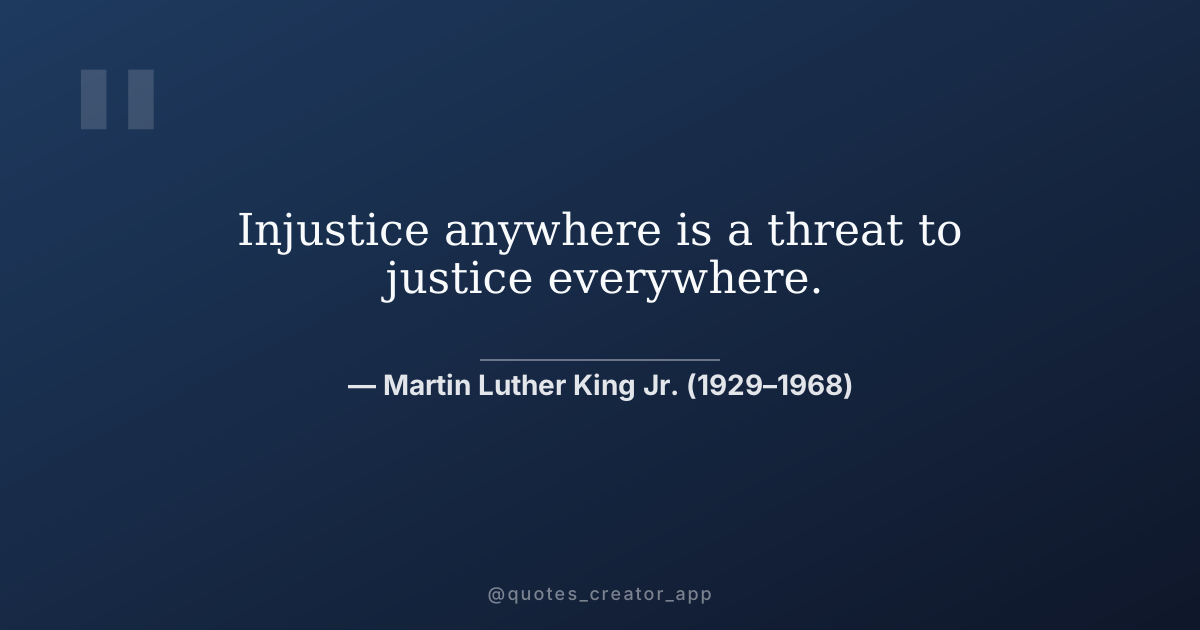
“Injustice anywhere is a threat to justice everywhere. We are caught in an inescapable network of mutuality, tied in a single garment of destiny. Whatever affects one directly, affects all indirectly.”
The context
In the spring of 1963, Birmingham, Alabama, was the most segregated city in the United States. Commissioner of Public Safety Bull Connor had turned fire hoses and police dogs on peaceful protesters, and the city’s Black citizens endured bombings so frequent that its nickname was “Bombingham.” King and the Southern Christian Leadership Conference had chosen Birmingham precisely because of its brutality: they believed that if nonviolence could work there, it could work anywhere. On April 12, 1963 — Good Friday — King was arrested for violating a state court injunction that banned protest marches. He was placed in solitary confinement, denied a phone call, and told that no lawyer could see him. For the first 24 hours, his family had no idea whether he was alive.
The next day, a smuggled copy of the Birmingham News reached his cell. Inside it, eight white clergymen — including a Catholic bishop, a rabbi, and the Episcopal and Methodist bishops of Alabama — had published a statement titled “A Call for Unity.” They called King an “outsider” and his demonstrations “unwise and untimely.” They urged Black citizens to withdraw support from the protests and trust the courts instead. King’s response began immediately, in the margins of the newspaper that carried the clergymen’s attack. When those margins ran out, he wrote on toilet paper, on scraps smuggled in by a sympathetic Black jail trusty, and on any surface he could find. The letter was pieced together and typed by his secretaries, then smuggled out of the jail in sections. It wasn’t written with the polished detachment of a man composing for history. It was written in anger, in urgency, and in the conviction that silence had become a form of violence.
The full letter runs nearly 7,000 words and is, by any standard, one of the most important political documents in American history. It was reprinted in magazines and newspapers throughout the summer of 1963, was included in King’s book Why We Can’t Wait, and has since been translated into dozens of languages. The line about injustice being a threat to justice everywhere is its most quoted sentence, but it is only the opening of a larger claim. King immediately follows it with the assertion that we are tied in a single garment of destiny, and that whatever affects one person affects everyone indirectly. This was his foundational philosophical claim: that the universe is morally structured such that no one can escape the consequences of injustice done to anyone else.
The meaning
On its surface, the statement is straightforward: if you tolerate injustice anywhere, you weaken the moral and legal structures that protect justice everywhere. A society that decides some group of people can be treated unfairly has already undermined the principle that fairness is a right, not a privilege. King was responding directly to the clergymen’s argument that Birmingham’s problems should be solved by Birmingham’s people and that he, a minister from Atlanta, had no right to interfere. His response was devastatingly simple: there is no such thing as an outsider when it comes to justice. The category of “outsider” is itself a product of the unjust system that divides people into those who matter and those who do not.
The deeper meaning reveals itself in what King says next. The phrase “inescapable network of mutuality” is not a political slogan; it is a theological and moral claim. King believed, drawing from both the Christian gospel and the philosophy of personalism he studied at Boston University, that human beings are not isolated atoms colliding in a morally neutral universe. We are, in his language, tied together in a single garment of destiny. This image is drawn from the biblical story of Joseph’s coat of many colors — a garment woven from many threads into one whole. Pull one thread, and the entire fabric unravels. It is a profound rejection of the idea that morality can be private, that ethics can be compartmentalized, or that one person’s suffering can be someone else’s business. In King’s vision, there is no “someone else.” There is only us.
This is also what makes the quote so emotionally powerful and so difficult to actually live by. It is comforting to believe that injustice over there is a separate problem from the justice we enjoy here. King’s line destroys that comfort. It says that your peace of mind, your sense of security, and even your moral identity are not truly yours if they depend on ignoring what is happening to other people. It is not just a political argument for a particular policy. It is a fundamental reorientation of how a person understands their relationship to the rest of humanity. Every act of injustice, no matter how small or distant, is a bill that will eventually come due. And every act of solidarity, no matter how symbolic or limited, is a deposit against that debt.
Why it still matters today
The COVID-19 pandemic gave King’s line a grim, unarguable demonstration. A virus that emerged in one city in China became, within months, a global catastrophe that shut down economies, overwhelmed hospitals, and killed millions. Vaccine inequity — wealthy nations stockpiling doses while poorer ones went without — turned out to be not just a moral failure but a strategic one, as new variants emerged from unvaccinated populations and circled back to threaten everyone. The phrase “nobody is safe until everybody is safe” became a public health mantra, and it was, whether the speakers knew it or not, a restatement of King’s argument: you cannot wall off suffering and expect your own world to remain unchanged. The pandemic did not just illustrate the quote. It proved it.
The same logic applies to the environmental crisis, economic inequality, and the erosion of democratic institutions. Climate change does not check passports. A supply chain disrupted by labor exploitation in one country raises prices in another. An authoritarian movement that silences dissidents abroad provides a template that authoritarians at home can study and adapt. In each case, the instinct to say “that is their problem” turns out to be not just morally hollow but factually wrong. King’s quote has survived and grown in relevance because the world keeps demonstrating that he was right. The garment of destiny is not a metaphor. It is a description of how the world actually works.
How to apply this in your own life
The first and hardest application is to stop compartmentalizing your ethics. Most of us have a version of this: we are principled at work but look away from what our employers do in other countries; we care about our own community but treat problems in other communities as not our concern; we consume products without asking how they were made or by whom. King’s claim is that these mental boundaries are illusions, and that living as though they are real is the foundational mistake that makes all other injustice possible. The practical step is to train yourself, when you encounter a story of suffering or injustice, to resist the reflex that says “what does this have to do with me.” Instead, ask the harder question: “in what ways am I already connected to this, whether I want to be or not?”
The second application is to recognize that small acts of solidarity are not small. King wrote this letter from a jail cell, on scraps of paper, answering men who had the institutional power of the church behind them. He had no official authority. He could not pass a law or issue an order. What he had was the willingness to write, to argue, to refuse to be silent, and to keep doing it no matter what it cost him. The network of mutuality is not an abstraction. It is made of specific, concrete acts: the article you share, the conversation you have at dinner, the cause you donate to, the meeting you show up for, the vote you cast. Each one is a thread in the garment. And if you follow King’s logic all the way down, you arrive at a conclusion that is both terrifying and liberating: there is no such thing as a neutral thread. Everything you do either strengthens the garment or pulls at the seams. The only question is which one you choose.
Create your own quote graphic with this quote
This is the kind of quote that carries weight. When you pair timeless words with thoughtful design, you create something people want to save, share, and return to. Use our free online quote maker to turn this exact quote into a shareable image in seconds — no signup needed. For advanced features like video quotes and 100+ templates, try the Quotes Creator Android app.
Why we chose this quote
Of all the lines Martin Luther King Jr. wrote or spoke — and there are hundreds that deserve attention — this one rewards the deepest examination because it is the philosophical keystone of his entire project. The “I Have a Dream” speech is poetry. The “Mountaintop” speech is prophecy. But the Letter from Birmingham Jail is the argument, and this sentence is its thesis. What makes it worth a full essay is that most people have heard it without really absorbing what it demands. It is not a platitude about being nice to each other. It is a morally devastating claim that there is no safe distance from injustice, no comfortable position from which you can watch suffering and remain clean. Every reader who encounters it has to decide whether they actually believe it, and if they do, what they intend to do about it. That kind of honesty, from a man writing on toilet paper in a segregationist jail cell, is why this quote has not aged a day.
— ThinkPeak Studio Editorial Team
Create your own quote graphic with this quote
Turn this line into a shareable graphic in seconds — free, no signup needed. For video quotes and 100+ templates, try the Android app.
Advertisement
Enjoyed this article? Get more like it in your inbox.