Quote Explained: “Tell me, what is it you plan to do with your one wild and precious life?”
By Mary Oliver, American poet
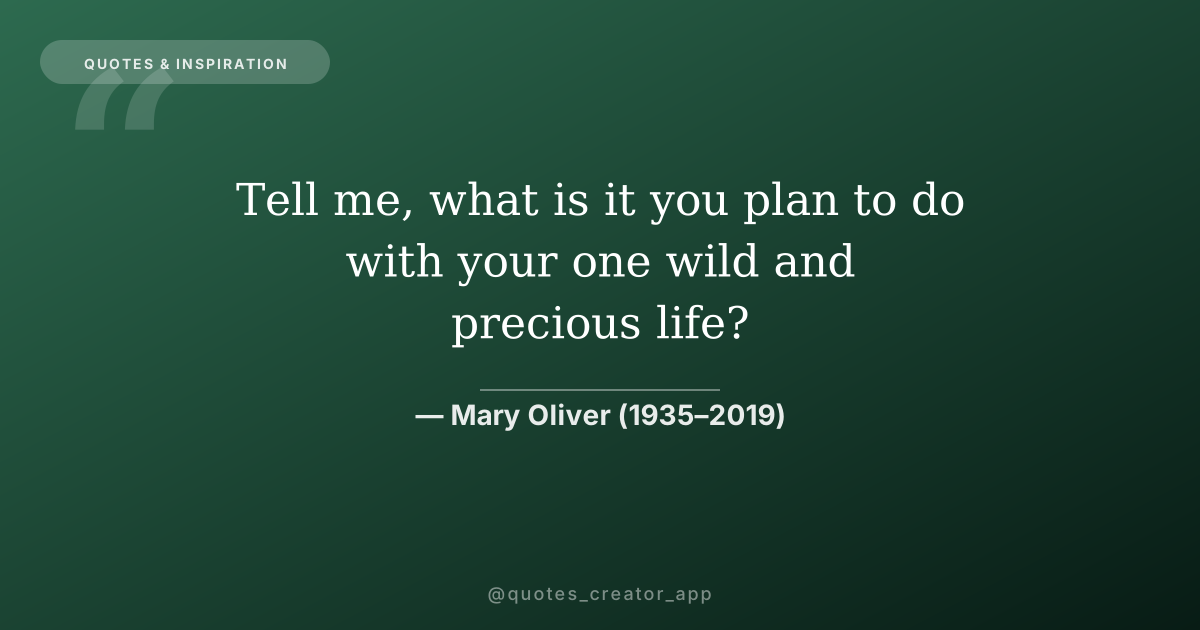
“Tell me, what is it you plan to do with your one wild and precious life?”
The context
The line comes from “The Summer Day,” the poem Mary Oliver read aloud more often than any other, and the one that made her — a shy, private woman who spent most of her life walking the woods and shorelines near Provincetown, Massachusetts — an unlikely household name. Oliver was a nature poet in the tradition of Whitman and Emerson, but she always resisted the label, because her subject was never simply the outdoors. It was the question of how to live. Her poems are records of attention: a grasshopper eating sugar from her hand, a pond, a black bear, a wild goose flying home. She wrote in plain, unadorned sentences that almost anyone could understand, and in doing so she reached an audience that academic poetry had long since abandoned. By the time of her death in 2019 at the age of eighty-three, she had won both the Pulitzer Prize and the National Book Award, but her deepest legacy was the millions of ordinary readers who kept a single line of hers tucked in a pocket or pinned above a desk.
“The Summer Day” itself is deceptively simple. It opens with a question — “Who made the world?” — and then spends most of its brief length doing almost nothing: watching a grasshopper, walking through fields, kneeling down in the grass, and confessing that she has been “idle and blessed.” Only in the final three lines does the poem turn, with devastating directness, to the reader. “Doesn’t everything die at last, and too soon?” she asks, and then, without waiting for an answer, delivers the line that has become her signature: “Tell me, what is it you plan to do with your one wild and precious life?” The structure matters enormously. The question is not a slogan tacked onto the poem; it is the destination the poem has been walking toward the whole time. The watching, the kneeling, the idleness — all of it was the answer the question was preparing the reader to give.
The context of the poet’s own life sharpens the question. Oliver survived a difficult and abusive childhood, and she spoke candidly about how walking in the woods had saved her — how paying attention to the natural world became, for her, a way of staying alive. She was not a person who had found life easy and therefore felt entitled to preach about it. She was a person who had learned, through grief and solitude, that a life is not something you possess but something you attend to. That is why the question never sounds like a guilt trip. It sounds like a friend, at the end of a long walk, finally asking the thing they came to ask. Oliver does not tell you what to do with your life. She asks what you plan to do — knowing that most of us have no answer, and that the asking itself is the beginning of one.
The meaning
The phrase “one wild and precious life” is a complete philosophy compressed into five words, and each one carries weight. “One” — singular, unrepeatable, non-renewable. You do not get another. “Wild” — not tame, not fully controllable, not something that submits quietly to five-year plans and color-coded calendars; life overflows, surprises, and resists being managed, which is exactly why it is alive. “Precious” — worth more than anything, and easy to lose. The three words form a kind of insistence: you get one of these, it cannot be domesticated, and it is beyond price. To ask what you plan to “do” with such a thing is to insist that a life is not something that merely happens to you. It is something you do — something you spend, something you shape, and ultimately something you answer for.
The deeper move is hidden in the word “plan.” Oliver does not ask what you dream of doing, or what you hope to do, or what you regret not doing. She asks what you plan to do — a word that carries the weight of intention, of deliberate choice, of the future tense understood as a commitment rather than a wish. Most people drift through life without ever forming a plan for the life itself. They plan their careers, their weekends, their vacations, their retirements, but never the life those plans are supposed to be in service of. The question exposes the gap between living and merely continuing. A dream is something you hold; a plan is something you act on today. Oliver is not asking about aspiration. She is asking about direction — about where, right now, the one irreplaceable life you have been given is actually pointed.
There is also a quiet challenge buried in the “wild.” Plans and wildness seem to stand at odds, and Oliver knows it. To plan your life is not to tame it, to schedule it into submission, or to strip it of surprise. It is to choose, deliberately, how you will answer the wild and precious thing you have been given. The grasshopper she watches for the length of the poem — a creature that will be dead within a season — teaches her what the final line finally says: pay attention, because everything dies at last, and too soon. The question is not morbid. It is the opposite of morbid. It is among the most life-affirming questions a poet has ever asked, because it assumes you still have time to answer it — that the grasshopper is still on your hand, the day is still summer, and the life is still yours to do something with.
Why it still matters today
The line has become one of the most shared pieces of poetry in the world — printed on mugs, framed on walls, tattooed on skin, read at graduations and memorials alike — and it has achieved that reach precisely because it names the anxiety of an age that has confused being busy with being alive. Modern life offers an infinite number of ways to fill a day and almost no help in deciding what a life is for. The calendar fills with meetings, the feed fills with content, the years fill with obligations, and somewhere underneath it all the unasked question remains: what is all this activity for? Oliver’s question, when it surfaces on a greeting card or in a speech, does its work by cutting through the noise and asking the one thing that matters. It is a question designed to make you stop scrolling.
Its resurgence also tracks a broader cultural turn toward mindfulness, attention, and “slow living” — all of which Oliver embodied decades before they became hashtags. She spent a lifetime doing, in public, what the modern wellness industry now sells as a technique: paying close, unhurried attention to the ordinary. But Oliver would have resisted being turned into a product. Her question is not a productivity prompt or a self-help slogan; it is an existential summons. In a culture that increasingly treats human attention as a resource to be harvested and sold to the highest bidder, the invitation to ask what you plan to do with your one wild and precious life is a small act of reclamation. It returns the question of meaning to the one person who can answer it, at the one moment when the answer still counts: you, now.
How to apply this in your own life
The most honest way to honor the question is to sit with it literally — to write it down, alone, with no phone, and to write an honest answer, even a fragment of one. Oliver’s genius is that she does not demand a grand, finished answer. She asks what you plan to do, and “do” can begin as small as “notice.” The first application is therefore not to overhaul your life but to re-aim your attention, because attention is the raw material from which any plan must be built. You cannot plan a life you have not first noticed. Spend an afternoon the way Oliver spent her days: watch one ordinary thing closely, without hurry, and see what it does to the rest of your thinking. The question, more often than not, answers itself once you slow down enough to hear it.
The second application is to treat the question as a filter for decisions rather than a one-time interrogation. Before you say yes to a commitment, before you trade another hour for a screen, before you let another year pass on autopilot, ask: does this move me toward what I plan to do with my one wild and precious life? Most of what fills a life fails that test — not because it is wicked, but because it is filler. Mary Oliver did not intend to make anyone quit their job or sell their house. She intended to make them wake up to the fact that the question has an answer, that the answer is theirs to write, and that the time to begin writing it is now — while the grasshopper is still on your hand, while the day is still summer, while the life is still wild, and still precious, and still yours.
Create your own quote graphic with this quote
This is a quote that stops people mid-scroll. When you pair timeless words with thoughtful design, you create something people want to save, share, and return to. Use our free online quote maker to turn this exact quote into a shareable image in seconds — no signup needed. For advanced features like video quotes and 100+ templates, try the Quotes Creator Android app.
Why we chose this quote
Mary Oliver is quoted everywhere, but she is usually quoted as decoration — reduced to a comforting line on a mug, stripped of the poem that gives the line its force. We wanted to treat this question as what it actually is: not a platitude but a summons, earned over the course of a poem about watching a grasshopper and confronting death. The phrase “one wild and precious life” is the rare piece of contemporary poetry that functions as complete philosophy, and it has only grown more urgent in an age that monetizes attention and mistakes busyness for meaning. We chose this quote because it does not flatter you with an answer — it hands you a question, and then trusts you to live it.
— ThinkPeak Studio Editorial Team
Create your own quote graphic with this quote
Turn this line into a shareable graphic in seconds — free, no signup needed. For video quotes and 100+ templates, try the Android app.
Advertisement
Enjoyed this article? Get more like it in your inbox.