Quote Explained: “I’ve learned that people will forget what you said, people will forget what you did, but people will never forget how you made them feel.”
By Maya Angelou, American poet, memoirist, and civil rights activist
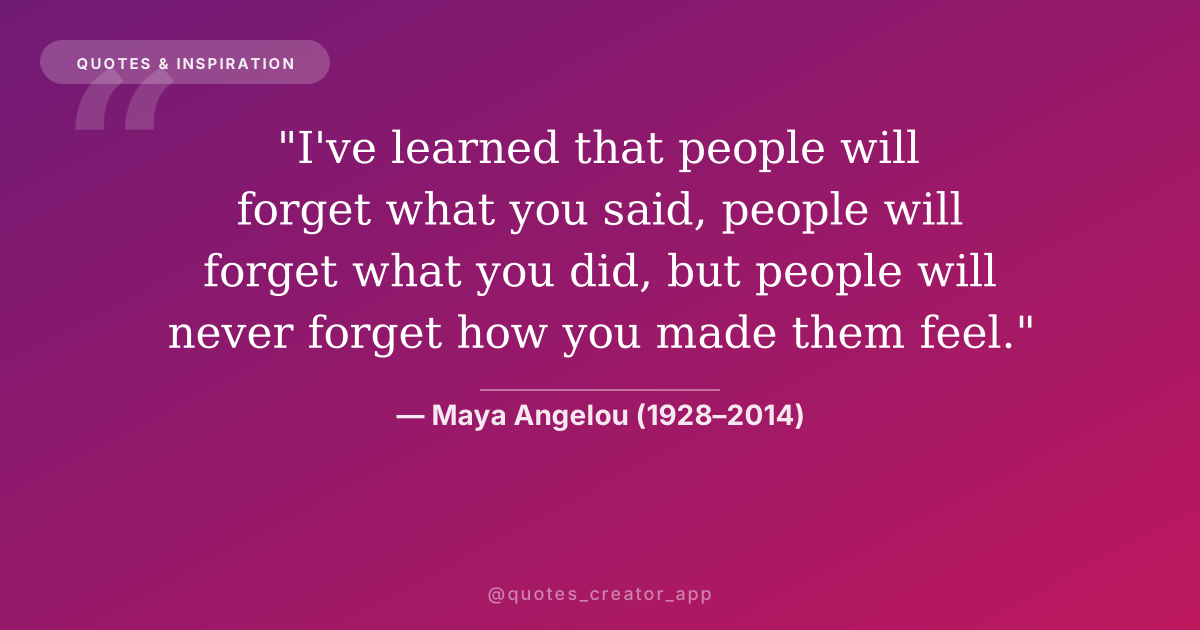
“I’ve learned that people will forget what you said, people will forget what you did, but people will never forget how you made them feel.”
The context
Maya Angelou was born Marguerite Annie Johnson in St. Louis, Missouri, in 1928 — a time when Jim Crow laws still governed the American South and the odds against a Black girl from a broken, impoverished home becoming one of the most revered voices in American letters were, by any sober reckoning, insurmountable. Her childhood was marked by trauma that would silence most people permanently: at the age of seven, she was raped by her mother’s boyfriend; when she told her family, the man was murdered, and Angelou, believing her words had killed him, stopped speaking for nearly five years. She read voraciously during those silent years — Shakespeare, Poe, Dunbar, the Black poets of the Harlem Renaissance — and when she finally began to speak again, she did so with a voice forged in the crucible of that silence. Everything she wrote afterward — the seven volumes of autobiography beginning with I Know Why the Caged Bird Sings (1969), the dozen collections of poetry, the essays, the speeches — was animated by the conviction that words have the power to wound or heal, and that the responsibility of a human being is to use that power for healing.
The precise origin of this quote is elusive in the way that many of Angelou’s most famous lines are — not because they are apocryphal, but because she spoke and wrote them so frequently, in so many variations, that the line between oral and written canon blurs. Variants appear across decades of interviews, commencement addresses, and public appearances. The sentiment crystallizes a theme that runs through her entire body of work: that the measure of a life, and the measure of a relationship, is not transactional but emotional. You will not be remembered for the cleverness of your arguments or the efficiency of your execution; you will be remembered for whether people felt seen, respected, and valued in your presence. Angelou arrived at this wisdom not by abstract philosophy but by living it — as a single mother working as a fry cook and a nightclub dancer, as a coordinator for the Southern Christian Leadership Conference alongside Martin Luther King Jr., as a journalist in Egypt and Ghana during decolonization, as a professor, a director, a Tony-nominated actress. Every role taught her the same lesson: what endures is not the resume but the resonance.
It is essential to understand that Angelou was not dispensing lightweight, feel-good advice. She was describing a discovery that had cost her everything to make. The woman who spent five years mute because she believed her voice had caused a death understood, at the deepest possible level, that what people remember is never the facts of an exchange but the emotional imprint it leaves. Her own life was proof: she forgot most of what was said to her during those silent years in Stamps, Arkansas, but she never forgot how Mrs. Bertha Flowers, the town aristocrat who befriended her, made her feel — worthy, intelligent, capable of more than silence. That emotional memory, more than any lecture or textbook, was what restored her voice. The quote is, in this sense, autobiographical. It is Angelou speaking from the scar, not the scar’s interpretation.
The meaning
At the surface, the quote makes a straightforward claim about the architecture of memory: declarative memory, which stores facts and events, is less durable than emotional memory, which stores the felt quality of an experience. You can forget the words of a conversation years later, but the warmth or coldness of the person who spoke them stays with you. You can forget the details of a project you worked on, but the feeling of being trusted or micromanaged, encouraged or dismissed, persists. This is not pop psychology; it is a well-documented phenomenon in cognitive science. The amygdala, which processes emotional significance, tags experiences with a salience that the hippocampus, which encodes declarative memories, cannot override. The brain is wired to prioritize feeling over fact because, from an evolutionary standpoint, whether a situation felt safe or dangerous was far more relevant to survival than the semantic content of whatever was said during it. Angelou, without access to fMRI scanners, had observed what neuroscientists would later confirm: emotion is the highlighter of memory, and what it does not mark, time erases.
The deeper layer of meaning is ethical rather than descriptive. Angelou is not merely reporting a fact of human psychology; she is issuing a challenge. If emotional impact is what lasts, then the single most important question you can ask about any interaction is: how did I make that person feel? The question reframes leadership, parenting, friendship, romance, and even casual encounters as exercises in emotional responsibility. A manager who delivers brilliant strategic feedback but does so with contempt will be remembered not for the brilliance but for the contempt. A parent who provides every material comfort but communicates disappointment in their child will be remembered for the disappointment. A partner who is technically faithful but emotionally absent will be remembered for the absence. The quote strips away the alibi that good intentions are enough, that as long as you were “right” the emotional collateral does not count. What you intended to communicate is irrelevant next to what the other person received. And what they received, more often than not, was not your words but the tone, the posture, the subtext, the presence or absence of genuine care that accompanied them.
There is also a profound inversion of conventional wisdom embedded here. Most people spend their lives trying to be impressive — to say the right thing, to be articulate, to construct arguments that cannot be refuted, to build achievements that cannot be dismissed. Angelou is suggesting that this entire project is misdirected. What people will remember about you has almost nothing to do with how impressive you were and almost everything to do with how present you were. It is a deeply humbling claim, because it means that the most impactful thing you can do in any interaction requires no credentials, no rhetorical skill, and no material resources. It requires only attention. The quality of your attention — whether you are truly listening or merely waiting to speak, whether you regard the other person as a full human being or a means to an end — is what creates the emotional memory that will outlast everything else. This is why the quote has been adopted by leadership coaches, therapists, educators, and parents with equal fervor. It applies to everyone because it demands something everyone can give.
Why it still matters today
In the age of digital communication, the quote has acquired a relevance that Angelou could only have intuited. We live in an era of unprecedented verbal output. Billions of messages, emails, posts, and comments are exchanged daily, each one a collection of words that, statistically, will be forgotten almost instantly. The sheer volume of language in circulation has devalued the word. And yet, the emotional impression of this digital deluge persists. A curt email from a boss on a Saturday morning is forgotten in its specifics, but the feeling of being invaded and unvalued lingers. A thoughtful direct message from someone who noticed you were struggling is scrolled past and archived, but the warmth of being seen remains. The medium has changed, but the mechanism Angelou described has not. If anything, the asymmetry between words and feelings has become more pronounced, because the ratio of words to actual human presence has become so extreme. The rarer presence becomes, the more its emotional weight intensifies. In a landscape of infinite text and vanishing attention, the person who makes you feel something real stands out like a lighthouse.
The quote also addresses, obliquely but powerfully, one of the central crises of contemporary public life: the collapse of trust in institutions. Governments, corporations, media organizations, and platforms issue statements constantly — apologies, commitments, values declarations, policy announcements. People forget nearly all of them. What they do not forget is how those institutions made them feel: lied to, exploited, ignored, condescended to. The gap between verbal promise and emotional experience is the gap in which trust dies. Angelou’s insight implies that no amount of communication strategy can compensate for a failure of emotional integrity. An organization that treats its employees as disposable will not be remembered for its well-crafted mission statement; it will be remembered for the feeling of being discarded. A politician who speaks beautifully about unity while treating opponents as subhuman will not be remembered for the oratory; they will be remembered for the contempt. The quote, in this sense, is not just personal advice. It is a principle of public accountability, and one that every institution currently struggling with a credibility deficit would do well to internalize.
How to apply this in your own life
The most immediate application is a practice that Angelou herself modeled: before entering any interaction that matters — a difficult conversation, a meeting, a dinner with family, a moment with a child — pause and ask yourself, “How do I want this person to feel when this is over?” The question is deceptively simple, but answering it honestly changes behavior. If you want someone to feel respected, you will listen differently. If you want them to feel valued, you will acknowledge what they have contributed before offering critique. If you want them to feel safe enough to be honest with you, you will moderate your reactivity. The shift from “What do I need to say?” to “What do I want them to feel?” reorients the entire interaction away from self-expression and toward connection. Angelou would not have claimed that this solves every problem, but she would have insisted that it solves the one that matters most: the problem of whether, when the interaction is over and the details have faded, the person you were speaking to will remember you as a source of warmth or a source of cold.
The deeper application is to extend this question beyond individual interactions and apply it to the arc of your relationships and your life. Regularly ask yourself: how do the people closest to me — my partner, my children, my friends, my colleagues — feel in my presence? Not what do they think of me, not whether they agree with my opinions or admire my achievements, but how do they actually feel when they are with me? The answer may be uncomfortable, because many people who believe themselves to be good, loving, and kind have never actually checked whether the people around them experience them that way. The application, then, is not just to intend well but to verify — to have the courage to ask, and the humility to hear answers you did not expect. Angelou spent her life demonstrating that this courage was possible, and that the reward for it was not admiration but connection, which is infinitely more durable. Her final gift to the reader is the permission to stop trying so hard to be impressive and start trying, with genuine attention, to be present. Because in the end, no one will remember what you said. But everyone will remember how you made them feel.
Create your own quote graphic with this quote
This is the kind of quote that carries weight. When you pair timeless words with thoughtful design, you create something people want to save, share, and return to. Use our free online quote maker to turn this exact quote into a shareable image in seconds — no signup needed. For advanced features like video quotes and 100+ templates, try the Quotes Creator Android app.
Why we chose this quote
Maya Angelou’s line has the rare quality of a truth that is instantly recognizable but endlessly deep. It says something everyone knows but almost no one acts on consistently, and it does so with a simplicity that is the hallmark of hard-won wisdom, not shallow thinking. We chose it because it cuts across every domain of life — work, love, family, community — and reframes success in terms that are psychologically accurate and morally challenging. In a culture obsessed with saying the right thing, building the right brand, and projecting the right image, Angelou quietly reminds us that none of it will matter in the end. What will matter is whether people felt something real in your presence. That is a standard we believe is worth holding ourselves to.
— ThinkPeak Studio Editorial Team
Create your own quote graphic with this quote
Turn this line into a shareable graphic in seconds — free, no signup needed. For video quotes and 100+ templates, try the Android app.
Advertisement
Enjoyed this article? Get more like it in your inbox.