Quote Explained: “People will never forget how you made them feel.”
By Maya Angelou, poet, memoirist, and civil rights activist
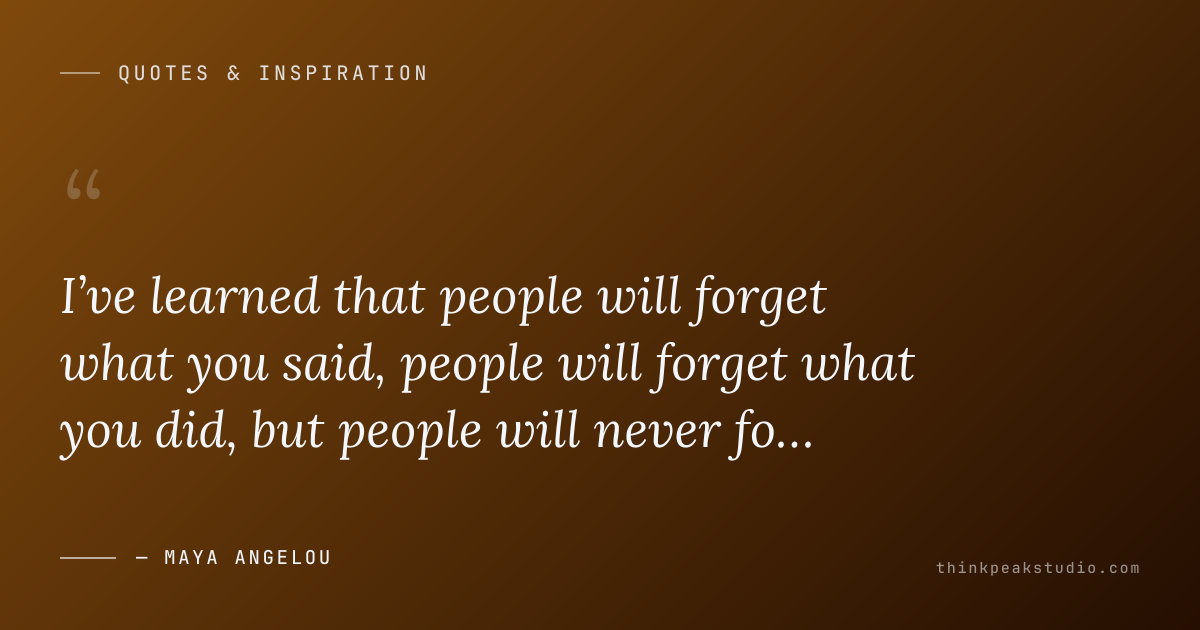
“I’ve learned that people will forget what you said, people will forget what you did, but people will never forget how you made them feel.”
The context
Few writers have earned the right to make a claim about feeling quite the way Maya Angelou did, because she spent the first part of her life learning what it means to be robbed of a voice. She was born Marguerite Johnson in 1928 in St. Louis, Missouri, and her childhood was marked by a trauma that would shape everything she later wrote. At the age of eight, she was raped by her mother’s boyfriend; when she told her family what had happened, the man was arrested and, days later, killed — and the child, believing her words had caused a man’s death, simply stopped speaking. For nearly five years she remained almost entirely silent, convinced that her voice was a dangerous thing. It was during that long silence that she became a reader, memorizing Shakespeare and Poe and Black poets with a ferocity that would one day resurface as her own unmistakable cadence — and it was a teacher named Bertha Flowers who finally coaxed her back into speech by showing her that a voice, used with love, could be a source of healing rather than harm. The woman who would one day tell the world that people never forget how you make them feel understood, from the innermost place a person can understand anything, both the wound of being silenced and the power of a voice to restore.
That reclaimed voice became one of the most consequential of the twentieth century. Angelou went on to become a dancer, a singer, an actress, a journalist, a civil rights organizer who worked alongside both Martin Luther King Jr. and Malcolm X — and, in 1969, the author of I Know Why the Caged Bird Sings, an autobiography so candid about race, violence, and survival that it transformed what memoir could do and has never once gone out of print. In 1993, at Bill Clinton’s first inauguration, she became only the second poet in American history — and the first Black woman — to recite a poem at a presidential swearing-in, reading “On the Pulse of Morning” to an audience of millions. By the time she died in 2014, she had received the Presidential Medal of Freedom and become something rarer than a celebrated author: a kind of national elder, a woman people turned to not only for language but for wisdom about how to live.
The quote itself — “people will forget what you said, people will forget what you did, but people will never forget how you made them feel” — is not drawn from a single book but from the accumulated wisdom of her later years, repeated in interviews, lectures, and conversations until it became one of the most quoted lines in the world. It is, unmistakably, hers: the distillation of a life spent thinking about voice, memory, and the invisible transactions that pass between people. And it endures for the same reason every great Angelou line endures. It is not clever; it is true. It names something every single person has already verified in their own life, and it does so with the calm authority of a woman who has lived long enough to know what actually lasts.
The meaning
On its surface, the quote is a claim about the architecture of memory, laid out with the clean three-part rhythm of a proverb. The first two clauses — “people will forget what you said” and “people will forget what you did” — assert that the content of your words and the record of your deeds both fade. The third — “people will never forget how you made them feel” — asserts that something else survives, and survives permanently. Angelou is drawing a line between two kinds of remembering: the semantic memory of facts, arguments, and events, which decays and blurs, and the emotional memory of feeling, which is encoded more deeply and resists erasure. You cannot reliably recall the exact words a teacher said to you decades ago, but you can recall, with startling vividness, whether that teacher made you feel seen or small. The sentence is, in effect, a precise observation about human beings that most people already know but have never heard put so plainly.
The deeper meaning is a claim about what a person fundamentally is to other people. We tend to imagine that we live in the world as our arguments, our achievements, our résumés — as the things we said and the things we did. Angelou quietly overturns that. To everyone who encounters us, we are not primarily our words or our accomplishments; we are the felt quality of our presence. We are the tightening or the easing someone experiences when we walk into a room. This is why the quote lands with such force: it relocates identity from the measurable to the felt, and insists that the truest thing about you is not what you produced but what you left behind in the bodies of other people. It is, at bottom, an argument that human beings are feeling creatures before they are thinking ones, and that any account of who we are that ignores this is incomplete.
There is also, beneath the observation, a quiet reordering of priorities that functions as a moral instruction. If the only thing people reliably keep from an encounter with you is how you made them feel, then the most important work you do in any interaction is emotional, not informational. The quote does not say words and deeds do not matter; it says they will be forgotten, and therefore they are not where your lasting impact lives. That impact lives in the tone of your attention, the quality of your listening, the warmth or coldness of your regard — the parts of living that are invisible, unglamorous, and almost never listed on a résumé. Angelou is not telling us to be nice as a strategy. She is telling us what is real: that kindness and cruelty are not small add-ons to a life but the only part of a life that other people actually keep.
Why it still matters today
The quote has never been more relevant, because we now live inside a machine built to contradict it. The modern world showers us with an unprecedented volume of words and deeds — posts, messages, headlines, opinions, achievements broadcast for approval — and encourages us to believe that this output is who we are. We are measured, increasingly, by what we say and what we do: by follower counts, engagement metrics, performance reviews, the endless archive of a life performed online. Yet none of it behaves the way Angelou said it would. People scroll past thousands of words a day and remember almost none of them. What they retain, what they actually carry away from any interaction, digital or physical, is tone — the feeling of being recognized or ignored, welcomed or dismissed. The quote cuts through the noise by reminding us that the most efficient, most enduring form of communication has always been the one no algorithm can measure: how you make a person feel.
Its relevance also reaches into the deepest problems of the age — the loneliness epidemic, the crisis of connection, the feeling that we are surrounded by voices and yet unheard. Entire industries now exist to explain what Angelou stated in a single sentence: that people will follow leaders, stay in jobs, remain loyal to brands, and cling to relationships not because of the arguments made or the features offered, but because of how they are made to feel. This is the quiet foundation of what business calls the “experience economy,” of what leadership studies call emotional intelligence, and of what therapy calls attachment. Angelou got there first, and she got there without jargon, by paying attention to the one instrument that never lies: her own memory of the people who had touched and wounded her. In an era that constantly asks what we can get from one another, she answers with the only thing that ever made getting anything possible — the feeling that passes between two people when one of them is truly present.
How to apply this in your own life
The most practical way to apply the quote is to turn it into a standing audit. At the end of a day, choose a single interaction and ask a question most of us never ask: how did I make that person feel? Not “was I right,” not “did I make my point,” not “what did I accomplish” — but what did they walk away carrying? The question is uncomfortable because it exposes how often we optimize an encounter for winning it or getting through it while ignoring its emotional residue. Then make the smallest possible correction, because the quote is clear that the correction need not be dramatic. It can be as small as putting your phone down and giving someone your full attention, remembering and using a person’s name, pausing before you reply so a loved one feels considered rather than processed, or choosing warmth over cleverness in a moment when both are available. These acts will never appear on a résumé, and that is precisely the point. They are the only part of you that is guaranteed to survive.
The deeper application is to rebuild your sense of what a good life is on Angelou’s foundation instead of the culture’s. The culture teaches us to chase what can be said and done — titles, achievements, arguments won, things produced. Angelou teaches that all of it will be forgotten, and that what remains is the feeling you left in the people who crossed your path. That is a liberating and terrifying thought at once — liberating because it removes the pressure to be impressive, and terrifying because it places a weight of responsibility on the ordinary, unremarkable moments that make up most of a life. To live by the quote is to stop treating kindness as a soft virtue and start treating it as the only form of legacy that cannot be lost. People will forget what you said and what you did. The question the quote leaves you with, and the only one that finally matters, is simpler and harder: how are you making them feel — right now, in the small room of the present moment, where the only legacy you will ever truly have is being made?
Create your own quote graphic with this quote
This is the kind of quote that lands in the chest and stays there. When you pair an idea this true with thoughtful design, you create something worth saving and returning to. Use our free online quote maker to turn this exact quote into a shareable image in seconds — no signup needed. For advanced features like video quotes and 100+ templates, try the Quotes Creator Android app.
Why we chose this quote
We chose this quote because it is one of the rare lines that is simultaneously obvious and profound — the kind of truth everyone has experienced and almost no one has articulated. Maya Angelou earned it the hard way: a woman who lost her voice for five years and spent the rest of her life understanding exactly what a voice, used with love or cruelty, does to another person. That is what gives the sentence its authority — it is not a pleasant platitude about being nice but a precise observation about what human memory actually keeps, spoken by someone who had spent a lifetime studying the human heart from the inside. In a culture that measures us by what we say and what we do, it hands us back the thing the culture forgets: that our lasting impact is not our output but our presence, and that no argument, no achievement, and no amount of performance can ever outlast the simple, permanent question of how we made someone feel. That is why it has become one of the most quoted lines in the world, and why it keeps finding people at the exact moment they need to hear it.
— ThinkPeak Studio Editorial Team
Create your own quote graphic with this quote
Turn this line into a shareable graphic in seconds — free, no signup needed. For video quotes and 100+ templates, try the Android app.
Advertisement
Enjoyed this article? Get more like it in your inbox.


