Quote Explained: “Wealth is what you don’t see.”
By Morgan Housel, author of The Psychology of Money
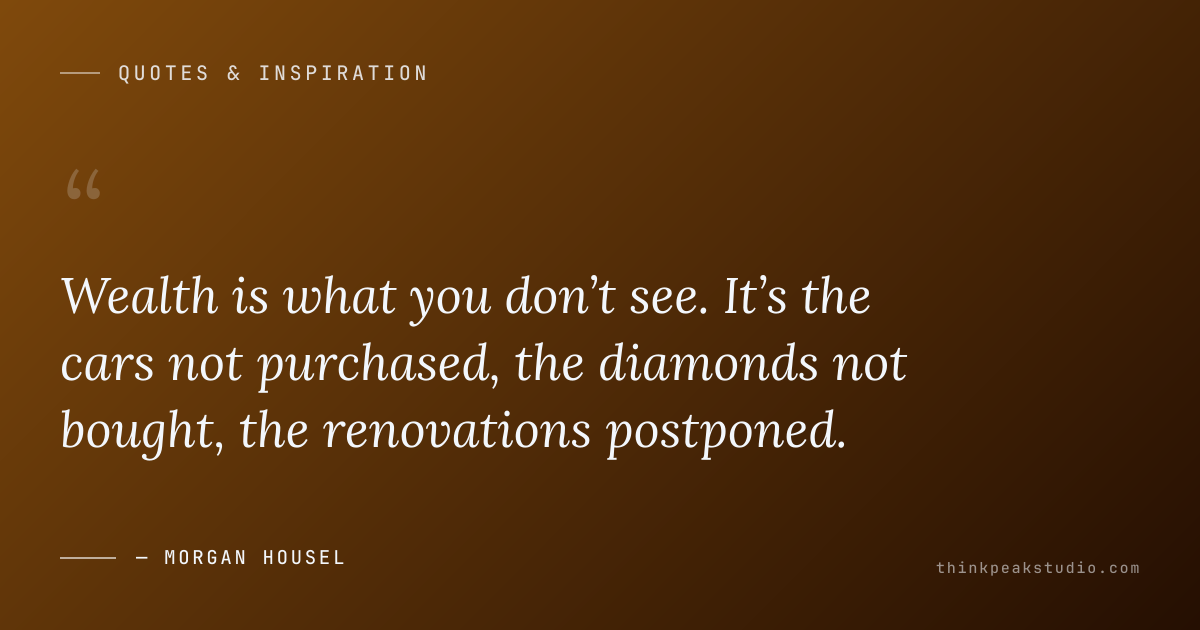
“Wealth is what you don’t see. It’s the cars not purchased, the diamonds not bought, the renovations postponed.”
The context
Before Morgan Housel became one of the most trusted voices in personal finance, he spent years writing about money in the least glamorous way imaginable — not about stock picks or market forecasts, but about behavior. As a columnist for The Motley Fool and later The Wall Street Journal, he built a quiet following by insisting that the biggest forces shaping your finances have almost nothing to do with intelligence and almost everything to do with temperament, patience, and self-awareness. He twice won the Best in Business Award from the Society for Advancing Business Editing and Writing, and he was a two-time finalist for the Gerald Loeb Award. But the work that would define him did not arrive until 2020, when he published The Psychology of Money, a collection of nineteen short stories about the ways people think about wealth, greed, and happiness. The book exploded — millions of copies sold, translations into dozens of languages, years on bestseller lists — precisely because it ignored the question everyone else was asking (“what should I invest in?”) and answered a deeper one instead: “what is money actually for, and why do smart people so often behave so badly with it?”
The quote sits at the center of the book’s most quietly radical chapter, titled simply “Wealth Is What You Don’t See.” Housel opens with a thought experiment that many readers have never forgotten. He asks you to imagine someone driving a $100,000 car. The assumption is that the driver is rich — that the car is evidence of wealth. But Housel points out that all the car actually proves is that the driver has $100,000 less than they did before they bought it. The car is not an asset; it is the visible remains of an asset that has already been spent. Wealth, by its very definition, is money that has not been converted into things. It is hidden by nature: it is the brokerage account, the unspent income, the equity that has not yet become a purchase. The moment money becomes visible — as a car, a watch, a house, a diamond — it stops being wealth and starts being an expense. This is the insight the quote compresses into six words: the wealthiest people in any room are usually the ones you would never pick out as wealthy.
Understanding why the line landed requires seeing what it was up against. Housel wrote it during the peak of a culture obsessed with visible consumption — the era of the “hustle and flex,” where social media had turned spending into a performance and where status was increasingly measured in what you could photograph and post. Instagram and TikTok had industrialized the old habit of “keeping up with the Joneses” into something far more pervasive, because now the Joneses were not just your neighbors but millions of strangers with curated, filtered lives. Housel’s sentence arrived as a quiet counterweight to all of it. It did not moralize about spending; it simply observed, with the disarming calm of a good journalist, that the thing everyone was trying so hard to display was, almost by definition, the thing that disappears the moment you display it. That paradox is why the quote spread far beyond the world of finance and into the wider conversation about status, ambition, and what a successful life actually looks like.
The meaning
The quote’s power comes from its elegant inversion of a deeply held assumption. Most of us, Housel observes, use the word “rich” and the word “wealthy” interchangeably, as if they meant the same thing. They do not. Being rich is a statement about income — about the money coming in this year, which you can see in the form of a new car, a bigger house, an expensive vacation. Being wealthy is a statement about assets — about the money that has been accumulated and not yet spent, which is invisible by definition. A surgeon earning $500,000 a year and spending $530,000 a year is rich but not wealthy; in fact, they are going broke at a very high speed. A retiree living modestly on a seven-figure portfolio is wealthy but would never be described as rich. The quote forces us to notice that the two categories point in opposite directions. Richness is what you are doing right now; wealth is what you have left over. And because wealth is the income you declined to spend, it can only ever be an absence — the cars not purchased, the diamonds not bought, the renovations postponed. It is measured in what is missing, which is precisely why it cannot be seen and why it so often goes unrecognized.
There is a subtler layer to the argument that most casual readers miss, and it is the real heart of Housel’s philosophy. The reason wealth is worth accumulating, he argues in the book’s later chapters, has very little to do with buying things. It is that wealth buys the most valuable thing money can purchase: control over your own time. Money’s greatest dividend is freedom — the ability to wake up and decide what you do with the day, to quit a job you hate, to absorb a crisis without panic, to say no to something you do not want to do. In this light, the invisible dollars are not sitting idle; they are quietly purchasing options and autonomy that no one else can see. The person driving the flashy car may be financing a lifestyle on debt; the person who looks ordinary may be financing a life of near-total freedom. Housel is not arguing for asceticism or deprivation. He is arguing that the visible version of wealth is often a poor imitation of the real thing — a purchase of appearance when the far more valuable purchase, the purchase of freedom, is invisible to everyone except the person who owns it.
Beneath even this lies a point about human nature that extends far beyond money. The quote is a specific instance of a general principle: the most important things in life are usually the ones that cannot be photographed. Compound interest is invisible; so are health, sleep, a secure relationship, a clear conscience, a mind at rest. The dramatic and the visible tend to be overrated precisely because they are visible, while the slow, the quiet, and the deferred tend to be underrated for the same reason. Housel’s sentence is therefore not really about finance at all. It is about the error of confusing what is seen with what is real — a confusion that governs far more of our lives than our bank accounts. The promotion you did not get, the habit you quietly kept for a decade, the apology you offered when no one was watching, the savings you built one unglamorous month at a time — these are the invisible assets that compound into the visible shape of a life. The quote is a reminder that you should judge your trajectory by what is accumulating in the background, not by what is currently on display.
Why it still matters today
In 2026, the quote is more pointed than when it was written because the machinery of visible consumption has only grown more sophisticated. Social media platforms now monetize attention by rewarding displays of wealth, and the line between “having money” and “appearing to have money” has blurred to the point of disappearance. Buy-now-pay-later services, renting designer goods for photos, and the normalization of financing entire lifestyles on credit have made it easier than ever to look wealthy while being financially fragile. The result is a strange inversion: the most visibly affluent people are frequently the least financially secure, while the genuinely wealthy often go unnoticed in the same room. Housel’s insight cuts through this confusion with a single clean observation — that visibility and wealth are, by definition, in tension. Every post that proves how much you spent is also, quietly, a receipt for how much wealth you just gave up. In a culture that has turned spending into a spectator sport, the sentence is a bracing reorientation: the metric that matters is not what the world can see, but what only you know.
The quote’s relevance also extends far beyond personal finance into the broader anxiety of the age. We live in an era of status inflation, where people measure themselves against strangers whose lives are curated, edited, and filtered beyond recognition. The pressure to signal — to post the milestone, to document the purchase, to prove the promotion — is relentless, and it produces a specific kind of misery: the feeling of constantly falling behind people who may themselves be in debt, or struggling, or performing a version of success that does not exist. Housel’s framing offers a way out. If wealth — and by extension, real progress — is what you do not see, then the competition is not winnable by display and the comparison is not even valid. The person you are losing to in your head may be losing in the way that actually matters. The quote is a quiet liberation: it dissolves the audience, silences the scoreboard, and hands the measure of your life back to the only person who can ever truly read it — you.
How to apply this in your own life
The practical application begins with a single redefinition. Stop measuring your financial health by your salary or your spending and start measuring it by the gap between the two — the money that stays invisible. Automate the savings so that the first thing that happens to your income is that a portion of it disappears into an account you do not touch. Before any significant purchase, apply what Housel calls the “would you still buy it if no one could ever know?” test: if the honest answer is no, you are not buying a thing, you are buying a performance, and the cost of that performance is not the price tag — it is the invisible wealth you are trading away for applause you may not even receive. Track your net worth, not your income, and treat your net worth as the real scoreboard precisely because no one else can see it. The goal is not to live joylessly. It is to make your spending a genuine choice rather than a reflex, and to let the unspent margin quietly compound into the one asset that never depreciates: freedom.
The deeper application is to generalize the principle beyond money. Ask yourself what the invisible version of your life looks like — the habits no one applauds, the skills you are building that produce nothing to show yet, the relationships you maintain without posting about them, the health you protect before it becomes a crisis. These are the equivalents of wealth: the deferred, the unseen, the accumulating. The quote invites you to stop optimizing for the visible and to start trusting the invisible, because that is where every compounding force in life actually lives. You will never see compound interest in action until, one day, you do. You will never see a habit pay off until, one day, it has. The person who understands that wealth is what you do not see has stopped chasing the reflection and started building the reality — and that, more than any account balance, is what the quote is really trying to give you. It is not advice about money. It is advice about where to point your attention in a world that is constantly trying to pull it toward the surface.
Create your own quote graphic with this quote
This is the kind of quote that quietly rearranges how you see things. When you pair an idea this clarifying with thoughtful design, you create something worth saving and returning to. Use our free online quote maker to turn this exact quote into a shareable image in seconds — no signup needed. For advanced features like video quotes and 100+ templates, try the Quotes Creator Android app.
Why we chose this quote
Most people encounter Morgan Housel through short-form financial advice that strips The Psychology of Money down to a list of saving tips, missing the philosophical depth underneath. We wanted to treat this sentence as what it actually is: not a budgeting rule but a complete argument about the difference between appearance and reality — and about the quiet, unphotographable things that actually determine a life. The line is rare in that it is both a comfort and a confrontation: it relieves you of the exhausting job of performing wealth, while holding you accountable for confusing the display of success with success itself. In a culture that has turned spending into a spectator sport, it is a reminder that the most valuable things you will ever own are the ones no one else can see. That is why it stays with people long after the book is closed.
— ThinkPeak Studio Editorial Team
Create your own quote graphic with this quote
Turn this line into a shareable graphic in seconds — free, no signup needed. For video quotes and 100+ templates, try the Android app.
Advertisement
Enjoyed this article? Get more like it in your inbox.


