On this page
Quote Explained: “It is not the strongest of the species that survives…”
The most-shared sentence ever credited to Charles Darwin — a line that appears nowhere in anything he wrote
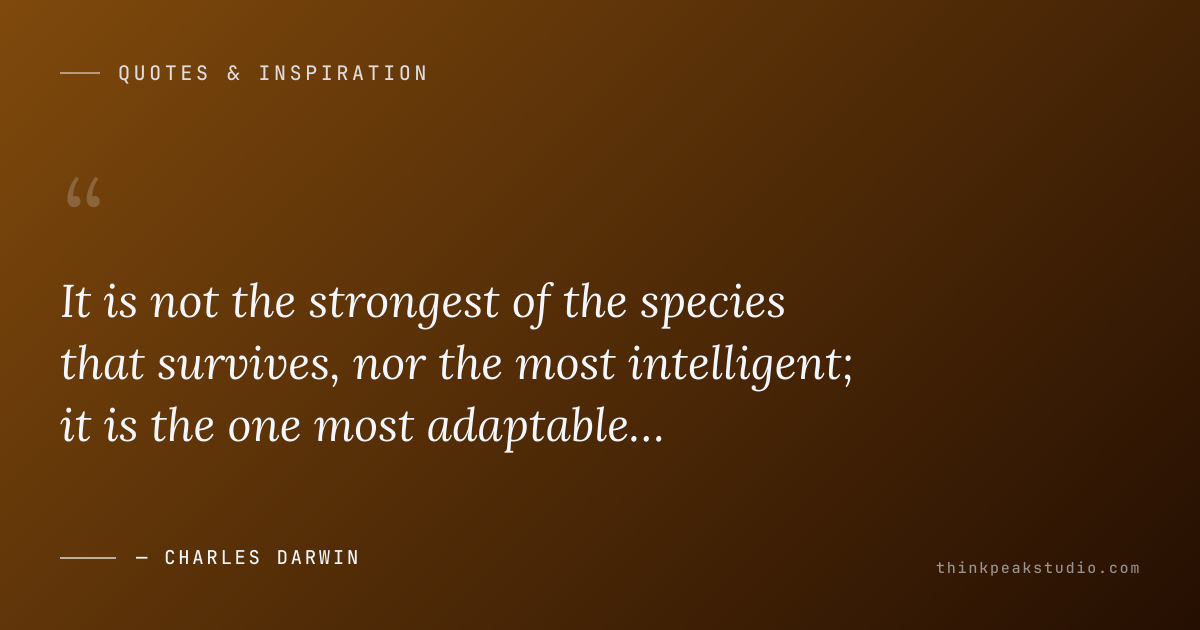
“It is not the strongest of the species that survives, nor the most intelligent; it is the one most adaptable to change.”
The context
Few sentences in the self-help canon are repeated with more confidence than this one. It is printed on classroom posters, recited in boardrooms, captioned over slow-motion footage of lions and storms, and handed almost every time to Charles Darwin. The problem is simple and total: the sentence does not appear in any of Darwin’s books, letters, notebooks, or papers. The Darwin Correspondence Project, the Cambridge-based scholarly edition of his correspondence, lists it among “Six things Darwin never said.” The historian of science John van Wyhe, founder of Darwin Online, called a version of it “probably the most common” false quotation attributed to Darwin, and noted that all of Darwin’s publications are now freely searchable, so there is “no longer any excuse” for the error. It is a rare case of a quotation whose author is famous, whose wording is familiar, and whose provenance is entirely fictional.
The trail does not begin with Darwin at all. It begins with a management professor. In 1963 Leon C. Megginson of Louisiana State University delivered a presidential address to the Southwestern Social Science Association, published that year in the Southwestern Social Science Quarterly (vol. 44, no. 1, pp. 3–13). Trying to apply evolutionary ideas to business, he wrote: “According to Darwin’s Origin of Species, it is not the most intellectual of the species that survives; it is not the strongest that survives; but the species that survives is the one that is able best to adapt and adjust to the changing environment in which it finds itself.” Notice what he did and did not do. He offered a paraphrase of an idea. He did not use quotation marks, and he did not claim the words were Darwin’s. He repeated the formulation in 1964 in the journal Petroleum Management, this time with the phrase “so says Charles Darwin” attached — even though the sentence was still his own summary. From there it was streamlined, shortened, and quietly converted into a direct quotation — the mechanism quotation researchers call misattribution by paraphrase. The lineage is documented in detail by Quote Investigator and by the biology researcher Nicholas J. Matzke, whose investigation the Darwin Correspondence Project cites.
The misfit is not only about provenance. It is about the science. “Survival of the fittest” was not Darwin’s phrase either — it was coined by the philosopher Herbert Spencer and adopted by Darwin, at Alfred Russel Wallace’s urging, because it was more memorable than “natural selection.” And Darwin’s actual mechanism runs against the grain of the popular line. Organisms do not survive because they choose to adapt; populations change because individuals vary, and the variants that happen to fit a given environment leave more offspring. Adaptation, in Darwin, is a statistical outcome, not a decision. The quote makes flexibility an individual virtue you can will into being; On the Origin of Species, published in 1859, describes a blind, cumulative process that no organism steers. That difference is not pedantry. It is the whole theory.
The meaning
Taken at face value, the sentence is a compact hierarchy of virtues. Strength loses; intelligence loses; adaptability wins. It flatters a particular modern reader — the flexible, the pivoting, the quick to retrain — and it consoles anyone who has watched a stronger or smarter competitor fail to see the change coming. Read that way, it is less a scientific statement than a piece of advice: do not try to be the strongest; try to be the most responsive. It reframes survival not as a contest of power or brains but as a match between an organism and its environment.
The deeper meaning is that the line quietly smuggles in a different theory of life. Its verb is “adapt,” which in ordinary English means something a person or a species does on purpose. Darwin’s theory does not work that way. A species does not survey its surroundings and adjust; it generates variation it cannot control, and the environment — indifferent, changing, often cruel — does the selecting. This is why biologists have long preferred “natural selection” to “survival of the fittest”: the second phrase sounds like a prize for effort, while the first names a mechanism that involves no intention at all. The popular quote is a kind of Lamarckism in modern dress, the comforting idea that what we need can be acquired by trying hard enough. Darwin’s real insight is less flattering and more useful. You cannot will adaptation. You can only produce options and let reality choose among them.
The third layer is subtler, and it is why the line keeps feeling true even though it is false as history. The definition of “fittest” depends entirely on the environment, and environments are always moving. There is no permanently winning trait — not strength, not intelligence, not even adaptability in the abstract — because the standard keeps changing. A trait that is an advantage in one decade becomes a liability in the next. That is the genuinely radical idea hiding inside a motivational slogan: fitness is not a property you own; it is a relationship between you and a world you do not control. The sentence is mistaken about who said it, but it gestures at something real and unsettling. The scoreboard is a moving target.
Relevance: why it still matters
The line matters now because it is doing enormous work in exactly the field it was invented for: management. It was a business professor, not a biologist, who assembled it, and it has returned to business as a justification for endless change — reorganizations, pivots, disruption. The correction matters. If adaptability is a decision, then leaders can simply command it, and the people who fail to keep up can be blamed. If adaptability is instead an emergent property of variation and selection, the job is structural: build teams that contain real diversity of thought, shorten the distance between a bad bet and the feedback that ends it, and stop protecting the strongest incumbent from an environment that is about to change. The Darwinian reading is not an invitation to hustle harder. It is an argument for designing for variation.
The line also matters as a case study in how the modern world decides what is true. It has no source, and it has never needed one, because it arrived with the most authoritative name in biology attached. A paraphrase became a quotation not through evidence but through repetition — through textbooks, trade journals, speeches, and now feeds. That mechanism is older than the internet, but it runs faster on it, and it will run faster still as synthetic text becomes indistinguishable from our own. The lesson is portable: a claim’s authority is not the same thing as its sourcing, and the most shareable version of a sentence is very often the least verifiable one.
Application: how to use it in your own life
For an individual, the useful move is to stop trying to “be adaptable” — an instruction no one can execute directly — and start doing what actually produces adaptation. That means variation: try more small things than you can be certain of, so that at least one of them is still standing when the environment shifts. It means feedback: put your work in front of reality early and cheaply, and let bad ideas die while they are small. And it means humility about the scoreboard: when a strength stops working, the honest conclusion is usually not that you failed but that the environment moved. The Darwinian version of self-improvement is not “become more flexible.” It is “run more experiments, and read the results without flinching.”
For teams and institutions, the quote points in almost the opposite direction from the way it is normally used. If survival depends on variation, the gravest risk is not slowness but uniformity — a room of like-minded people defending a strategy the market has already begun to abandon. So diversify the views that can influence decisions, make it safe to be the person who names the changed environment, and let selection pressure reach the strongest product line and the most senior idea, not only the weakest. Then apply the same discipline to the quotations you repeat: when you cannot verify a source, say “attributed to,” which is honest and costs you nothing. This particular line is worth keeping — it is a decent thought about change. It is worth keeping accurately, too, which means not handing Darwin a sentence that was never his.
Create your own quote graphic with this quote
This is a sentence built for a wall — short, bracing, and impossible to read without thinking about what you would change. When you pair words this direct with clean typography, you get something worth saving and returning to. Use our free online quote maker to turn this exact quote into a shareable image in seconds — no signup needed. For advanced features like video quotes and 100+ templates, try the Quotes Creator Android app.
Why we chose this quote
We chose this quote because it is at once one of the most repeated sentences in the language and one of the clearest examples of how a quotation is manufactured. Its author is almost always given as Charles Darwin, and it appears nowhere in his work: the Darwin Correspondence Project counts it among the things he never said. Its real origin is a 1963 paraphrase by Leon C. Megginson, a management professor at Louisiana State University, who meant to summarize Darwin’s ideas for a business audience and never claimed the words were his. The sentence then traveled through decades of management writing until it hardened into a direct quotation, and by the time it reached the internet it had the authority of the most famous name in biology behind a claim he never made. That history is not a footnote. It is a lesson in how repetition, not evidence, decides what we believe — and in why the ideas we find most comforting are the ones most worth checking. The line survives because the thought inside it is useful; it deserves to be read with its real story attached.
— ThinkPeak Studio Editorial Team
Create your own quote graphic with this quote
Turn this line into a shareable graphic in seconds — free, no signup needed. For video quotes and 100+ templates, try the Android app.
Advertisement
Enjoyed this article? Get more like it in your inbox.


