Quote Explained: “Don’t count the days, make the days count.”
By Muhammad Ali, “The Greatest”
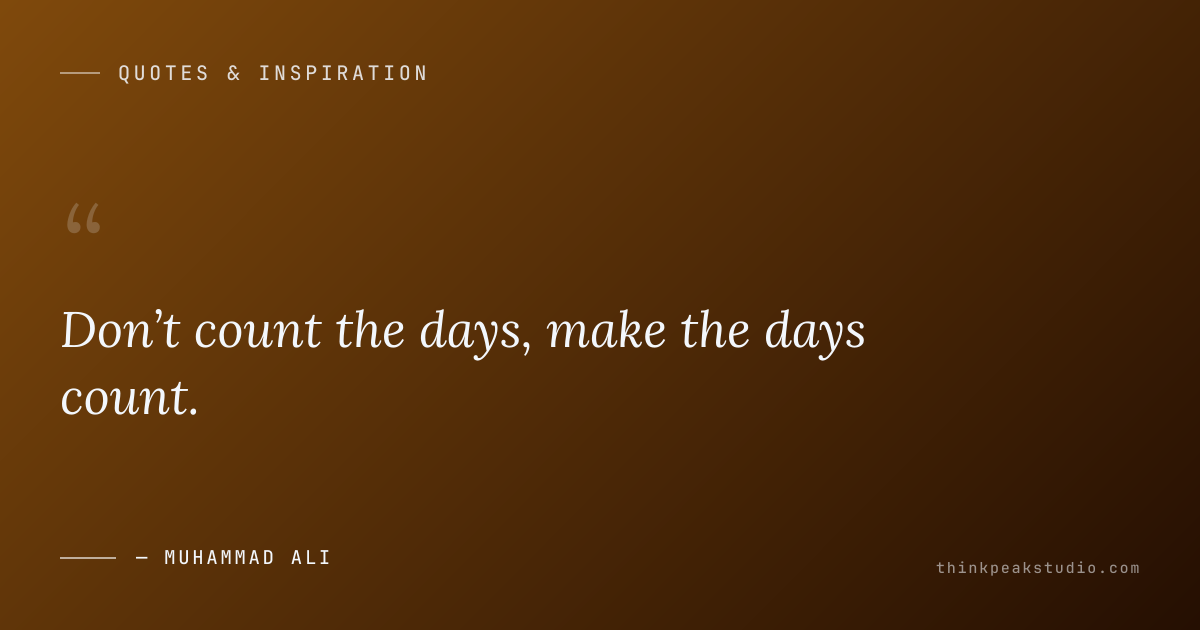
“Don’t count the days, make the days count.”
The context
No one who heard the words would need to ask who said them. They carry the unmistakable cadence of Muhammad Ali — born Cassius Marcellus Clay Jr. in Louisville, Kentucky, in 1942, a man who announced his own greatness so often and so loudly that the world eventually had no choice but to agree. He was twelve when his bicycle was stolen and a police officer named Joe Martin pointed him toward a boxing gym; six years later he was an Olympic gold medalist; six years after that, in 1964, he dethroned the terrifying Sonny Liston to become heavyweight champion of the world, stood in the ring, and shouted, “I shook up the world.” He called himself “The Greatest” before the evidence fully supported it, and then spent two decades making sure it did. His footwork was ballet, his hands were lightning, and his mouth was a weapon all its own. “Float like a butterfly, sting like a bee,” he told the press, and then he went out and proved the poetry true.
But the man behind the bravado lived a life defined by losses of time, and that is precisely why this short line carries so much weight. In 1967, at the absolute peak of his physical powers, Ali refused induction into the United States military on the grounds of his religious beliefs and his opposition to the Vietnam War. The establishment punished him with a cruelty that bordered on the vindictive: he was stripped of his title, denied a boxing license, convicted, fined, and barred from the ring for more than three years — the years when his body would never again be faster or stronger. He spent his prime fighting in courtrooms instead of arenas, and he lost money, standing, and time he could never get back. Then, in the final decades of his life, Parkinson’s disease — long suspected to be the cost of his brutal profession — gradually stole from him the very instrument he had used to astonish the world: his speed, his voice, his body. Here was a man who had every reason to count his days in grief, to watch the clock run down and mourn what was lost.
Instead, he made the days count. During his exile he did not wait in silence; he lectured on college campuses, spoke at rallies, and turned a boxing ban into the largest platform an athlete had ever occupied for a political cause. Decades later, trembling visibly, he lit the Olympic cauldron in Atlanta in 1996 before a global audience that rose to its feet. This is the soil from which the quote grows. It is not a gym slogan from a young man who had never known loss. It is a philosophy forged in the fire of having years stolen from him — and having discovered, in that theft, that the quantity of days is not what a life is made of. The line is widely attributed to Ali, and even where its exact source is unrecorded, it has become his in the way that only a truth lived so completely can belong to a person.
The meaning
The quote’s genius is in a single verb repeated with opposite directions, and the difference between those two versions of “count” is the entire philosophy. To “count the days” is to treat time as something you tally rather than something you use — to mark off the calendar like a prisoner scratching lines on a wall, watching the number grow while your life runs down. It is the posture of waiting: waiting for Friday, waiting for summer, waiting for the diagnosis, waiting for the chance, waiting for the right moment that never quite arrives. To “make the days count” is the opposite gesture. It is to treat each day not as a unit to be consumed but as an opportunity to be seized — to ask, at the end of it, whether anything you did today mattered, whether you moved toward something, loved someone, made something, or stood for something. Counting is passive and retrospective; making count is active and present. The quote does not merely celebrate the present moment. It issues a command about what you owe to it.
There is a deeper distinction buried in the grammar, and it concerns the direction your life is facing. Counting the days is a way of living in the future tense: your real life is always located somewhere ahead of you, and today is only the empty corridor you walk through to get there. It is the trap of the deferred life — the version of existence where you are forever getting ready to live instead of living. Making the days count drags you forcefully back into the present tense, because only the present can be made to count. You cannot make tomorrow count; tomorrow does not exist yet, and by the time it arrives it will have become another today. You cannot make yesterday count; it is already written. The quote is therefore an argument about the only place where agency actually lives. The past is a receipt and the future is a wager, but today is the only coin you can actually spend. Ali, a man who understood better than most that the future can be taken from you without warning, was insisting that the only sane response to that fragility is to stop treating time as an infinite resource and start treating it as the finite, precious thing it is.
Read at its fullest depth, the quote is a quiet meditation on mortality that refuses to be morbid. It contains an unspoken truth: we count the days because we know they are numbered, and we know they are numbered because they are. The impulse to count is not foolish — it is the natural human awareness that time is running out. What Ali proposes is not that we deny this awareness but that we convert it. The knowledge that days are finite, that the sand in the hourglass is already moving, should not send us into passive counting; it should drive us into active meaning-making. This is the wisdom the old Stoics called memento mori — remember you will die — but Ali strips it of its somber robes and gives it a boxer’s grin. Remember you will die, and then go live accordingly, not in fear but in urgency. The countdown that would paralyze another person became, for him, the engine of intensity. Every day mattered more, not less, because the days were finite. That inversion — scarcity as motivation rather than despair — is the quiet core of the whole line.
Why it still matters today
In 2026, we are living through an epidemic of counting without making count. The devices in our pockets are, among other things, meticulous accountants of time: they track our streaks, our screen time, our step counts, our “days since,” and serve us an endless feed precisely engineered to make us lose days without noticing that they are gone. Social media has industrialized the deferral of living — we scroll through other people’s made-to-count days while our own slip by unspent, and the platform quietly converts our hours into their revenue. There is a word for what happens when counting the days is optimized to its logical extreme: doomscrolling. We sit, counting the days of a news cycle or an election or a recovery, while the actual substance of life — the work, the relationships, the small courage — waits unattended in the next tab. Ali’s line, delivered decades before the smartphone existed, reads now like a prophecy aimed directly at the notification center. It asks the single question the algorithm never will: what are you actually doing with the day you are currently in?
The quote also speaks with renewed force to a culture that has made busyness a substitute for meaning. We have never had more tools for counting the days — calendars, planners, habit trackers, productivity suites — and yet report record rates of burnout, disconnection, and the hollow feeling that time is passing without leaving anything behind. The problem is not that we lack the capacity to count; it is that counting has become the substitute for the harder question of whether the days add up to anything. A packed calendar is not a meaningful life; a long streak is not necessarily a worthwhile one. Ali’s distinction cuts straight through this confusion, because it does not ask how full your days are. It asks whether they count — whether, at the end of this brief and unrepeatable interval, you did something that made your being here matter, to yourself or to anyone else. In an age that measures everything and weighs almost nothing, that is a startlingly rare kind of clarity.
How to apply this in your own life
The practical application begins with a simple but radical daily question: at the end of today, what will I point to? Not what did I consume, not what did I scroll, not what did I survive — but what did I make, move, or mend? To answer it honestly, you have to define in advance what a “counted” day looks like for you, because otherwise the question collapses into vagueness. It might be one hour of undistracted work on the thing you keep postponing; it might be a conversation with your child in which you were genuinely present; it might be twenty minutes of exercise, one paragraph written, one apology offered, one small act of courage in defense of something you believe. The scale is irrelevant; the direction is everything. Ali did not win the heavyweight title every day, but every day he trained as though the title depended on it. The discipline is not to achieve something heroic daily. It is to ensure that each day leaves some mark, however small, on the direction of your life — so that when the days are counted back at the end, they form a shape rather than a blur.
The deeper application is a renegotiation of your relationship with time itself. Most of us treat time the way we treat money — as something to be saved, hoarded, protected — and we spend years postponing the life we say we want until conditions are perfect, until we are less tired, less busy, less afraid. Ali’s quote dismantles this postponement at the root, because it refuses to let the future be the place where life happens. It asks you to stop waiting for the conditions to be right and to make the conditions right today, with whatever you have, from wherever you stand. This is not an argument for recklessness; it is an argument for presence and intent. The days will be counted either way — by the calendar, by the app, by the doctor, by the obituary. The only open question, the only thing that is actually yours to decide, is what they will count toward. You can let them count toward nothing, drifting by in an accumulating blur. Or you can make them count — and in doing so, transform a life from a number into a meaning. That is the whole of the lesson, and it fits in eight words, which is fitting, because the truest things always do.
Create your own quote graphic with this quote
This is the kind of quote that deserves to be seen every morning. When you pair Ali’s clarity with thoughtful design, you create something worth pinning above a desk or sending to a friend who needs it. Use our free online quote maker to turn this exact quote into a shareable image in seconds — no signup needed. For advanced features like video quotes and 100+ templates, try the Quotes Creator Android app.
Why we chose this quote
Most motivational quotes are written by people who have never been tested, and you can feel the thinness in them. Muhammad Ali was tested in ways few humans ever are — his prime was stolen by a government that punished his conscience, and his body was slowly taken by the very profession that made him legendary — and yet he emerged from all of it not bitter but urgent, insisting that the answer to limited time is not despair but intensity. That is what makes this quote rare: it is a line about making life meaningful that was spoken, in effect, by a man watching his own days be counted down. It does not pretend death away or promise you more time. It tells you the harder and more honest thing — that you already have all the time you are ever going to get, and the only real question is what you will do with the day you are standing in. In a culture drowning in distraction and deferred dreams, that is a message worth keeping close.
— ThinkPeak Studio Editorial Team
Create your own quote graphic with this quote
Turn this line into a shareable graphic in seconds — free, no signup needed. For video quotes and 100+ templates, try the Android app.
Advertisement
Enjoyed this article? Get more like it in your inbox.


