Quote Explained: “Play long-term games with long-term people.”
By Naval Ravikant, entrepreneur and investor
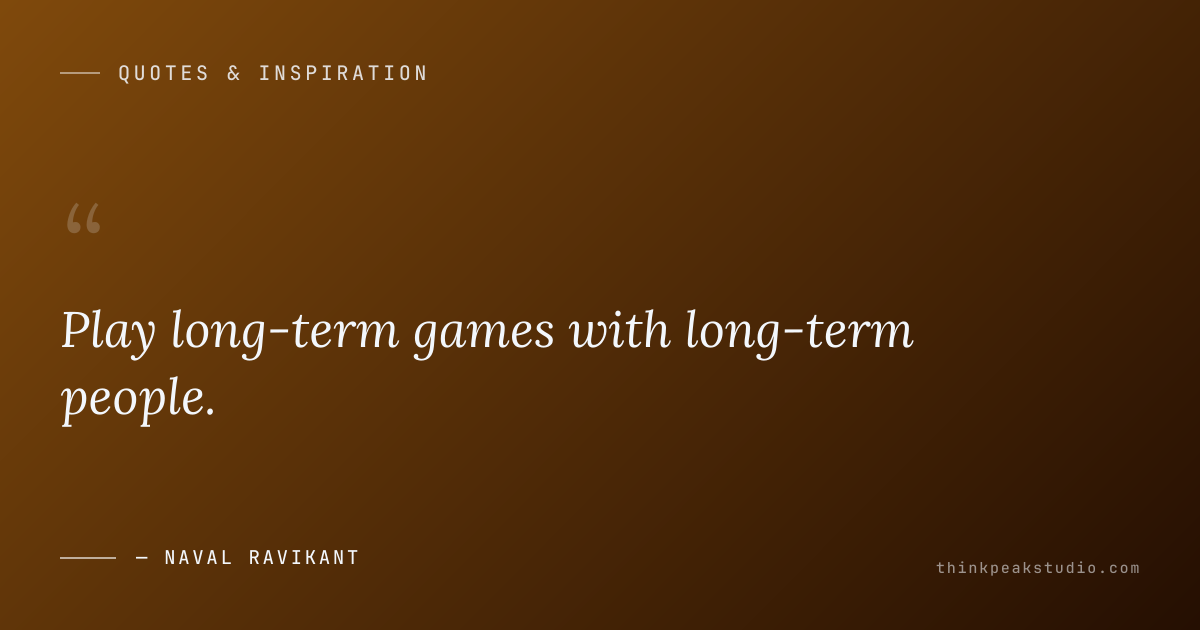
“Play long-term games with long-term people.”
The context
Naval Ravikant is a rare kind of figure — an investor whose greatest asset is not a portfolio but a way of thinking. Born in New Delhi in 1974 and raised in New York by a single mother, he arrived in the United States with almost nothing and worked his way through Dartmouth College before carving an unlikely path into Silicon Valley. As a young angel, he wrote some of the earliest checks into companies that would become world-famous — Twitter, Uber, Notion, and many more — and he co-founded AngelList, the platform that effectively democratized how startups raise money and how ordinary people invest in them. By any conventional measure, he had already won. But what made Naval famous was not his returns. It was his sentences. Beginning around 2018, he started posting long threads of terse, aphoristic wisdom on Twitter — most famously a series that came to be known as “How to Get Rich (without getting lucky)” — in which he compressed decades of reading across economics, philosophy, physics, and computer science into a kind of secular scripture for the internet generation. Those threads were later collected into a book, The Almanack of Naval Ravikant, and they transformed him into something Silicon Valley rarely produces: a thinker whose ideas traveled further than his deals.
The line “Play long-term games with long-term people” sits near the center of that thread, and it has become its most quoted fragment — repeated by founders, investors, podcasters, and productivity devotees alike. On first reading it looks almost too simple, the kind of thing a fortune cookie might say. That is the whole trick. Naval’s method is to compress a great deal of hard-won, painful experience into a single sentence and then leave the work of unpacking to the reader. The sentence grew out of years of watching the technology industry up close, where he noticed something that contradicted the myth of the lone genius: the people who built the most enduring value were rarely the smartest or the most aggressive. They were the ones who had chosen, deliberately or by instinct, to play a longer game than everyone else, and to surround themselves with people who were playing it too. He came to believe that almost all the returns in life — financial, creative, and relational — are a function of compounding, and that compounding only happens when you stop resetting your position and stay in the game long enough for trust to build.
The quote is, in a sense, the entire Naval philosophy compressed into seven words. He has written elsewhere that specific knowledge, accountability, and leverage are the building blocks of wealth, but underneath all of them runs a single, quieter assumption: that time and trust are the two scarcest resources a person can spend, and that the surest way to waste both is to squander them on short games and short people. This is not a line he inherited from a guru or borrowed from a book. It is a conclusion he reached the expensive way — by watching talented people destroy their own potential through impatience, and by watching average people build extraordinary lives simply by refusing to leave the table. To understand the quote fully is to understand that its two halves are not separate pieces of advice at all. They are the same piece of advice stated twice, from two different angles, and the repetition is the point.
The meaning
The first half of the sentence — “play long-term games” — is an argument about time. Most of the opportunities we are offered in life are short games: win the argument today, close the sale this quarter, post the thing that goes viral this afternoon. These games have a seductive property. They pay out immediately, and they feel like progress. But they are mostly zero-sum and mostly noise. A long-term game is different in kind, not just in degree. It is positive-sum — everyone can win over enough time — and it compounds. Reputation compounds. Skill compounds. Trust compounds. Money compounds. The catch is that compounding is back-loaded: it produces almost nothing visible in the beginning and almost everything at the end. The first year of writing looks pointless; the tenth year looks like genius. Naval’s insight is that the single biggest decision you make is not how hard you try but which game you decide to play, because effort applied to a game you will abandon in a year is effort that can never compound. The time horizon is not a detail of the game. It is the game.
The second half — “with long-term people” — completes the thought, and it is where most people stop paying attention. A long-term game cannot be played alone, because almost every meaningful game in life involves other people: a business has partners and customers, a career has colleagues and mentors, a life has friends and family. And here is the problem. If you commit to a long-term game but fill it with short-term people, you do not actually have a long-term game. You have a long-term intention that will be repeatedly betrayed. Short-term people optimize for themselves; they renegotiate when it suits them, they exit when things get hard, and they defect when the payoff of defection exceeds the payoff of loyalty. Trust — the one asset a long game absolutely requires — can only be built with people who share your time horizon. When both sides know they will still be at the table in ten years, the incentive to be honest today is overwhelming. The two halves of the quote are therefore not a list. They are an equation: the length of your game and the length of your relationships are the same number.
Read at its deepest level, the sentence is a definition of character. It tells you that the people worth building a life with are not necessarily the most talented, the most charming, or the most exciting — they are the ones who keep their commitments and play for keeps. And it tells you that the most important thing you can become is a long-term person yourself, because long-term people attract other long-term people, and short-term people repel them. There is a quiet moral algebra underneath the surface: you cannot demand a long game from others while playing a short game with them. The person who is constantly scanning for a better offer, a better partner, a better audience is, by their behavior, announcing to everyone around them that they are not safe to trust. The quote is therefore less a piece of career advice than a mirror. It asks you to look honestly at your own time horizon and your own reliability, because the games and people you attract are a faithful reflection of the game you are.
Why it still matters today
In 2026, we are living in an economy and a culture that have never been more optimized for the short term. The dominant platforms reward speed: the post that performs is the one that triggers an emotion in the first three seconds, and it is forgotten three days later. The labor market has tilted toward the gig, the contract, the pivot; the average worker is told to treat every job as temporary and every relationship as negotiable. The funding markets celebrate the fast exit, the quick flip, the company sold before its product is even mature. All of this is a machine for playing short games with short people, and it works exactly as designed — it generates activity, churn, and a constant low-grade anxiety. What it does not generate is the thing Naval’s sentence points to: compounding. The most valuable outcomes in life still take a decade, and they still require trust, and neither can be assembled out of short-term transactions. The quote is a quiet act of resistance against the dominant tempo, a reminder that the fastest way to lose a long game is to keep treating it like a short one.
The quote has also become more relevant, not less, in the age of artificial intelligence. As machines get better at the short-term tasks — writing the tweet, drafting the email, generating the image, closing the routine sale — the durable human advantage shifts decisively toward exactly the two things Naval names: long-term relationships and long-term judgment. An AI can produce a plausible answer in a second, but it cannot sit with a partner through ten hard years of building trust. It cannot hold a reputation that has been earned and honored over a lifetime. In a world where the short game is increasingly automated, the long game becomes the only game where humans still have a decisive edge. The people who will thrive are not the ones who can produce the most output today, but the ones who have spent years becoming someone worth betting on over the long run. Naval wrote the sentence years before the current AI boom, but it reads now like a prediction — the scarcest thing in an automated world will be genuine, compounded trust between people who have chosen each other for the long haul.
How to apply this in your own life
The practical application begins with a single, uncomfortable audit. Look at the commitments that currently occupy your time — your work, your relationships, your creative projects, your friendships — and ask two questions of each one. First: is this a game I would still want to be playing in ten years? And second: are these people I would still want to be at the table with in ten years? Most of us have never asked either question, and the answers can be quietly devastating, because they reveal how many of our hours are being spent in games we don’t actually want to win and with people we don’t actually trust. The point of the audit is not to quit everything tomorrow. It is to become conscious of your time horizon as a choice rather than an accident. Once you see it clearly, the leverage is enormous: simply extending the length of one relationship or one project — and announcing that extension — changes how you and everyone else behave within it.
The deeper application is to become, deliberately, a long-term person. This is not a passive virtue; it is a set of repeatable behaviors. Make commitments you do not break. Show up when it is inconvenient. Refuse the small defection — the white lie, the renegotiation, the quiet exit — even when no one would notice, because trust compounds exactly like money, and it is destroyed far faster than it is built. Choose a handful of people and decide, explicitly, that you are going to play a decades-long game with them — a partner, a co-founder, a friend, a mentor — and then treat that decision as binding. The remarkable thing about long-term people is how magnetic they become. When others see that your word means something and that you do not quit, the best long-term people in the room will quietly arrange themselves around you. And that is the final, unstated promise of Naval’s sentence: if you play long-term games with long-term people, you do not just get the results of the game. You get the people — and the people are the real prize.
Create your own quote graphic with this quote
Some quotes are worth pinning above a desk and reading every morning before you start deciding how to spend your day. This is one of them. When you pair Naval’s clarity with thoughtful design, you create something that rewards being seen again and again. Use our free online quote maker to turn this exact quote into a shareable image in seconds — no signup needed. For advanced features like video quotes and 100+ templates, try the Quotes Creator Android app.
Why we chose this quote
Naval Ravikant has written thousands of words, but this single sentence contains more wisdom than most entire books, because it names the one variable that quietly determines almost everything else: your time horizon. Most advice tells you to work harder, move faster, hustle more — and none of it asks the prior question of which game you are playing and who you are playing it with. This quote does. It is also one of the few pieces of modern wisdom that has survived the leap from tweet to proverb, because it is true in every domain — in business, in love, in art, in friendship. In a culture that increasingly rewards the disposable and the fast, a sentence that argues for the durable and the patient feels almost radical. That is why we chose it: it is a compass, not a slogan. It tells you how to orient an entire life in seven words.
— ThinkPeak Studio Editorial Team
Create your own quote graphic with this quote
Turn this line into a shareable graphic in seconds — free, no signup needed. For video quotes and 100+ templates, try the Android app.
Advertisement
Enjoyed this article? Get more like it in your inbox.


