Quote Explained: “Education is the most powerful weapon which you can use to…”
By Nelson Mandela, anti-apartheid revolutionary and first Black president of South Africa
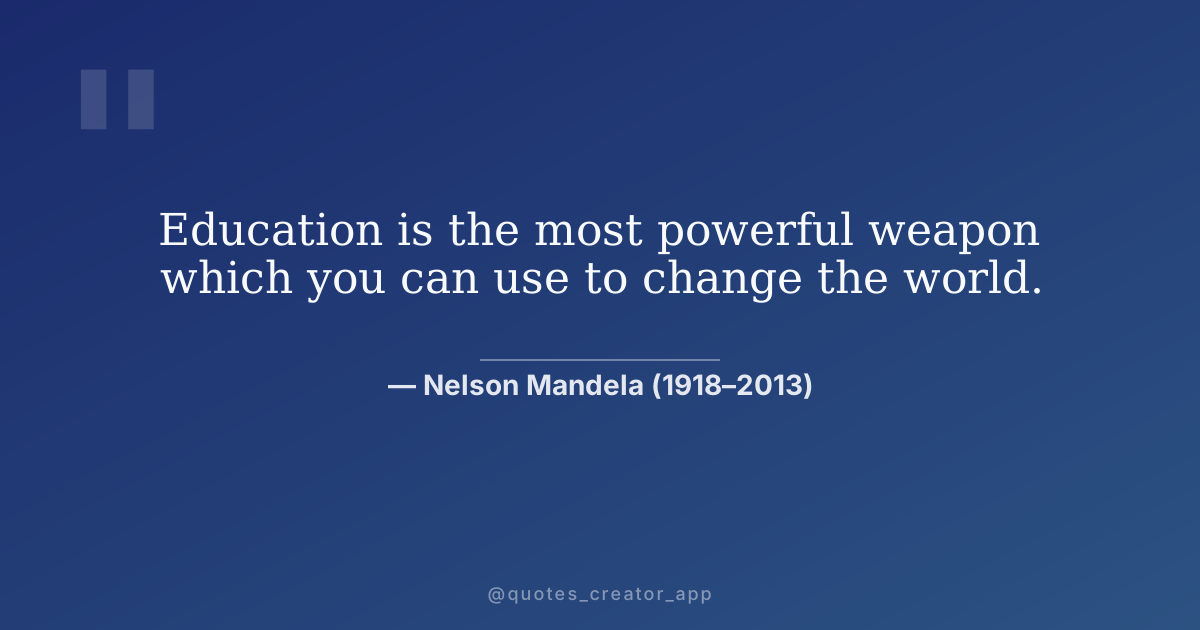
“Education is the most powerful weapon which you can use to change the world.”
The context
In the late 1980s and early 1990s, South Africa stood at a precipice. The apartheid regime, which had institutionalized racial segregation and oppression since 1948, was crumbling under the combined weight of internal resistance, international sanctions, and diplomatic isolation. Nelson Rolihlahla Mandela, the imprisoned leader of the African National Congress, had become the world’s most famous political prisoner — a symbol of resilience that even his captors could no longer ignore. After 27 years behind bars, much of it in a tiny cell on the windswept Robben Island, Mandela was released on February 11, 1990, to a global audience that had largely forgotten what he looked like. The grainy images of him walking free, hand in hand with his wife Winnie, electrified a world that had campaigned for his freedom through song, boycott, and protest. Within weeks, Mandela embarked on an international tour — London, New York, Boston, and beyond — not as a head of state, but as the leader of a liberation movement still negotiating the treacherous path toward a democratic transition that was far from assured.
When Mandela addressed the students at Boston’s Madison Park High School on June 23, 1990, he was a man walking a tightrope between celebration and responsibility. The world wanted to fete him; his fractured country needed him to negotiate the terms of its future. South Africa in 1990 was in turmoil — years of violent clashes between ANC supporters and the Inkatha Freedom Party, alongside brutal state repression, had claimed thousands of lives. Mandela was not merely a moral icon at this moment; he was a strategist trying to hold together a fragile peace process while persuading the international community to maintain sanctions until real structural change was secured. Into this high-stakes context, he chose to speak not to bankers or diplomats, but to high school students — many of them Black and Latino, many from families grappling with the very systemic inequality Mandela had spent his life dismantling. The decision to prioritize an inner-city school during a whirlwind world tour was itself a declaration of what he believed mattered most.
The students in that auditorium had grown up in the shadow of Boston’s own racial tensions — a city where school desegregation battles had exploded into violence barely a decade and a half earlier. Mandela understood viscerally that his audience was not made up of passive listeners but of young people whose life trajectories would be determined by the quality of education they received or were denied. He had lived that reality in the most extreme form. As a young man, he had been one of the few Black South Africans to attend university and qualify as a lawyer. On Robben Island, he turned the prison into an informal university — teaching fellow inmates to read and write, organizing political education classes under the guise of recreation, and completing his own LLB degree through correspondence. When he told those Boston students that education was “the most powerful weapon,” he was not offering a platitude. He was summarizing a truth forged across decades of deprivation, struggle, and an improbable triumph.
The meaning
On its surface, the statement is straightforward: among all the instruments available to a human being for reshaping their circumstances and the world around them, none is more potent than education. But Mandela’s choice of the word “weapon” in place of gentler alternatives — “tool,” “path,” or “key” — is deliberate and revealing. A weapon is something you wield in a fight. It implies conflict, opposition, an adversary that must be overcome. Mandela’s adversary was apartheid, yes, but also the deeper enemies it served: ignorance, poverty, powerlessness, the systematic manufacture of inferiority. These were not forces that could be reasoned with through polite dialogue. They had to be defeated. And in his lexicon, education was the instrument of that defeat — not violence, not political maneuvering alone, but the deliberate, disciplined acquisition of knowledge.
The quote transcends its immediate South African context and speaks to a profound philosophical understanding of power and liberation. The apartheid state maintained its grip not only through police batons and pass laws but through an education system deliberately engineered to produce a subordinate Black workforce. The Bantu Education Act of 1953 had explicitly stated that Black South Africans should receive schooling that prepared them only for “their opportunities in life” — which meant manual labor under white supervision. Controlling what people learned was the prerequisite for controlling what they could become. Mandela’s counter-insight was therefore revolutionary in its simplicity: those who monopolize education monopolize the future. And the corollary was more revolutionary still — if you equip oppressed people with knowledge, you hand them the keys to dismantle their own oppression. In this framing, education becomes the ultimate equalizer: the one asset that cannot be seized, the one investment that multiplies every other form of power, the one thing that makes every other liberation possible.
What gives the quote its enduring emotional force is the identity of the speaker. Here is a man who spent nearly three decades in prison — who was separated from his children, denied sunlight for years at a time, confined to a seven-by-nine-foot cell — telling the world that the most powerful resource any human being possesses is not a gun, not money, not a political office, but something that can be pursued in a prison cell, in a library, in a classroom with no windows. Mandela himself modeled this truth. The Robben Island prisoners referred to the prison as “the University” because of the intense intellectual culture they cultivated there despite every deprivation — debates, lectures, literacy classes, study groups conducted in limestone quarries between bouts of hard labor. When the world’s most famous ex-prisoner, fresh from 27 years of incarceration, tells you that education is the greatest weapon, the statement cannot be dismissed as rhetoric. His life is his evidence. The quote resonates because it is not theoretical. It is autobiographical testimony from a man who staked everything on its truth.
Why it still matters today
More than three decades later, Mandela’s words remain a fixture in global conversations about development, equality, and human rights. The United Nations’ Sustainable Development Goal 4 — “ensure inclusive and equitable quality education and promote lifelong learning opportunities for all” — echoes the spirit of his claim with institutional precision. Malala Yousafzai, shot by the Taliban at age fifteen for advocating girls’ education, has become the living embodiment of the quote’s truth on a different continent and in a different struggle. The line has been painted on school walls from Nairobi to New Delhi, referenced in UNESCO reports, and cited by activists fighting to close the digital divide and the gender gap in STEM. It has traveled far beyond its origins at a Boston high school because it captures something irreducible and non-negotiable: you can bomb a building, but you cannot bomb an educated mind.
In 2026, the quote confronts a world where the barriers to education have evolved but have by no means disappeared. According to UNESCO, over 250 million children and youth remain out of school globally. In wealthy nations, student debt has become a defining economic burden for an entire generation. Artificial intelligence is reshaping the knowledge economy so rapidly that the very definition of education is in flux — what does it mean to be “educated” when machines can generate plausible answers to almost any question? In conflict zones from Sudan to Ukraine, schools are being bombed or repurposed as military installations. Mandela’s framing is useful precisely because it is militant: it reframes education not as a luxury or a policy preference but as a strategic necessity — a weapon in the fight against inequality, extremism, and authoritarianism. In an era of algorithmic disinformation, when the ability to distinguish truth from propaganda is itself a form of power, the quote gains new urgency. Education now means not merely learning facts but learning to think critically in a media environment designed to exploit cognitive vulnerability at industrial scale.
How to apply this in your own life
To take this insight seriously is to stop treating education as a phase of life that concludes with a diploma. Mandela was 76 years old when he became president of South Africa. He completed his law degree through correspondence while incarcerated. He read voraciously — philosophy, history, biographies, economic theory — throughout his entire life, never treating his intellectual formation as a completed task. The implication of his words is that learning is a lifelong discipline, not a credential to be obtained and framed. If education is indeed the most powerful weapon, then sharpening that weapon is a continuous responsibility. This means carving out time to read deeply rather than scroll passively, seeking out perspectives that challenge your assumptions, and approaching unfamiliar subjects with genuine curiosity rather than reflexive defensiveness.
There is a deeper and more uncomfortable application: the quote challenges the widespread habit of outsourcing one’s thinking to institutions, algorithms, or charismatic authority figures. A person armed with genuine education — the ability to reason independently, to interrogate sources, to synthesize conflicting information, to hold difficult tensions without rushing to resolution — is a person who cannot be easily controlled. This is why authoritarians everywhere, regardless of ideology, seek to undermine educational systems, defund universities, and replace expertise with propaganda. Mandela’s weapon is not merely a tool for personal advancement; it is a shield against manipulation. To take his words seriously is to accept that the responsibility for your own intellectual development cannot be delegated. No app, no influencer, no certification can do the work for you. In that sense, the quote is simultaneously an empowerment and a demand.
Create your own quote graphic with this quote
This is the kind of quote that carries weight. When you pair timeless words with thoughtful design, you create something people want to save, share, and return to. Use our free online quote maker to turn this exact quote into a shareable image in seconds — no signup needed. For advanced features like video quotes and 100+ templates, try the Quotes Creator Android app.
Why we chose this quote
We chose this quote not because it is obscure — on the contrary, it is one of the most quoted lines in modern history — but because its very familiarity has dulled its edge. When a quote becomes a poster on a classroom wall, it risks being absorbed into the background, its radical intent softened into a pleasant sentiment. But Mandela was not a sentimental man; he was a lawyer, a revolutionary, and a strategist who understood that the most subversive thing you can do in an unjust society is to equip people with the ability to think. That is what makes these words, spoken to teenagers in a Boston high school 36 years ago, still dangerous — and still necessary.
— ThinkPeak Studio Editorial Team
Create your own quote graphic with this quote
Turn this line into a shareable graphic in seconds — free, no signup needed. For video quotes and 100+ templates, try the Android app.
Advertisement
Enjoyed this article? Get more like it in your inbox.