On this page
Quote Explained: “No man is an island”
John Donne’s Meditation XVII — the passing bell, the continent, and the claim that another person’s death is a loss to you
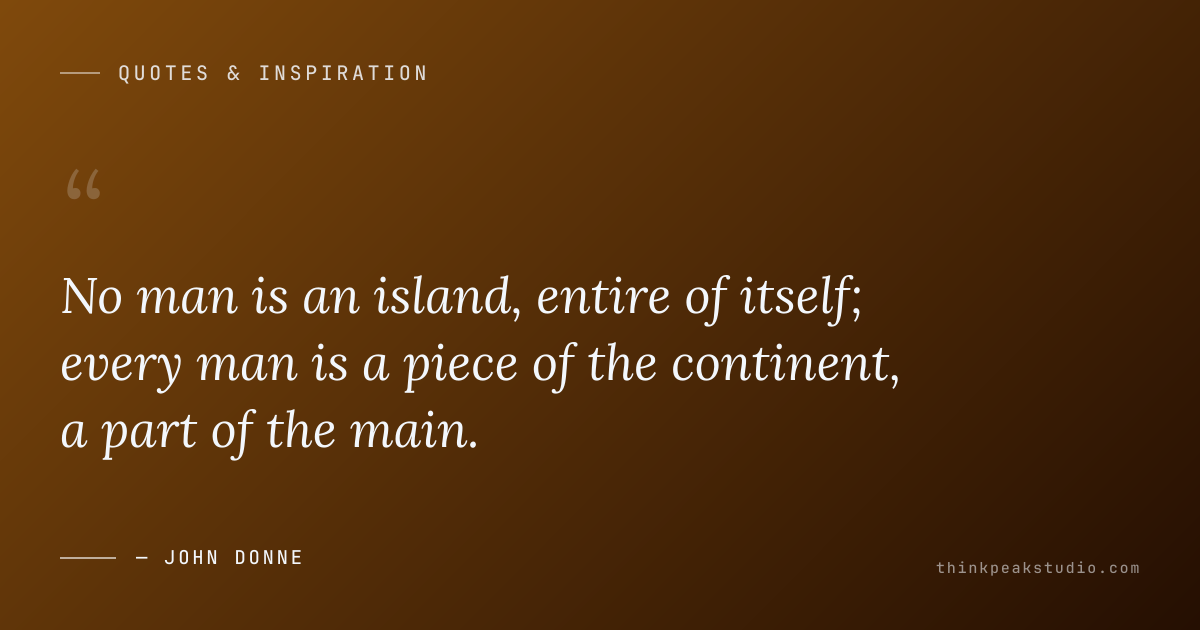
“No man is an island, entire of itself; every man is a piece of the continent, a part of the main.”
Context
In 1623, John Donne fell seriously ill. He was by then Dean of St Paul’s Cathedral in London, an office he held from 1621 until his death, and he believed he was dying. Biographers identify the illness as typhus or relapsing fever, both of which were common and frequently fatal in seventeenth-century London. Confined to his bed, listening to the bells of the surrounding churches, Donne did what he had done all his life: he turned the crisis into writing. The result was Devotions upon Emergent Occasions, and severall steps in my Sicknes, a prose sequence of twenty-three devotions, each built on a single pattern — a meditation, an expostulation, and a prayer. The book was published in 1624. The seventeenth devotion, usually called Meditation XVII, contains the passage that became one of the most quoted paragraphs in the English language.
Donne was born between January 24 and June 19, 1572, in Bread Street, London, into a Roman Catholic family at a time when practicing that faith was illegal in England. He was a scholar, a soldier, a secretary, and a Member of Parliament before he became a priest; his poetry — the love lyrics and the Holy Sonnets — made him the leading figure of what later critics named the Metaphysical poets. He had buried his wife, Anne, in 1617, and grief runs through everything he wrote in his clerical years. By the time he wrote the Devotions, mortality was not an abstraction to him. He died on March 31, 1631. The Devotions is the work in which his private fear and his public office meet most directly, and Meditation XVII is its centre.
The exact wording is worth care, because the passage is prose, not a poem. Donne wrote it as a single paragraph inside a meditation, and the 1624 text reads “No man is an Iland, intire of it selfe; every man is a peece of the Continent, a part of the maine.” The familiar broken-line presentation — the version that looks like free verse and gets reprinted as “No Man Is an Island” — is a later adaptation, and the source of those line breaks is unknown. The full sentence runs on past the famous opening to its real conclusion: “any mans death diminishes me, because I am involved in Mankinde; And therefore never send to know for whom the bell tolls; It tolls for thee.” That bell was the “passing bell,” rung in English parishes when a death had occurred, so that whoever heard it would know that someone had passed and would pray for them. Donne hears it, and instead of asking who died, he answers his own question.
Meaning
The argument is carried entirely by a single metaphor, and the metaphor moves. Donne begins with a denial: no man is an island, “entire of itself” — a thing complete in isolation, needing nothing outside its own shores. The opposite of the island is the continent: “every man is a piece of the continent, a part of the main.” The word “main” here means the mainland, the great connected mass. So far the claim is abstract: we belong to a larger whole. Then Donne makes it concrete by shrinking the scale. If a clod of earth is washed away by the sea, Europe is the less; so is it if a promontory is lost, or “a manor of thy friend’s or of thine own.” A clod, a headland, an estate — the examples descend from the geological to the personal, and every one of them is a subtraction from the same body. The unit of moral accounting, Donne insists, is not the individual but the whole.
The second movement supplies the reason. “Any man’s death diminishes me, because I am involved in mankind.” The word “involved” carries its older sense of being enfolded or wrapped into something; to be involved in mankind is to be a part of it, unable to stand outside it and watch. That is why the bell needs no investigation: because you are already part of the one who died, the bell is tolling for you. “Never send to know for whom the bell tolls” is not a riddle with a clever answer; it is a refusal to let the listener off the hook. Donne is not asking who is dead. He is telling you that you are.
The passage is also, and perhaps first, a theological claim. Earlier in the same meditation Donne writes, “The church is Catholic, universal, so are all her actions; all that she does belongs to all” — when she baptises a child, it concerns him; when she buries a man, it concerns him too. His image for humanity is a single book: “all mankind is of one author, and is one volume,” and when one man dies, one chapter is not torn out but “translated into a better language.” Read this way, “No man is an island” is not secular humanism; it is a statement about the mystical body, the shared life in which each member’s suffering is the whole’s. The genius of the line is that it survives being lifted out of that theology. Long after the passing bell stopped ringing, the image of the continent still works, because the experience it names — that another person’s loss lands on you as your own — does not require the reader to share Donne’s faith.
Relevance
The line has outlived its occasion by a wide margin, and its travels tell us why it lasts. Ernest Hemingway borrowed “For Whom the Bell Tolls” for his 1940 novel about the Spanish Civil War, placing Donne’s words on a frontispiece so the whole book would be read under their shadow. Thomas Merton, the Trappist monk, took the phrase as the title of his 1955 book No Man Is an Island, turning it toward the contemplative life. Between those two uses lies the range of the sentence: it can frame a war novel or a book of prayer because it describes a fact about human life rather than a policy about it.
It remains relevant precisely because the feeling it corrects has not gone away; in some ways the connected age has sharpened it. We have more contact than any generation in history and, by many accounts, more isolation. A network is not a community; a feed is not a continent. Donne’s test is uncomfortable because it makes indifference a form of self-harm. If each person is a piece of the main, then harm done to another is not merely harm done nearby — it is a loss to the whole of which you are a part. The line asks not whom you are obliged to help, but whether you can honestly draw the boundary of the self anywhere short of everyone.
Application
Practically, the passage argues against the island mindset wherever it appears. In a team, the person who believes their work stands alone is usually the one whose absence is felt last and whose contribution is understood least; the person who sees the team as one body asks what the whole needs. In grief, the meditation gives a reason to attend: when someone dies, the loss is not the family’s alone, and showing up is not a courtesy but an acknowledgment of a shared connection. In civic life, it dissolves the fiction that public outcomes and private lives are separate; because the continent is one, what happens to a stranger is, in the end, happening to you. The application is not sentimental. It is a discipline of asking, in each case, whose loss this actually is.
The passage is also a lesson in craft. Donne makes an argument with one controlling image, then escalates it — island, continent, clod, promontory, manor, mankind — and lands it on the reader with four words: “it tolls for thee.” The final turn is what fixes it in memory, because it converts a general truth into a personal address at the last possible moment. That is a technique any writer can use: choose one metaphor, push it through concrete instances until it is unmistakable, and end by pointing it at the reader. And there is a second lesson in the record itself. We can still quote Donne accurately, down to the spelling of “Iland,” because he published the Devotions in 1624 rather than leaving it in manuscript. Writing something down, and getting it into print, is what lets it survive the occasion that produced it.
Create your own quote graphic with this quote
This is a line that rewards a quiet setting: short enough for a wall, weighty enough for a card, and built to be read slowly. Set it in a firm serif against a dark field, give the words room, and let the contrast between island and continent do the work. Use our free online quote maker to turn this quote into a shareable image in seconds — no signup needed. For advanced features like video quotes and 100+ templates, try the Quotes Creator Android app.
Why we chose this quote
We chose this quote because it is one of the few famous lines whose fame has obscured its argument. Most people know “No man is an island” as a pleasant reminder to be kind; fewer know that it comes from a deathbed meditation written during a plague-era illness, that it ends not with solidarity in general but with the flat claim that you are the one the bell is tolling for. John Donne wrote Meditation XVII inside Devotions upon Emergent Occasions, a sequence of twenty-three devotions published in 1624 after the serious illness he suffered in 1623. The passage is prose, not a poem — the original reads “No man is an Iland, intire of it selfe” — and the bell at its centre is the passing bell rung when someone in the parish had died. Donne’s move is to refuse the question the bell invites. You do not need to ask who died, he says, because you are part of them; the bell tolls for you. The line went on to title Hemingway’s For Whom the Bell Tolls in 1940 and Thomas Merton’s No Man Is an Island in 1955, but its force is older and harder than either borrowing suggests. We chose it because it survives being taken out of context while refusing to be flattened by it — a sentence that is more demanding the more carefully you read it.
— ThinkPeak Studio Editorial Team
Create your own quote graphic with this quote
Turn this line into a shareable graphic in seconds — free, no signup needed. For video quotes and 100+ templates, try the Android app.
Advertisement
Enjoyed this article? Get more like it in your inbox.


