Quote Explained: “We are all in the gutter, but some of us are looking at the stars.”
By Oscar Wilde, Irish author, poet, and playwright
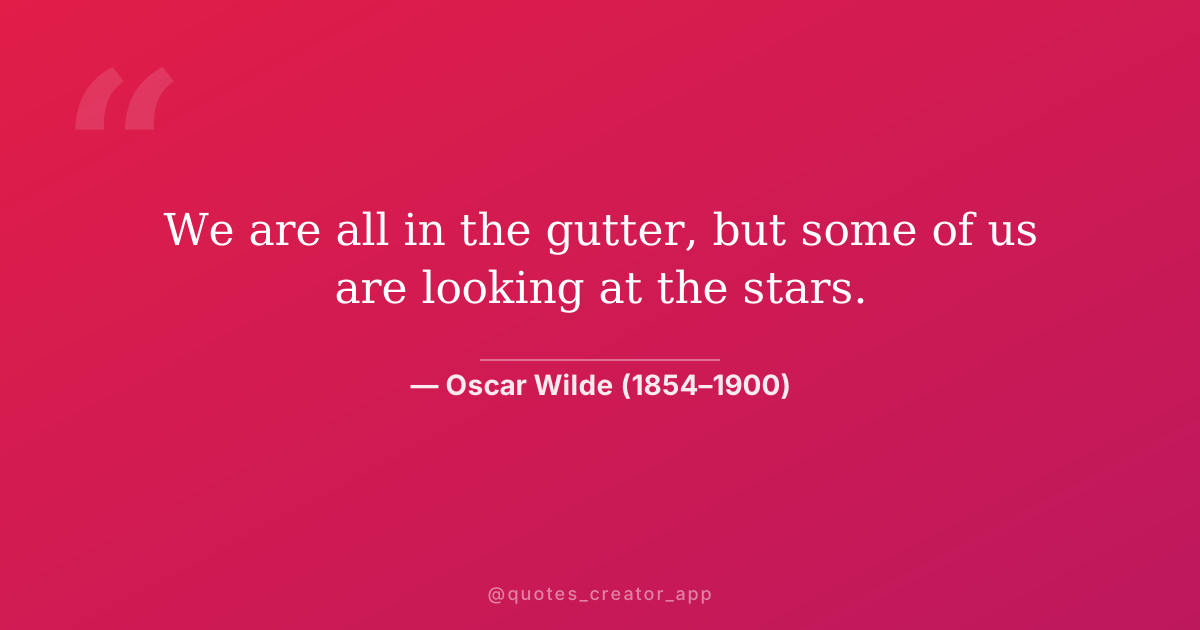
“We are all in the gutter, but some of us are looking at the stars.”
The context
When Oscar Wilde wrote Lady Windermere’s Fan in early 1892, he was standing at the summit of late-Victorian literary London. The previous year had seen the publication of The Picture of Dorian Gray, a novel that scandalized and electrified the public in equal measure, and his essays on aestheticism had made him the unofficial spokesman of a movement that championed beauty as the highest human value. The play, his first West End comedy of manners, opened at the St James’s Theatre on 20 February 1892 to packed houses and rapturous applause. Wilde, then thirty-seven, had become not merely a writer but a celebrity—the most quotable man in England, dressed in velvet and carrying a lily, holding court at the Café Royal and the Savoy.
But the glittering surface concealed gathering shadows. By 1892, Wilde had already met Lord Alfred Douglas—“Bosie”—the young aristocrat whose father, the Marquess of Queensberry, would soon become Wilde’s nemesis. The clandestine relationship that would destroy Wilde’s reputation and land him in Reading Gaol for two years of hard labour was already taking shape even as theatre audiences laughed at Lord Darlington’s epigrams. The line “we are all in the gutter, but some of us are looking at the stars” is delivered in Act III, spoken by the charismatic but morally ambiguous Lord Darlington to Lady Windermere—a woman who has just discovered that her entire understanding of virtue and sin, of who deserves judgment and who deserves mercy, has been built on a lie.
The first-night audience at the St James’s would have caught the humour immediately—Darlington is a dandy, a flirt, a man who cloaks genuine feeling in defiant frivolity. But beneath the wit, Wilde was embedding something far more personal: a philosophical conviction that the pursuit of beauty and meaning is not an escape from life’s squalor but the noblest response to it. The gutter was real for Wilde—he was living a double life under constant threat of exposure, navigating a society that would soon turn on him with savage moral certainty. When he had a character say “we are all in the gutter,” he was including himself. And when he had the same character look up at the stars, he was mapping the path he intended to walk, even if he could not know how soon the gutter would swallow him completely.
The meaning
On its surface, the line is a crisp, almost mathematically balanced observation about human nature. The gutter—ugly, functional, wet with rainwater and worse—is the image Wilde chooses for ordinary life: the daily grind of bills and disappointments, the moral compromises we make to get by, the thousand small indignities of existing in a society that judges and condemns. The stars, by contrast, are pure and unreachable—beauty for its own sake, ideals that illuminate without demanding, light that travels millions of miles to reach eyes that may or may not bother to look up. Lord Darlington is not denying the gutter’s existence; he is insisting on it. The word “all” is crucial—nobody, not the wealthy, not the virtuous, not the respectable Lady Windermere herself, escapes the muck of being human.
But the deeper force of the line lies in its refusal to equate circumstance with identity. The gutter is where you are, not who you are. And the choice to look at the stars is exactly that—a choice. Wilde, through Darlington, rejects both the cynic who insists the gutter is all there is and the sentimentalist who pretends the gutter does not exist. The position he advocates is harder and more honest: acknowledge the mud you are standing in, feel the cold and the wet of it, and then deliberately, almost defiantly, tilt your head back. This is not naive optimism. It is strategic hope—the kind that knows exactly how bad things are and decides that the stars are worth looking at anyway.
There is a quieter, more personal layer that only becomes fully visible when you know what happened next. Three years after writing this line, Wilde was inmate C.3.3 at Reading Gaol, stripped of his name, his wealth, his reputation, his wife, his children, his freedom. He had been in the gutter before—the metaphorical gutter of Victorian moral judgment—but now he was in a literal one: a prison cell with a plank bed, a slop bucket, and the relentless, dehumanizing machinery of hard labour. And yet, from that cell, he wrote De Profundis, a 50,000-word letter that is, in its own way, an act of looking at the stars. He did not deny his suffering; he transformed it into art. The epigram he had placed in a dandy’s mouth in 1892 had become, by 1897, the blueprint for his own survival.
Why it still matters today
The line has outlasted its play because it names a tension that every generation rediscovers: the gap between how things are and how we wish they were. You hear echoes of it in Brené Brown’s work on vulnerability and shame, in the Stoic revival that urges us to control our responses rather than our circumstances, and in the quiet ritual of someone scrolling through beautiful photography on a phone during a grim commute. The quote has been printed on posters, tattooed on forearms, and posted on social media during moments of collective grief precisely because it refuses to sugarcoat anything. In an age of curated perfection—where everyone else seems to be living a star-filled life while you alone are stuck in the gutter—Wilde’s words remind you that the comparison is false. Everyone is in the gutter. The only variable is where they are looking.
What makes the line especially resonant now is that it does not promise rescue. It does not say “some of us will climb out of the gutter” or “hard work will lift you to the stars.” It offers only a reorientation of attention, and in a world that constantly demands that we fix, optimize, and escape, that modesty is radical. You may not be able to leave the job you hate, heal the relationship that is breaking, or reverse the diagnosis you just received. But you can still look up. You can still notice beauty. You can still orient yourself toward something larger than your suffering. Wilde’s line insists that this, by itself, is a form of dignity.
How to apply this in your own life
The gutters of modern life are not always dramatic—they are the soul-crushing sameness of a long commute, the weight of financial stress, the paralysis of creative block, the quiet disappointment of a life that does not look like the one you imagined. Wilde’s advice, channeled through Lord Darlington, is not to deny these realities but to refuse to let them monopolize your attention. When you catch yourself spiraling into despair, pause and ask: what are the stars I have stopped looking at? It might be a creative project you abandoned, a friendship you have neglected, a book you keep meaning to read, a walk you keep meaning to take. These are not luxuries you earn after escaping the gutter. They are the things that make the gutter bearable while you are in it.
More concretely, build stargazing into your daily rhythm. Keep a notebook where you record one beautiful thing you noticed each day—a line of poetry, a stranger’s kindness, the way light fell through a window at a particular angle. Curate your social media feeds to include artists, writers, and thinkers who remind you that beauty exists, rather than feeds that amplify comparison and despair. This is not toxic positivity. Toxic positivity demands that you pretend the gutter is a garden. Wilde asks only that you remember the sky is still there, even when you are standing ankle-deep in mud. That small shift in attention, repeated across days and years, is the difference between merely surviving and continuing to live.
Create your own quote graphic with this quote
This is the kind of quote that carries weight. When you pair timeless words with thoughtful design, you create something people want to save, share, and return to. Use our free online quote maker to turn this exact quote into a shareable image in seconds — no signup needed. For advanced features like video quotes and 100+ templates, try the Quotes Creator Android app.
Why we chose this quote
Wilde wrote this line in 1892, when he was the most celebrated playwright in London and the future seemed limitless. Three years later, he was in prison, his name a scandal, his health broken. He died in exile at forty-six. And yet that single sentence—eighteen words spoken by a fictional dandy in a drawing-room comedy—has outlived the Victorian moral machinery that destroyed him. It endures because it is not a platitude handed down by someone who never suffered. It is a hard-won truth from someone who would soon suffer more than most of us can imagine, and who still chose, from the very bottom of the gutter, to keep looking at the stars. That is why we wanted to explain it.
— ThinkPeak Studio Editorial Team
Create your own quote graphic with this quote
Turn this line into a shareable graphic in seconds — free, no signup needed. For video quotes and 100+ templates, try the Android app.
Advertisement
Enjoyed this article? Get more like it in your inbox.