Quote Explained: “The only person you are destined to become is the person you decide to be.”
By Ralph Waldo Emerson, American essayist, philosopher, and leader of the Transcendentalist movement
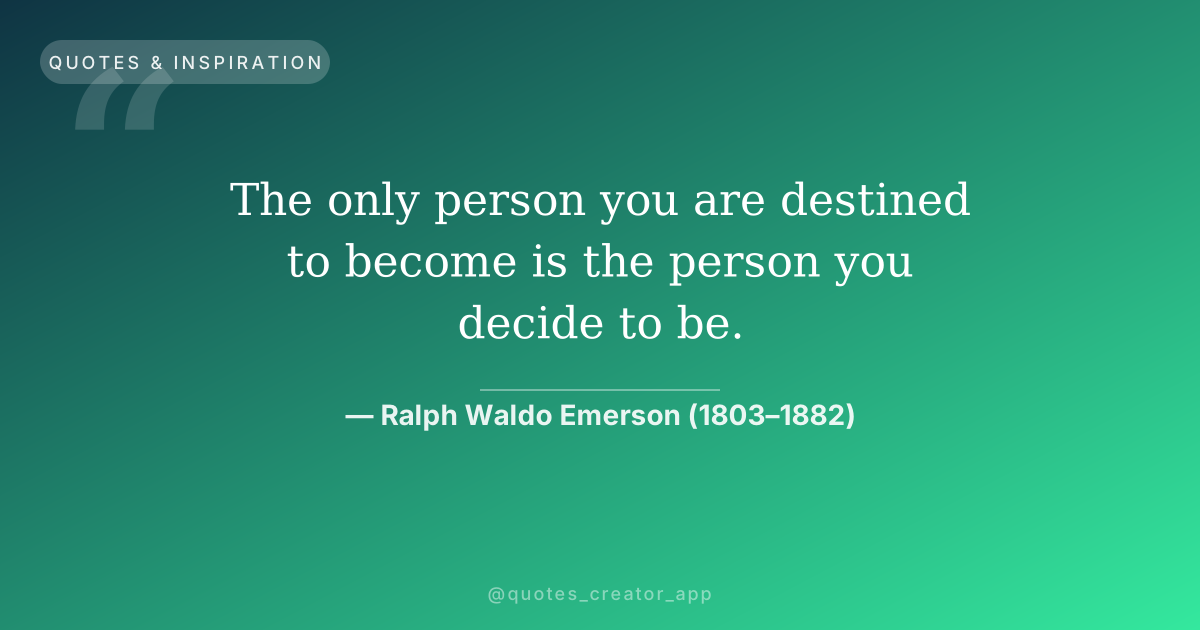
“The only person you are destined to become is the person you decide to be.”
The context
The year was 1841. Ralph Waldo Emerson had already scandalized polite Boston society four years earlier with his “Divinity School Address,” a lecture at Harvard that argued for direct individual communion with the divine — bypassing church, clergy, and centuries of theological tradition. The Harvard faculty was mortified. Emerson was banned from speaking on campus for a generation. But he did not retreat. He leaned further into the intellectual revolution he was igniting, gathering around him a circle of thinkers and writers — Henry David Thoreau, Margaret Fuller, Bronson Alcott — who were reimagining what it meant to be a human being in a young nation still discovering its philosophical identity. This was Transcendentalism, the first homegrown American philosophical movement, and Emerson was its undisputed center of gravity.
It was against this backdrop that Emerson published the first series of his Essays in 1841, the collection that contains “Self-Reliance” — his most enduring work and the intellectual birthplace of the idea that would eventually crystallize into the quote we examine here. Emerson was writing in a young republic still haunted by European intellectual deference. America’s colleges taught European thought. Its literary tastemakers looked to London. Its most ambitious minds still felt, on some level, that the real thinking happened elsewhere. Emerson’s project was nothing less than to declare intellectual independence: every individual possesses within themselves all the resources they need to know truth, to live virtuously, and to shape their own character. The self was not something you discovered passively, given to you by birth, class, or circumstance. It was something you forged.
The specific phrasing that became famous — “The only person you are destined to become is the person you decide to be” — distills Emerson’s entire philosophy into a single, portable line. He was not a determinist. He did not believe that your character was locked in by your parents, your upbringing, or your natural talents. He believed, with a conviction that bordered on the mystical, that the sovereign self could choose itself into existence. At a time when most of the Western world still understood destiny as something written by God or by nature, Emerson answered with a radical alternative: destiny is written by decision. You are not walking a path assigned to you. You are, in every moment, laying the path with your own feet.
The meaning
At first reading, the quote sounds like a motivational poster — vaguely inspiring, somewhat obvious, the kind of thing you nod at and scroll past. But slow down and it becomes considerably more challenging. The first word worth interrogating is “destined.” Emerson could have said “the person you might become” or “the person you hope to become.” He chose “destined,” a word heavy with inevitability and fate, drawn from the language of prophecy and divine will. By pairing “destined” with “decision,” Emerson performs a conceptual sleight of hand: he takes a word that has always belonged to external forces — the gods, the stars, the circumstances of birth — and relocates it entirely within the sphere of individual choice. Destiny, in Emerson’s hands, is not something you wait for or stumble into. It is something you manufacture through the quality and courage of your decisions.
The second key word is “only.” Emerson is not making a gentle suggestion. He is issuing an exclusive claim. There is exactly one factor that determines the person you ultimately become, and that factor is your decision. Not your past. Not your failures. Not the opinions of others. Not even your own previous self-conception. This is more abrasive than it first appears, because it strips away every excuse. If the only determinant of your future self is your decision, then every rationalization for staying stuck — “I’m not that kind of person,” “I was never good at this,” “People like me don’t do that” — collapses under the weight of its own artifice. Emerson is not denying that circumstances can be difficult, even brutal. What he is denying is that they are determinative. A difficult circumstance may make a decision harder to execute, but it does not annihilate the power to decide. That power, Emerson insists, remains irreducible.
And then there is the word “decide,” which comes from the Latin decidere, meaning “to cut off.” This etymology is revealing. A decision, properly understood, is not a preference or a wish or a loosely held intention. It is a severing. When you decide to be a certain kind of person, you are cutting off the versions of yourself that you are choosing not to become. Emerson understood, in a way that much modern self-help does not, that becoming someone new always involves a kind of grief — a letting go of the familiar self, the comfortable self, the self that other people have learned to expect. The person you decide to be is not a costume you slip on over your existing identity. It is an identity that displaces the old one. Every authentic decision to grow requires a corresponding decision to let something of your former self die.
Why it still matters today
We live in an era saturated with personality tests, astrological typing, attachment styles, genetic explanations, childhood trauma narratives, and algorithmic recommendations that tell us who we are based on what we have clicked. Never in human history have we had more sophisticated systems for explaining ourselves to ourselves — and never, perhaps, has the felt experience of personal agency been so attenuated. The modern self is a paradox: anatomized into ever finer categories by psychology and neuroscience, yet increasingly unsure whether it possesses the freedom to change. Emerson’s quote cuts through this fog with a sharp, almost uncomfortable clarity. It refuses to let you off the hook. Whatever your Enneagram type, whatever your attachment pattern, whatever the algorithms have concluded about your preferences, Emerson would say: you can decide otherwise. The data describe what you have been, not what you must become.
The quote also arrives with fresh urgency in the context of what the sociologist Zygmunt Bauman called “liquid modernity” — an age in which traditional structures of identity (career, community, religion, marriage) have dissolved into a marketplace of endlessly interchangeable options. The challenge of our time is not a shortage of possible selves. It is an overabundance, and the paralysis that comes with it. Emerson offers not a menu of identity options but a principle of selection: the person you decide to be. Not the person the market tells you to be. Not the person your social media following rewards. Not the person your parents imagined for you. The person you decide to be, in a quiet moment of honest reckoning with your own values and capacities. In an age of infinite scrolling, Emerson offers the radical proposition of stopping, choosing, and cutting off all the rest.
How to apply this in your own life
The most practical way to activate Emerson’s insight is to write down, in a single sentence, the person you are currently deciding to become. Not the person you wish you were. Not the person you plan to become “someday.” The person your daily decisions are currently producing, right now. Then compare that sentence to another one: the person you would like to become if you were truly honest with yourself. The gap between those two sentences is the gap between your stated values and your lived decisions. Emerson would argue that this gap is not primarily a knowledge problem — you already know what you value. It is a decision problem. You have not severed from the alternatives. You are trying to become a disciplined person while still deciding like an undisciplined person. You cannot serve two selves. At some point, the deciding must become exclusive.
The deeper application, however, involves what psychologists call “self-narrative.” Every human being carries an internal story about who they are, where they came from, and where they are going. Most of us treat this story as though it were a documentary — a factual record of events and traits we passively inherit. Emerson invites us to treat it as a draft, subject to revision at any moment by the authority of a decision. Tomorrow morning, you can wake up and decide that the story no longer ends in mediocrity, or bitterness, or the replaying of old grievances. You can decide that you are now the kind of person who finishes things, or who speaks kindly, or who takes creative risks. The decision alone does not complete the transformation; habits must follow, actions must reinforce. But the decision creates the architecture within which those habits and actions can operate. It draws the boundary. It says: this is the self I am building. Everything else — every distraction, every contrary habit, every voice of doubt — falls on the other side of the line. That clarity is power. That is what Emerson meant by destiny.
Create your own quote graphic with this quote
This is the kind of quote that carries weight. When you pair timeless words with thoughtful design, you create something people want to save, share, and return to. Use our free online quote maker to turn this exact quote into a shareable image in seconds — no signup needed. For advanced features like video quotes and 100+ templates, try the Quotes Creator Android app.
Why we chose this quote
Ralph Waldo Emerson is often remembered for “Self-Reliance” and his call to trust one’s own intuition, but this distilled formulation captures the existential core of his philosophy with remarkable economy. It is simultaneously a comfort and a challenge. A comfort, because it assures us that no past mistake, no inherited limitation, no external judgment has the final word on who we become. A challenge, because it places the full weight of that becoming squarely on our own shoulders. In a culture that oscillates between blaming individuals too harshly and absolving them too completely, Emerson strikes a rare balance: immense compassion for where you have been, and immense demand for where you choose to go.
— ThinkPeak Studio Editorial Team
Create your own quote graphic with this quote
Turn this line into a shareable graphic in seconds — free, no signup needed. For video quotes and 100+ templates, try the Android app.
Advertisement
Enjoyed this article? Get more like it in your inbox.