Quote Explained: “The wound is the place where the Light enters you.”
By Rumi, 13th-century Persian poet, theologian, and Sufi mystic
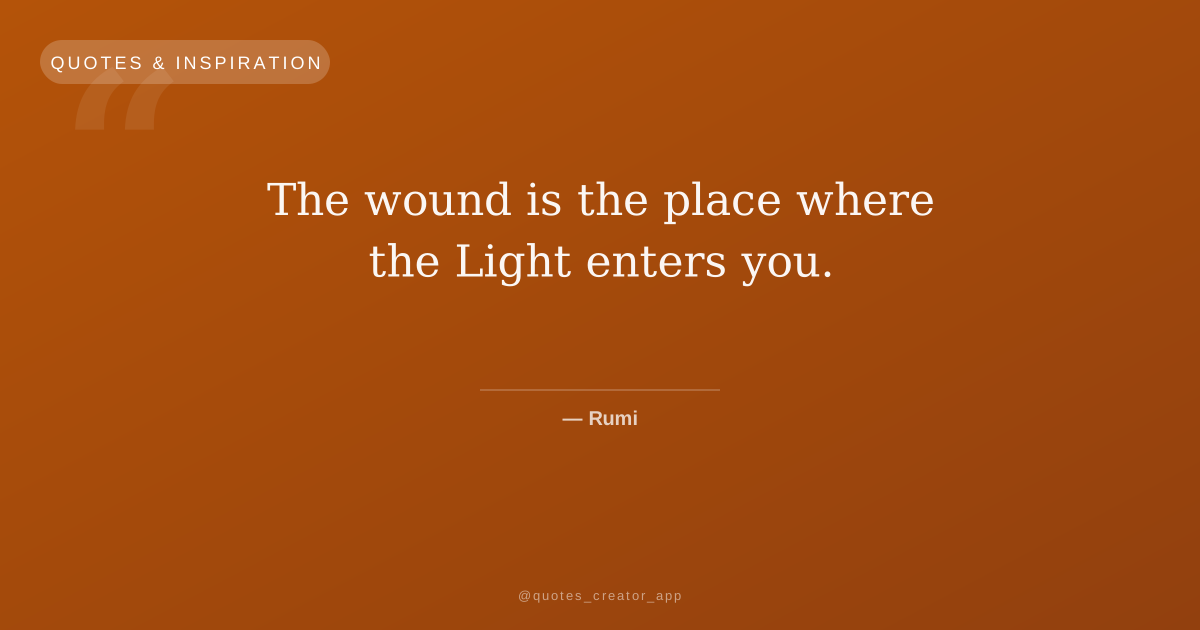
“The wound is the place where the Light enters you.”
The context
In the early 1240s, a respected Islamic jurist and theology professor in Konya, Anatolia, was going about his ordinary life. His name was Jalal ad-Din Muhammad Balkhi, and he was already an accomplished scholar in his late thirties, steeped in the traditions of Hanafi jurisprudence, Quranic exegesis, and Greek philosophy. He taught at a madrasa, delivered sermons at the mosque, and had inherited a comfortable position in the religious establishment of the Seljuk Empire. Nothing in his biography up to that point suggested he would one day become one of the most widely read poets in human history, let alone a mystic whose words would be quoted by therapists, artists, and spiritual seekers eight centuries later. Then a wandering dervish named Shams Tabrizi arrived in Konya, and the man we now call Rumi was broken open.
The meeting with Shams was not a gentle merging of kindred spirits; it was a spiritual cataclysm. Shams, a fierce and uncompromising mystic who had spent years wandering the Islamic world in search of a soul worthy of divine friendship, took one look at the comfortable scholar and saw through him. He reportedly asked Rumi: “Who was greater, Bayazid Bestami (a famous Sufi saint) or the Prophet Muhammad?” Rumi gave the expected orthodox answer. Shams rejected it, and a debate began that lasted for months. What Shams did, essentially, was demolish Rumi’s carefully constructed intellectual identity. He showed the professor that his books, his sermons, and his social standing were a fortress that kept out the very thing he claimed to be seeking: the direct, raw, annihilating experience of the Divine. Rumi’s wound began the moment Shams exposed the gap between his knowledge and his being.
When Shams disappeared — likely murdered by jealous disciples — Rumi was shattered in the absolute sense. The grief that poured out of him over the next several decades produced a body of work that has no real parallel in world literature. He composed the Divan-e-Shams-e Tabrizi, a collection of more than 40,000 verses addressed to his lost beloved, and the Masnavi-e Ma’navi, a six-volume poem that one commentator called “the Quran in Persian.” Every line of it came from the wound of separation. Rumi did not heal from his grief in the conventional sense; he transformed it into a kind of supernova of spiritual creativity. He wrote about love as the animating force of the universe, about loss as the precondition for reunion, and about pain as the chisel that carves the soul into something large enough to hold God. The man who had once taught law from behind a lectern now spun in ecstatic dance in the streets, his robes billowing, his students forming the whirling order of Sufis that still practices his choreography of surrender today.
The meaning
At first reading, Rumi’s line seems almost unbearably optimistic. It suggests that there is a silver lining to every suffering, a purpose to every pain. But the Persian mystical tradition in which Rumi was writing was not interested in cheap reassurance. When Rumi says “the wound,” he is not talking about a paper cut or a minor disappointment. He is talking about the kind of rupture that shatters a person’s understanding of who they are — the loss of a beloved, the collapse of a life’s work, the sudden revelation that everything you believed was built on sand. The word he uses in the original Persian carries connotations of a break, a fracture, a separation from wholeness. And the “Light” — with a capital L in English translation — is not a metaphor for positive thinking or emotional optimism. In Sufi theology, Light is a direct reference to the divine essence: Nur in Arabic, the same word used in the famous Quranic “Light Verse” (Surah An-Nur, 24:35) that describes God as the Light of the heavens and the earth.
The mechanism Rumi is describing is one of the oldest and most counterintuitive insights in the spiritual traditions of the world: that the ego is a sealed vessel, and that it must be broken in order for the divine to enter. A perfectly intact cup cannot receive anything; it is already full of itself. It is only when the cup cracks that liquid can pour in. Rumi’s own biography is the clearest demonstration of this principle. His identity as a jurist and professor was a complete, self-sufficient system. It fed him, housed him, gave him status, and protected him from the terrifying abyss of direct mystical experience. Shams Tabrizi did not fill Rumi; he broke Rumi. And through the crack, the Light entered with such force that it has been illuminating readers for eight hundred years.
This is what the Sufis call suluk — the spiritual path of annihilation and return. The wound is not the final destination; it is the doorway. The point is not to remain broken but to allow the breaking to create a permanent opening. Rumi’s entire literary project can be read as an extended meditation on this paradox: that the things we experience as the worst moments of our lives are often the very things that make us capable of receiving grace. He does not minimize suffering. He does not say it is easy, or that you should pretend it does not hurt. He simply insists that the pain is not the end of the story. The wound is the beginning.
Why it still matters today
In an age that is simultaneously more aware of trauma and more desperate to avoid pain, Rumi’s insight lands with extraordinary force. Modern psychology has largely caught up with what the poet knew intuitively: that post-traumatic growth is a real and documented phenomenon. Studies have shown that people who experience significant adversity often report increased personal strength, deeper relationships, a greater appreciation for life, and a more profound sense of spiritual or existential meaning. Rumi’s “Light entering through the wound” is not a religious artifact; it is a prescient description of post-traumatic growth, written in the language of the 13th century. The insight that suffering can be a catalyst for transformation rather than merely an obstacle to happiness is one of the most empirically validated and yet culturally resisted truths of human experience.
The quote also resonates deeply with the modern conversation about vulnerability and authenticity. Brené Brown’s research on vulnerability as the birthplace of courage, connection, and belonging is essentially a secular, research-based restatement of Rumi’s poetic insight. Brown’s central claim — that we cannot selectively numb emotion, and that the price of avoiding pain is the loss of joy, gratitude, and love — echoes Rumi’s insistence that the wound is not a flaw to be hidden but an opening to be honored. The cultural pressure to present a curated, pain-free version of ourselves to the world is directly challenged by Rumi’s image of the leaky, broken vessel as the only one capable of receiving light. Our cracks, he suggests, are not evidence of failure. They are evidence of capacity.
Mindfulness practices, which have become a mainstream feature of mental health care in the West, also find an ancient cousin in this quote. The willingness to sit with pain rather than flee from it, to observe the wound without immediately trying to fix it or explain it away, is the core discipline of both mindfulness and Sufi contemplation. Rumi is not advocating for masochism or passivity. He is pointing to a spiritual technology: if you can stay present with your suffering long enough, you will discover that it is not a wall but a door. The Light does not enter around the wound or in spite of the wound. It enters through it.
How to apply this in your own life
The most immediate application of this quote is to stop treating your wounds as problems to be solved and start treating them as openings to be explored. This is not about glorifying pain or pretending that hardship is a gift you should be grateful for. It is about shifting your relationship to suffering from one of resistance to one of attention. The next time you encounter a painful experience — a rejection, a failure, a loss — try asking yourself: what has this experience broken open in me? What beliefs, attachments, or defenses has it weakened or demolished? Instead of rushing to rebuild the walls exactly as they were, consider the possibility that something larger wants to enter through the gap. This is the essence of reframing hardship as initiation rather than punishment.
A second practice is to develop what the Sufis call muraqaba — vigilant awareness of your inner state. When you notice yourself trying to suppress, distract, or numb a painful feeling, pause. Recognize the impulse to seal the wound before the Light has had a chance to enter. This does not mean wallowing in pain or refusing legitimate comfort and support. It means creating a small space of intentional stillness in which you can observe the pain without immediately reacting to it. In that space, the wound becomes transparent rather than opaque. It ceases to be a hard lump of suffering and becomes a window. Rumi’s image invites you to stay with the brokenness just long enough to see what wants to come through it.
Finally, there is a social and relational dimension to this wisdom. We are often tempted to hide our wounds from others, fearing that they will define us, diminish us, or disqualify us. Rumi suggests the opposite: that the places where you have been broken are precisely the places where you are most capable of receiving and transmitting Light. The people who have touched you most deeply in your life were likely not the ones who had it all together. They were the ones who had been broken open and had let you see the Light streaming through the cracks. When you share your wounds with others — not for sympathy but for connection — you become a lamp for someone else who is still in the dark, still wondering if their own breaking is the end of the story. Rumi’s quote is not just for your own healing. It is a reminder that the Light that enters you through your wounds is meant to shine through you, into the world.
Create your own quote graphic with this quote
This is the kind of quote that carries weight. When you pair timeless words with thoughtful design, you create something people want to save, share, and return to. Quotes Creator gives you the tools to turn this quote into a beautiful graphic — custom fonts, gradient backgrounds, and export sizes for every platform.
Why we chose this quote
Rumi’s words have survived for eight centuries because they are not platitudes. They are maps drawn by someone who walked through fire and discovered that the fire was not the enemy. “The wound is the place where the Light enters you” is one of the most psychologically sophisticated and spiritually profound statements ever made about human suffering. It refuses every easy answer — it does not say the wound is good, or that you deserved it, or that it will go away if you just think positively. It simply describes what can happen when a human being stays open in the very place where it would be most natural to close. We chose this quote because in a world that tells us to hide our pain, medicate our pain, or transcend our pain, Rumi invites us to do something far more difficult and far more rewarding: to let our pain become our portal.
— ThinkPeak Studio Editorial Team
Create your own quote graphic with this quote
Turn this line into a shareable graphic in seconds — free, no signup needed. For video quotes and 100+ templates, try the Android app.
Advertisement
Enjoyed this article? Get more like it in your inbox.